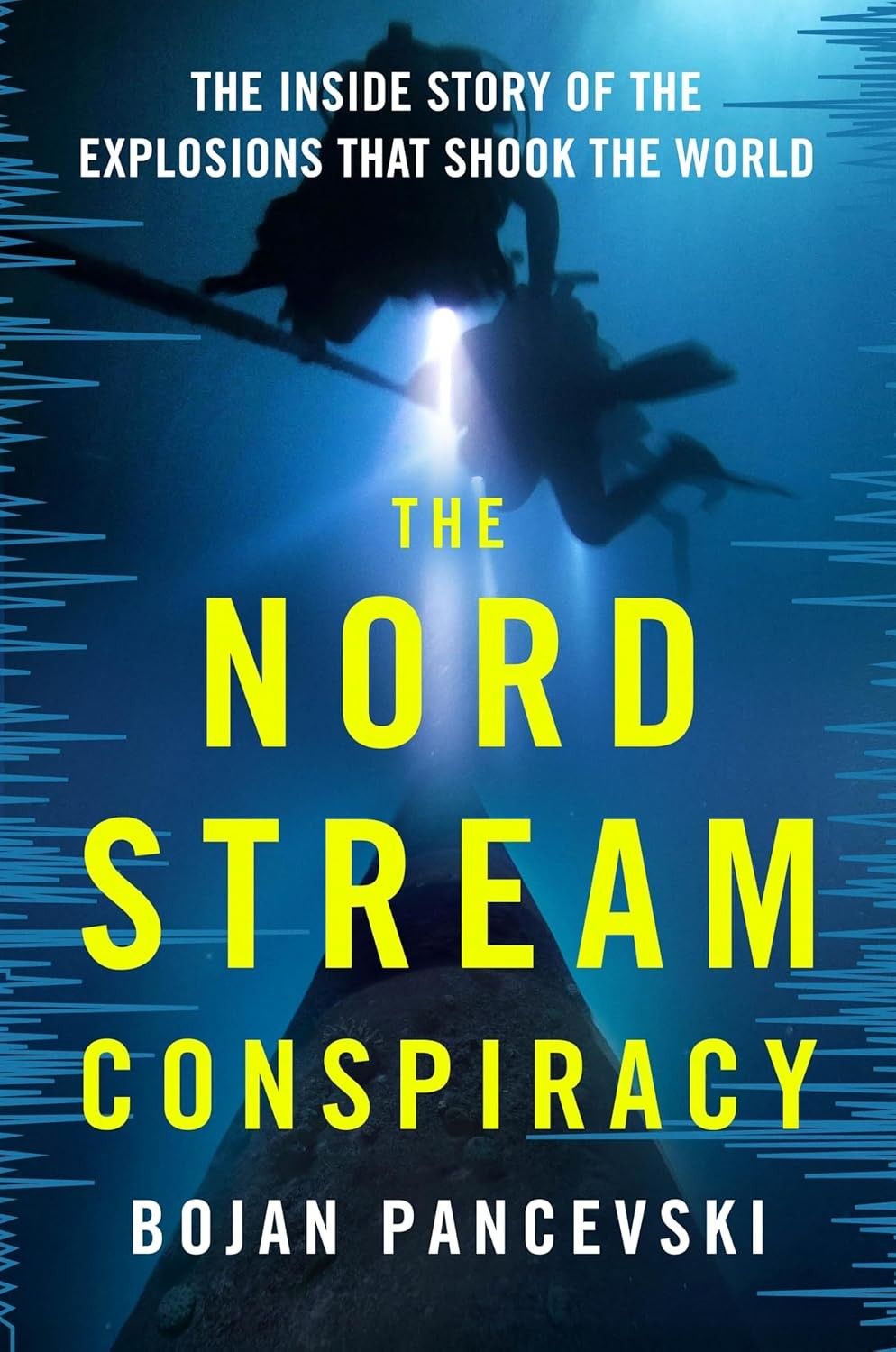

The Nord Stream Conspiracy: The Inside Story of the Explosions That Shook the World
By Bojan Pancevski/ Henry Holt and Co.
Reviewed by: Jean-Thomas Nicole
The Reviewer — Jean-Thomas Nicole is a Policy Advisor with Public Safety Canada. The opinions expressed are those of the author and do not reflect the official policies or positions of Public Safety Canada or the Canadian government.
REVIEW: There are books that explain events, and there are books that fundamentally reshape how we understand them. Bojan Pancevski’s The Nord Stream Conspiracy: The Inside Story of the Explosions That Shook the World belongs firmly in the latter category. What began, in the public imagination, as a mysterious act of sabotage surrounded by speculation, accusation, and geopolitical theater becomes, through Pancevski’s meticulous reporting, a far more human, complex, and unsettling story. This is not merely a book about a pipeline explosion. It is a book about power, secrecy, improvisation, and the messy intersection of war and politics in the twenty-first century.
I finished the book with a profound sense of admiration—not only for the scale of the reporting involved but also for Pancevski’s ability to transform an extraordinarily technical and politically charged subject into a compelling narrative. Few journalists could take a story involving underwater infrastructure, intelligence services, international law, and competing national interests and render it with the pace and tension of a thriller while maintaining the discipline of serious investigative journalism. Pancevski precisely manages that feat.
Bojan Pancevski is an award-winning foreign correspondent and author, a 2025 Pulitzer finalist with The Wall Street Journal, and the only foreign recipient of Germany’s Werner Holzer Award. For our readers working in international affairs and policy, the award is notable because it specifically celebrates journalists who provide sustained, on-the-ground reporting from conflict zones, geopolitical hotspots, and foreign capitals—precisely the kind of reporting that often informs policymakers, diplomats, and security analysts. Pancevski’s reporting thus focuses on geopolitics, security, and major international conflicts, particularly in Europe and Russia’s war against Ukraine.
One of the book’s greatest strengths is its refusal to rely on simplistic explanations. The September 2022 sabotage of the Nord Stream pipelines has generated countless theories, many of them conspiratorial, ideological, or openly partisan. Pancevski cuts through this fog with patience and rigor. Rather than presenting history as a clash between clearly defined heroes and villains, he reveals a world populated by deeply flawed, often contradictory individuals. The actors at the center of the story are not superhuman intelligence operatives executing a flawless master plan. They are people shaped by ambition, patriotism, resentment, loyalty, and circumstance.
What struck me most was the portrait of the Ukrainian participants often referred to as the “Startup.” Pancevski depicts them not as caricatures but as human beings. They are brave and reckless, disciplined, impulsive, idealistic, and opportunistic. Their operation, astonishing in both its ambition and audacity, emerges less as the product of bureaucratic precision than of individual determination and improvisation. The result is a narrative that feels remarkably authentic. The reader never forgets that history is often made by imperfect people operating under extraordinary pressures.
The author’s treatment of Ukraine is especially noteworthy. Given the broader context of Russia’s invasion and the immense sympathy Ukraine has attracted in much of the West, it would have been easy to lapse into either romanticization or cynicism. Pancevski does neither. His account is empathetic without being sentimental and critical without becoming dismissive. The individuals involved are shown as products of a country fighting for survival, yet their actions are explored with a seriousness that avoids moral simplification. This balance is one of the book’s most impressive achievements.
Equally compelling is the parallel story of the German investigation. In many ways, this becomes a second narrative running alongside the sabotage itself. If the operation embodies improvisation and daring, the investigation represents patience, method, and institutional persistence. The German investigators emerge as fascinating figures in their own right—individuals attempting to uncover truth amid political sensitivities, diplomatic constraints, and layers of deliberate deception.
Pancevski excels at illustrating how modern investigations unfold. Contrary to popular depictions in film and television, breakthroughs rarely result from dramatic revelations. Instead, they emerge through painstaking analysis, technical expertise, and relentless attention to detail. Following the investigators as they gradually reconstruct the events surrounding the attack becomes as suspenseful as the operation itself. The procedural elements of the story never feel tedious because they are embedded within larger questions about accountability, sovereignty, and the limits of state power.
Another aspect of the book that deserves praise is its treatment of infrastructure as a geopolitical battleground. Before reading The Nord Stream Conspiracy, I understood the pipelines primarily as economic assets and symbols of Europe’s complicated relationship with Russian energy. By the end, I viewed them differently. Pancevski demonstrates how critical infrastructure has become one of the defining strategic vulnerabilities of our era. Pipelines, telecommunications cables, satellites, power grids, and shipping networks all form an invisible architecture upon which modern societies depend. The sabotage of Nord Stream serves as a reminder that these systems are not merely technical constructs; they are political targets.
This broader theme elevates the book beyond the specifics of the case. The destruction of Nord Stream becomes a lens through which to examine modern conflict itself. The battlefield is no longer confined to traditional military fronts. It extends beneath oceans, into cyberspace, and across complex networks that connect economies and societies. Pancevski captures this transformation with clarity and insight, making the book relevant not only to those interested in the Nord Stream explosions but to anyone seeking to understand contemporary geopolitics.
Stylistically, the work is equally impressive. Pancevski writes with confidence and restraint. His prose is accessible without sacrificing sophistication, and his narrative structure sustains momentum throughout. Particularly effective are his character sketches. Many individuals appear under pseudonyms or operational nicknames, yet they emerge as memorable figures rather than anonymous operatives. This attention to character prevents the book from becoming overly abstract or technical.
I was also struck by the author’s willingness to leave certain questions unresolved. In an age when many books strive to deliver definitive answers and moral certainty, The Nord Stream Conspiracy embraces ambiguity. Some aspects of the story remain contested. Certain motivations remain opaque. Legal accountability remains elusive. Rather than forcing conclusions, Pancevski acknowledges the limits of what can be known. This intellectual honesty strengthens the book’s credibility and reflects the reality of intelligence operations and international politics, where complete clarity is often impossible.
If I have one criticism, it is that readers unfamiliar with European energy politics may occasionally find themselves overwhelmed by the complexity of the background. The book assumes a degree of interest in geopolitical affairs and rewards attentive reading. Yet this is a minor concern, especially given the intricacy of the subject matter.
In sum, The Nord Stream Conspiracy is a remarkable work of investigative journalism. It combines rigorous reporting, compelling storytelling, and thoughtful geopolitical analysis in a way that few contemporary non-fiction books achieve. More importantly, it forces readers to confront uncomfortable truths about modern conflict, statecraft, and the fragility of the systems that underpin contemporary life.
This is a book that lingers long after the final page. Not because it provides easy answers, but because it illuminates the uncertainty, improvisation, and human complexity that lie behind events often reduced to headlines. Pancevski has produced not only the definitive account of one of the most consequential acts of sabotage in recent history, but also a powerful meditation on the hidden struggles shaping our world today. It is essential reading for anyone interested in geopolitics, intelligence, energy security, or simply the unpredictable ways in which history is made.
The Cipher Brief participates in the Amazon Affiliate program and may make a small commission from purchases made via links.
Sign up for our free Undercover newsletter to make sure you stay on top of all of the new releases and expert reviews.
Read more expert-driven national security insights, perspective and analysis in The Cipher Brief because National Security is Everyone’s Business