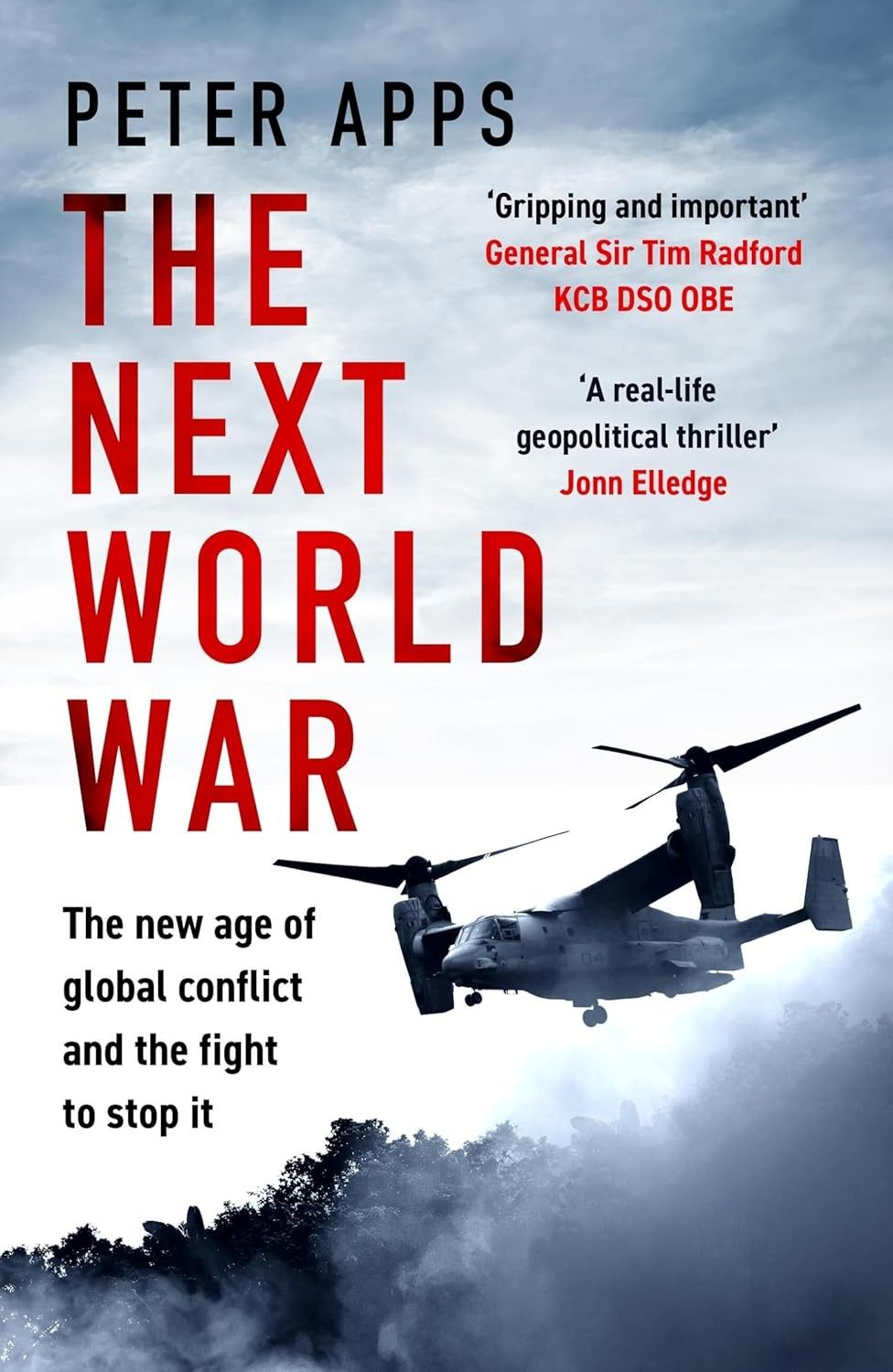


BOOK REVIEW: The Next World War: The New Age of Global Conflict and the Fight to Stop It
By Peter Apps / Wildfire Publishing
Reviewed by: Jean-Thomas Nicole
The Reviewer — Jean-Thomas Nicole is a Policy Advisor with Public Safety Canada. The opinions expressed are those of the author and do not reflect the official policies or positions of Public Safety Canada or the Canadian government.
REVIEW: There is a particular kind of dread that settles not with a crash but with a whisper — the slow, accumulating recognition that the world one inhabits is no longer the world one understands. Peter Apps’s The Next World War is a book written from within that whisper. It is not a prophecy of doom, nor a polemic dressed in khaki. It is something more disquieting: a meticulous, field-grounded account of how the architecture of global peace is fracturing — quietly, simultaneously, and in more places than most citizens care to know.
Apps, a Reuters journalist and British Army reservist, opens not from a command center or a policy seminar but from the grey, wind-battered coastline of northern Taiwan, where a fishmonger named Mrs. Chen speaks plainly about what an invasion would mean for her sons. “We will die or we will flee,” she says. It is a line that could have been spoken in Narva, in Darwin, in the villages south of the Suwałki Gap. That universality, the quiet proximity of catastrophe to ordinary life,is the emotional engine of the book, and Apps returns to it with disciplined regularity. He understands, as few strategic writers do, that the texture of impending war is not found in missile specifications but in the silence of people who have begun, however reluctantly, to imagine the unimaginable.
The analytical architecture is ambitious. Across fifteen chapters, Apps constructs a layered panorama of interconnected flashpoints: Taiwan, Ukraine, the South China Sea, the Baltic states, the Middle East and argues that the defining danger of the current era lies not in any single crisis but in their convergence. This is the logic of the “polycrisis:” overlapping escalations that compress decision-making timelines, overwhelm institutional capacity, and create the conditions for miscalculation on a historic scale. The concept is not new, but Apps gives it rare empirical weight. He moves fluidly between a rusting Philippine landing craft on Second Thomas Shoal, Finnish conscripts learning to survive Arctic conditions through sheer rage, and the sterile corridors of the Pentagon where officials confront the reality that America’s industrial base cannot produce missiles fast enough to sustain even a limited campaign. The cumulative effect is persuasive and sobering.
At the strategic core of the book lies a thesis about deterrence, specifically, its fragility. Apps argues that the post-Cold War assumption of stable deterrence has eroded along three axes: military capability, societal resilience, and political cohesion. Western defense-industrial bases, atrophied by decades of just-in-time procurement and low-intensity conflict, are demonstrably incapable of sustaining the kind of prolonged, high-attrition warfare now unfolding in Ukraine. Societal willingness to bear the costs of conflict in casualties, conscription, economic and disruption remains untested and, where polled, discouraging. And the alliance system upon which the entire edifice rests is under unprecedented strain, not primarily from adversaries but from within, as the return of Donald Trump to the White House introduces a transactional logic fundamentally at odds with the institutional commitments that have underwritten Euro-Atlantic security since 1949.
The treatment of the Trump administration is notably even-handed. Apps concedes the deterrent value of unpredictability while documenting, with considerable journalistic precision, the chaos it produces among allies. The Oval Office confrontation with Zelenskyy, the leaked Signal chat revealing the administration’s openly contemptuous view of European “free-loading,” the temporary suspension of intelligence sharing with Ukraine, these episodes are rendered not as partisan commentary but as structural phenomena, symptoms of a deeper reordering of American strategic priorities that will outlast any single presidency. The implication, stated with quiet force, is that the era of automatic American commitment to its allies is over, and that the next U.S. president, whoever they may be, will inherit a world in which that fact has been internalized by friend and adversary alike.
Where the book is most original is in its insistence that modern war is not merely a military event but a societal one. Apps draws a direct line from drone warfare over Ukrainian trenches to the vulnerability of undersea cables in the Baltic, from cyber-attacks on water treatment plants to the global economic shock that would follow even a limited blockade of Taiwan. The message is clear: in a world of integrated supply chains and critical infrastructure dependencies, the battlefield is everywhere, and the distinction between combatants and civilians is dissolving faster than international law can accommodate. Finland, with its tradition of total defense and a conscript reserve proportionally larger than most standing armies, emerges as the book’s quiet hero, a model of what democratic resilience looks like when a society takes the threat seriously.
There are, inevitably, limitations. The breadth of the canvas spanning five continents, dozens of actors, and multiple domains of conflict occasionally comes at the expense of analytical depth. The treatment of Chinese strategic culture and internal decision-making, for instance, remains external, filtered primarily through Western intelligence assessments. And while the diagnosis is powerful, the prescription is less fully developed: Apps advocates preparation, resilience, and credible deterrence, but does not elaborate in detail on the institutional reforms or policy architectures that might deliver them. This is, in fairness, a book of strategic warning rather than strategic design but for the policy reader, the gap is felt.
These are minor reservations, however, against a work of genuine consequence. Apps estimates the probability of a major war over the coming decade at thirty to thirty-five per cent, a figure he offers not as certainty but as a calibration of risk, and one that demands a response commensurate with its gravity. The book’s epigraph might well have been drawn from the NCO who trained his grandfather during the Second World War: What is the first duty of a soldier? To keep the peace. What is the second? To kill the enemy. That duality, the imperative to prepare for the worst precisely to prevent it — is the moral center of The Next World War, and it is one that every democratic society would do well to confront before the choice is no longer theirs to make.
The Cipher Brief participates in the Amazon Affiliate program and may make a small commission from purchases made via links.
Sign up for our free Undercover newsletter to make sure you stay on top of all of the new releases and expert reviews.
Read more expert-driven national security insights, perspective and analysis in The Cipher Brief because National Security is Everyone’s Business