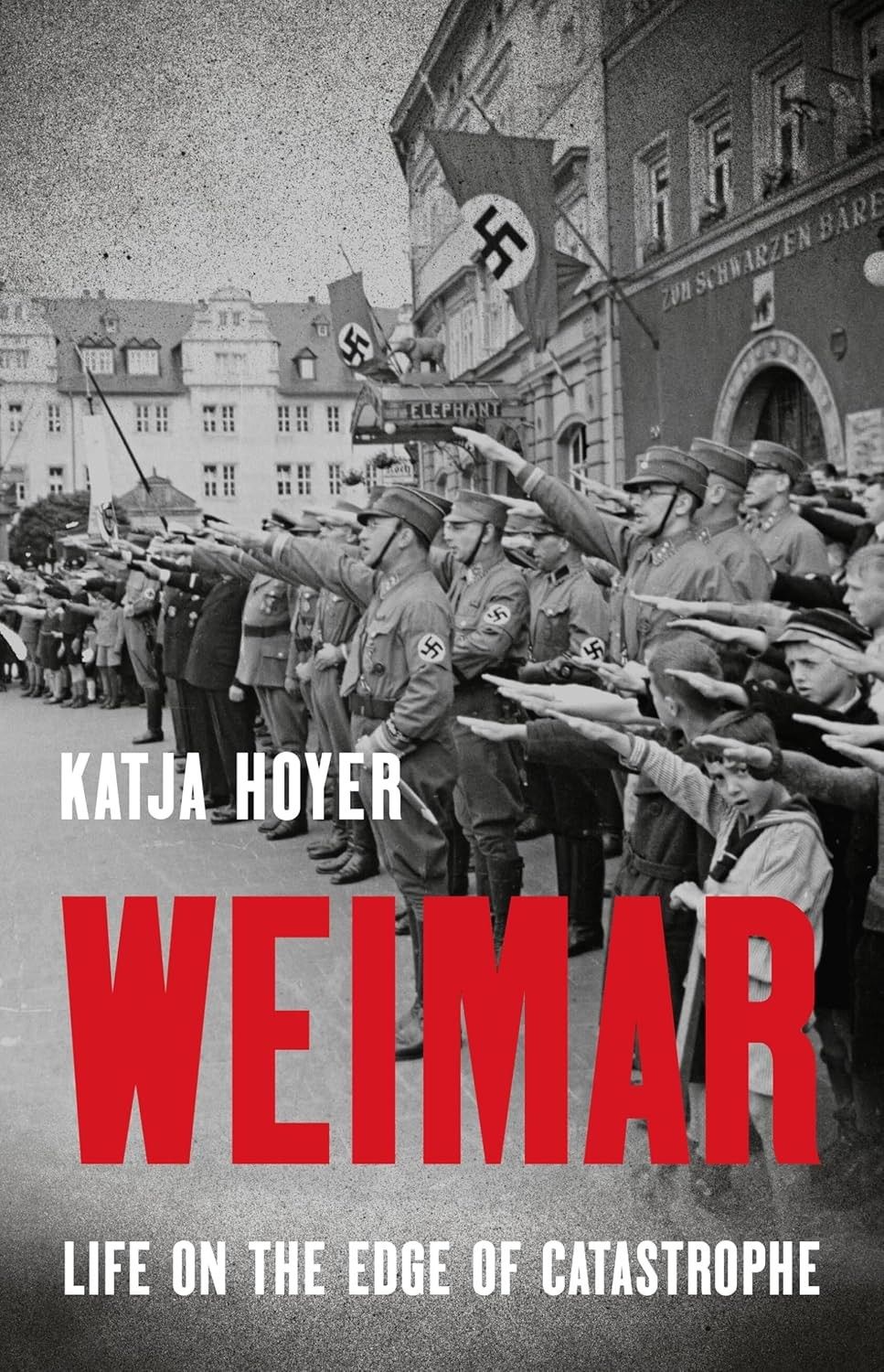


BOOK REVIEW: Weimar: Life on the Edge of Catastrophe
By Katja Hoyer / Basic Books
Reviewed by: Jean-Thomas Nicole
The Reviewer: Jean-Thomas Nicole is a Policy Advisor with Public Safety Canada. The opinions expressed are those of the author and do not reflect the official policies or positions of Public Safety Canada or the Canadian government.
REVIEW: Katja Hoyer’s Weimar: Life on the Edge of Catastrophe approaches one of modern Europe’s most exhaustively analyzed tragedies with an almost disarming premise: if we want to understand how a liberal democracy can curdle into a genocidal dictatorship, we should stop beginning with the eventual monster and start instead with the ordinary lives that learned, day by day, to live alongside the unthinkable.
Katja Hoyer is a German–British historian and serves as a Visiting Research Fellow at King’s College London, as well as a Fellow of the Royal Historical Society. She is the author of the international bestsellers Beyond the Wall: East Germany, 1949–1990 and Blood and Iron: The Rise and Fall of the German Empire. In addition to her scholarly work, she writes as a columnist for the Berliner Zeitung and contributes regularly to major British and American outlets, including the BBC, Bloomberg, The Telegraph, and The Guardian. She also co-hosts the German history podcast Reichs & Republics and publishes a biweekly newsletter, Zeitgeist.
The book opens not with the familiar tableaux of parliamentary collapse or torchlit marches, but with an act of forced looking. In April 1945, Weimar’s townspeople are marched to nearby Buchenwald and confronted with ovens, ash, bodies, and the evidence of industrial murder—an encounter framed as a reckoning with bystanding, with what it means to have “lived under the thick black plumes of Nazi crematoria…a bystander to mass murder” and still claim not to have known.
From that threshold of horror, Hoyer turns back to the beginning and asks, with a historian’s steadiness rather than a prosecutor’s flourish, how a place saturated in “culture and thought” could also become a habitat for “philistinism and barbarism,” and how individuals—caught in history’s undertow—nonetheless made choices that mattered.
Her method is at once capacious and intimate. The scaffolding is chronological, organized into large thematic movements—rebirth, struggle, crisis, decisions, darkness—yet the narrative’s pulse comes from the granular texture of a single town, year by year, as national emergencies arrive not as abstractions but as ration cards, coal shortages, street rumors, unemployment, inflation, political intimidation, cultural feuds, and family grief.
The result is a book that repeatedly performs a moral zoom: from constitutions and cabinets down to kitchens and shops, then back out again, insisting that macro-history becomes legible only when we see how it is metabolized in daily life.
Weimar is a perfect prism for this kind of history because its symbolism is not ornamental but structural. The town that lent its name to Germany’s first full democracy was also a stage on which anti-democratic energies learned to rehearse. Hoyer places Weimar’s cultural prestige—Goethe and Schiller, Bach and Liszt, Nietzsche, and the myth of “spiritual greatness”—in constant, uncomfortable dialogue with the political experiments and resentments that surrounded it.
The Weimar Republic’s constitutional birth becomes, here, not merely a ceremony but a lived social test: the exhilaration and confusion of first elections with women voting; the shaky legitimacy of new institutions; the noise and fatigue that creep in when the promise of democracy meets hunger, trauma, and the longing for order.
What elevates the book beyond an elegant conceit is Hoyer’s insistence on people—specific people—as the medium of explanation. Her central thread is Carl Weirich, a middle-class shop owner whose diary anchors the narrative with an accumulating record of aspiration, wartime strain, bereavement, and the daily improvisations demanded by collapse. Around him gather other lives that complicate any single moral script: Rosa Schmidt, a Jewish hotelier navigating the currents of prejudice and survival; cultural figures and local officials trying to govern amid impossible constraints; and younger Weimarers whose formative years are spent inside an atmosphere where modernity, reaction, and political extremism jostle for the future.
Hoyer is explicit that her quoted speech is drawn from historical records and that the diarist’s particulars have been cross-checked where specifics appear—a methodological note that quietly underwrites the book’s confidence: these are not illustrative characters but real human beings in whom the century’s pressures left their mark.
One of the book’s most resonant achievements is the way it treats culture not as a protective halo but as a contested battleground. Weimar becomes home to the Bauhaus—an explosion of avant-garde ambition and social experimentation—and to the backlash that reads such modernism as foreign, decadent, or subversive. The town’s theatre, its clubs and hotels, its streets and rituals become arenas in which Germans argue—often viciously—about what “Germany” is and who gets to speak for it.
In this sense, Hoyer’s Weimar is not simply “the republic before Hitler,” but a landscape where aesthetic quarrels, social anxieties, and political resentments braid together until authoritarian solutions begin to feel, to too many, like relief.
The prose is notably accessible, shaped for a wide audience without sacrificing the density of lived detail. Hoyer’s voice tends toward restraint: rather than standing between the reader and her subjects to deliver verdicts, she often allows diaries, letters, and contemporary observations to carry their own revelations, including the small evasions by which people protect their self-image while the world darkens. This choice will appeal to readers who distrust moralizing history, yet it also sets a challenge: those seeking a more polemical explanation for Nazism’s rise may find that Hoyer’s narrative prefers description, nuance, and moral psychology to a single prosecutorial thesis.
That said, the book’s moral intelligence lies precisely in its refusal of easy stories. Hoyer does not flatten Weimarers into types—villains, victims, heroes—nor does she grant them absolution through the language of inevitability. Her repeated tension is between circumstance and agency: no one is free of the era’s pressures, yet people still choose—sometimes boldly, more often quietly—what to see, what to say, what to tolerate, and what to rationalize.
In the opening confrontation with Buchenwald, the insistence that bystanding has a moral weight becomes the book’s undertone, echoed backward through the interwar years as the reader watches the gradual normalization of the unacceptable.
If there is a limitation, it is the one Hoyer embraces: the local frame. Readers hoping for a comprehensive survey of national high politics may occasionally feel the lens tighten when it might have widened. Yet the wager pays off, because Weimar’s story—its blend of cultural prestige and political vulnerability, its early entanglements with extremist rehearsal, its proximity to Buchenwald—does function as a concentrated case study of democratic fragility.
Weimar matters because it makes catastrophe feel neither alien nor preordained. It shows how a society learns to live on the edge of disaster, mistaking adaptation for safety, fatigue for realism, and “order” for salvation—until the moment comes when the world insists on being seen.
The Cipher Brief participates in the Amazon Affiliate program and may make a small commission from purchases made via links.
Sign up for our free Undercover newsletter to make sure you stay on top of all of the new releases and expert reviews.
Read more expert-driven national security insights, perspective and analysis in The Cipher Brief because National Security is Everyone’s Business