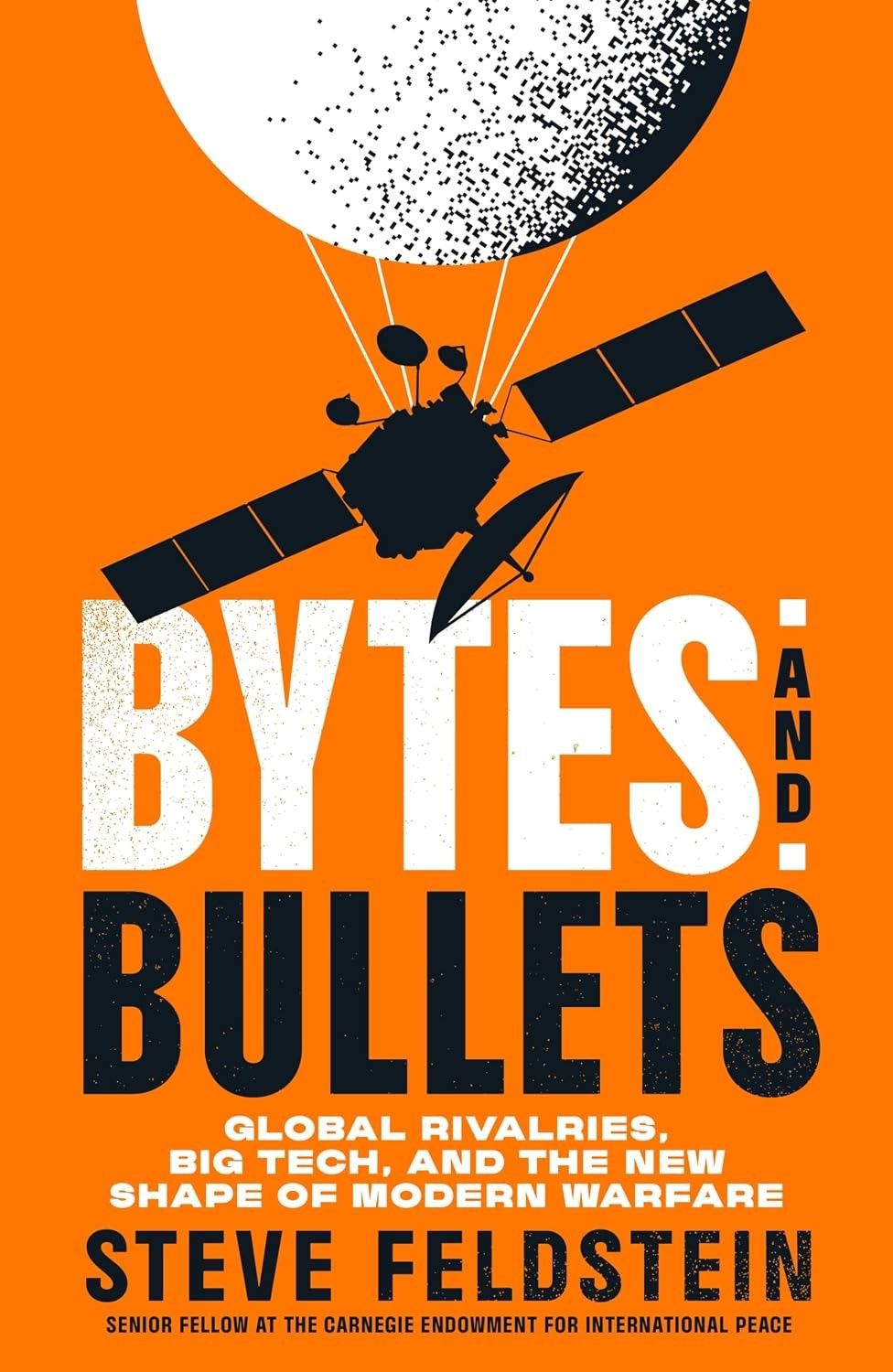

BOOK REVIEW: BYTES AND BULLETS: GLOBAL RIVALRIES, BIG TECH, AND THE NEW SHAPE OF MODERN WARFARE
By Steve Feldstein / St. Martin's Press
Reviewed by: Heidi Vierow
The Reviewer — Heidi Vierow, PhD, a retired CIA Clandestine Service officer, currently is an Intelligence Strategy and Policy Advisor at MITRE.
REVIEW: In Bytes and Bullets: Global Rivalries, Big Tech, and the New Shape of Modern Warfare, Steve Feldstein has written a clearly organized and cleanly argued book. His thesis: “advanced technology has become a powerful tool of competition and a primary focal point of geopolitical rivalry.” He lays out his book in six sections:
- 1.Competition among nations in the digital age,
- 2.The comingling of civilian and military technologies,
- 3.The tech war between the U.S. and China,
- 4.An analysis of China's and Russia's responses to America's tech export controls,
- 5.The push by middle-power countries (Israel, Turkey, the Emirates) to leverage technology to gain political influence and stature, and
- 6.The consequences of the new age of geopolitics.
This book is both detailed and based on scholarly research, and it is also eminently readable. Feldstein, a senior fellow at the Carnegie Endowment for International Peace, writes skillfully for a broad audience. For example, Feldstein explains how the Department of Commerce got involved in the chip wars and the impact of that involvement. Furthermore, he analyzes Ursula von der Leyen's strategy and tactics in leading Europe's positions on tariffs and tech trade and how France is trying to become the third powerhouse in AI. He also provides a primer on the Emirates' role in AI development. His sections on China and Russia are nuanced and insightful. In his discussion of AI technology's role in military advancements, he explains technological advancements from traditional military warfare to rapidly changing counterspace operations.
The book can be read cover to cover or sampled a section or even a subsection at a time. For instance, defining a strategic technology is challenging. He points to the Pentagon's list of six critical technologies, which lacks a “consistent theory or rationale for why certain technologies are deemed strategic and how the government should handle these innovations.” A government's funding of these types of technologies, he explains, faces three main types of hurdles: “good ideas that are poor financial investments” (e.g., infrastructure for high-speed railroads); technology that has high barriers to entry with limited commercial appeal (e.g., space exploration, satellite technology); and technology that has high barriers to entry with significant commercial applications (e.g., commercial airplanes). In the case of the U.S., he argues that the government should intervene if any of these hurdles exists to protect domestic technology and to keep opponents out. (Think of China's influence on U.S. ports and its investments in U.S. land strategically located near military bases.) He explains the economic impacts from labor to domestic ties that result from these strategic technologies. In subsequent chapters he delves into how China and Russia have driven the U.S. to invest and divest from certain technologies.
Likewise, Feldstein provides a complex and fascinating overview of how America's transition to an open innovation system at the end of the Cold War set the stage for the explosion of technical power. On a national scale, the rapid growth of technological innovation has led to the shift in the defense industrial base from a handful of major prime companies that rested on their laurels to the innovative, entrepreneurial neo-primes (e.g., Anduril, Palantir, Shield AI) swept into a revision of contracting with the federal government. On an international scale, the growth in innovation has changed the face of warfare, such as is seen in Ukraine. On the one hand, Ukraine's defense sector has advanced the use of cheap drones to strategic advantage, and on the other hand, Russia has leveraged legacy technology to amplify its more limited access to newer technologies.
The book is a massive effort to assemble and synthesize a historical and current stream of reporting via numerous forms of media sources. His research includes interviews with technology innovators and experts, diplomats, current and former politicians and military leaders, reporters, and think tank analysts from around the globe. He explains complex, multiyear global engagements and competition over technology. Without being reductive, he synthesizes this research into succinct chapters illustrated with fulsome discussions.
Feldstein writes extremely well. His style is personable and professional, and his arguments are well ordered and bolstered with clearly explained examples, which range from hundreds of years ago to 2026 with a focus on the twenty-first century. The introduction and bibliography alone are worth the book's price. Like Jonathan Pelson's Wireless Wars: China's Dangerous Domination of 5G and How We're Fighting Back, this book is a significant contribution to our understanding of the impact of technology on global affairs.
The Cipher Brief participates in the Amazon Affiliate program and may make a small commission from purchases made via links.
All statements of fact, opinion, or analysis expressed are those of the author and do not reflect the official positions or views of the US Government. Nothing in the contents should be construed as asserting or implying US Government authentication of information or endorsement of the author's views.