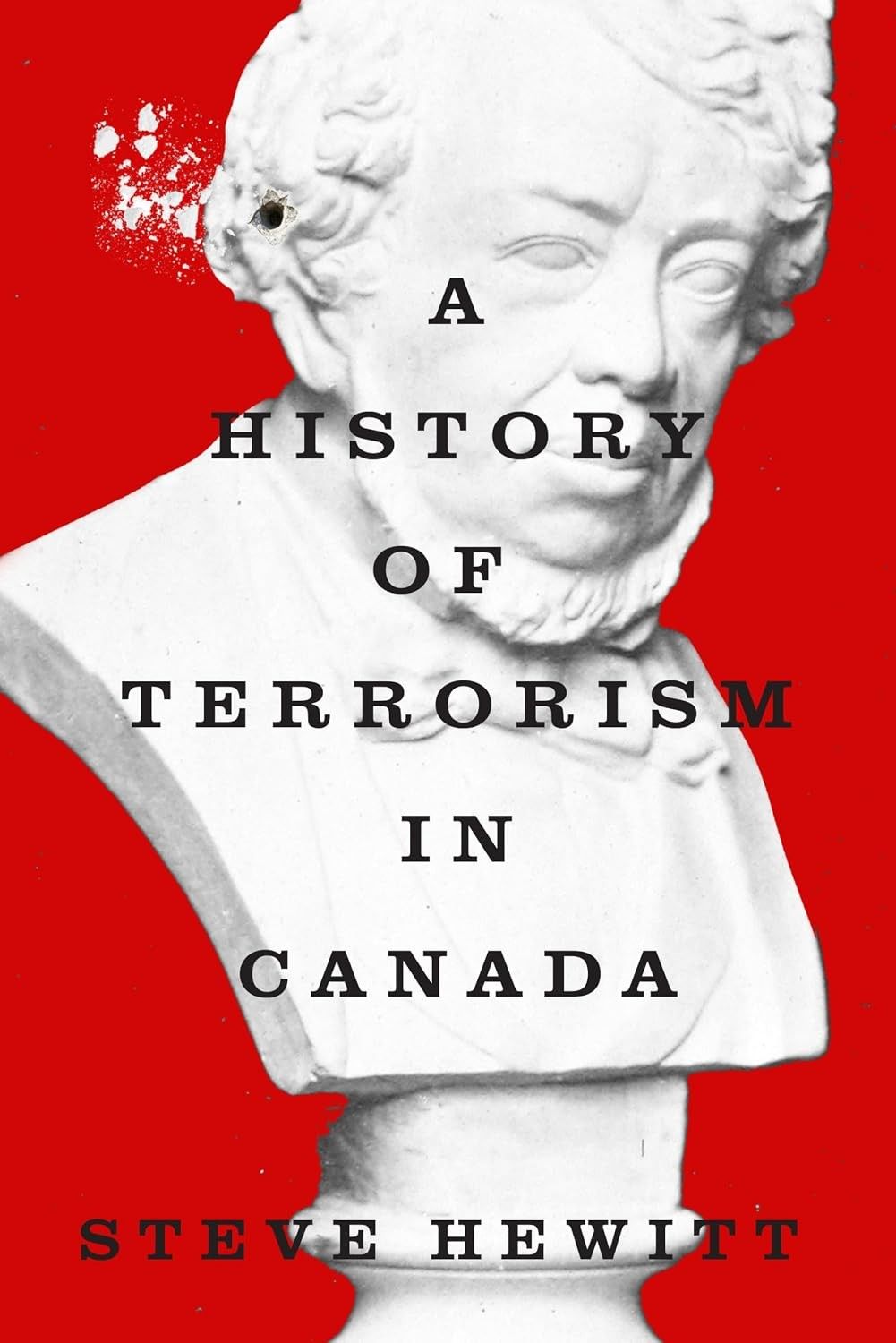

Book Review: A History of Terrorism in Canada,
By: Steve Hewitt/ McGill-Queen's University Press
Reviewed by: Jean-Thomas Nicole
The Reviewer Jean-Thomas Nicole is a Policy Advisor with Public Safety Canada. The opinions expressed are those of the author and do not reflect the official policies or positions of Public Safety Canada or the Canadian government.
REVIEW —Steve Hewitt’s A History of Terrorism in Canada arrives with quiet confidence, yet it quickly reveals an ambition to unsettle familiar narratives. Rather than treating terrorism as an aberration imposed from abroad, Hewitt presents it as a recurring, if often suppressed, feature of Canadian history. The book’s central claim is not simply that terrorism has occurred in Canada, but that Canadians—along with their institutions and scholarship—have repeatedly chosen to forget it.
Hewitt, a historian of security and intelligence, brings significant expertise to this task. Drawing on extensive archival research, including thousands of pages of declassified records, he reconstructs not only events themselves, but the bureaucratic and political frameworks through which they were understood, misinterpreted, and acted upon. This empirical grounding lends the work a distinctive texture, anchoring its arguments in the language and logic of the state.
The structure of the book reflects its dual ambition as both narrative and reference. It traces a broad chronology: from regional uprisings, to the institutional rise of counterterrorism, the Air India bombing, and the post-9/11 era. Later chapters consider lone actor violence, complemented by appendices cataloguing fatal incidents. This architecture underscores Hewitt’s intent to bridge past and present, situating contemporary concerns within a deeper historical continuum.
The conceptual core of the book emerges in its introduction, where Hewitt challenges the enduring myth of Canadian innocence. Juxtaposing the 1868 assassination of Thomas D’Arcy McGee, a Founding Father of the Canadian Confederation and the only Canadian politician to be assassinated, with the 2014 killing of Corporal Nathan Cirillo, a young soldier shot dead while standing ceremonial guard at the National War Memorial in Ottawa, he exposes the artificial distance Canadians place between past and present violence. The notion of a “peaceable kingdom,” a long-standing national self-image of exceptional peacefulness he suggests, has functioned as a selective lens, obscuring the persistence of political violence within the national story.
To counter this narrative, Hewitt advances a key interpretive framework: Canadian terrorism is fundamentally “glo-cal.” It is shaped simultaneously by local grievances and global dynamics—diasporas, empires, ideological currents, and transnational networks. This perspective dissolves the traditional boundary between “domestic” and “international” terrorism, allowing Hewitt to connect disparate episodes into a coherent pattern. From Fenians to Sikh separatist violence, Canadian cases emerge not as isolated anomalies but as variations on recurring historical dynamics.
A second unifying thread is the role of empire. Hewitt traces how the legacies of the British Empire—and later the influence of the United States—have shaped both the origins of political violence and the evolution of state responses. Imperial structures, administrative practices, and geopolitical alignments provide a connective tissue linking episodes across time.
The early chapters demonstrate this approach with clarity. In his discussion of the Fenian raids, i.e., cross-border incursions by Irish American militants in the 1860s–70s aimed at pressuring Britain by threatening its Canadian colony, Hewitt resists framing them simply as cross-border aggression, instead situating them within diasporic politics and anti-colonial struggle. He highlights early intelligence practices, including the use of informants and infiltrators, and the enduring challenges of assessing credibility in a context shaped by rumor, political pressure, and limited information.
The treatment of the Sons of Freedom, a radical sect of Russian-origin pacifist settlers who waged a decades-long campaign of arson and bombing to resist Canadian government assimilation policies, further complicates conventional explanations. Rather than attributing their campaign of arson and bombing to religious extremism alone, Hewitt situates it within broader contexts of state assimilation, social tension, and coercive policies, including the controversial removal of children. The result is a portrait of violence as part of a feedback loop, where grievance and repression become mutually reinforcing.
Hewitt extends this “glo-cal” framework into the FLQ i.e., Front de Libération du Québec, a violent separatist group that carried out bombings and kidnappings in the 1960s–70s period, challenging the tendency to view it as purely domestic. He emphasizes transnational influences, including decolonization movements and revolutionary theory, while also examining how Canadian authorities, shaped by Cold War assumptions, often overemphasized foreign direction. His account of the October Crisis, a 1970 national emergency triggered by FLQ kidnappings of a British diplomat and a Quebec cabinet minister, prompting Prime Minister Trudeau to invoke the War Measures Act, resists simplification, presenting both the brutality of the kidnappings and the expansive use of emergency powers. In doing so, he raises enduring questions about how democracies respond to fear and the precedents such responses establish.
The institutional dimension comes to the fore in Hewitt’s analysis of the development of Canadian counterterrorism. He traces a gradual shift in focus—from domestic subversion to international threats—particularly in the context of global events such as the Munich Olympics attack. Yet this evolution, he shows, was accompanied by persistent challenges: difficulties engaging with diverse communities, definitional inconsistencies, and institutional blind spots. The result is a portrait of a security apparatus that is rhetorically confident but operationally imperfect.
These limitations reach their most tragic expression in the Air India bombing, the 1985 destruction of Air India Flight 182 off the Irish coast, killing 329 people — most of them Canadian citizens — in what remains Canada's deadliest terrorist attack, which Hewitt terms as “Canada’s 9/11.” His intent is not to draw equivalence, but to emphasize the scale of the tragedy and the extent to which it has been deeply buried and marginalized in national memory.
Notably, he underscores contemporary ignorance of a Hindi phrase that translates to something like “a tragic event,” an “incident,” or an “attack that happened,” framing this forgetfulness as part of a broader pattern. At the same time, he carefully navigates the issue of belonging, rejecting simplistic categorizations of the attack as either foreign or domestic. Instead, he presents it as emblematic of the “glo-cal” nature of Canadian terrorism.
Throughout, Hewitt maintains a careful balance between analytical rigor and narrative engagement. He is attentive to the politics of definition, including debates over “state terrorism” and the asymmetries that allow governments to condemn violence while exempting their own actions. Importantly, the book shows how the label “terrorism” functions not only as description, but as a political instrument—one capable of mobilizing extraordinary powers, shaping public perception, and targeting communities.
The breadth of the work necessarily entails limits. Hewitt acknowledges that Indigenous experiences are better understood through frameworks such as colonialism and genocide, even as he gestures toward connections with state violence and surveillance. Some readers may also wish for deeper exploration of perpetrator motivations or survivor perspectives in sections dominated by institutional analysis. These, however, do not undermine the book’s core contribution. Rather, they highlight its role as a foundational synthesis that invites further inquiry.
In the end, A History of Terrorism in Canada is less a conventional history than a challenge to national self-understanding. Hewitt compels readers to abandon the comforting notion that terrorism is an external shock to an otherwise peaceful narrative. Instead, he presents it as an enduring element of Canadian history—uneven, often obscured, but deeply embedded.
For American readers, the book offers a valuable reminder that many of the forces driving terrorism and counterterrorism transcend national borders, making Canada's experience both relevant and instructive.
Hewitt’s most significant achievement lies not simply in documenting incidents, but in exposing the role of forgetting itself. By recovering neglected histories and emphasizing continuity, Hewitt provides a framework for thinking more critically about contemporary threats. A society that understands its past more fully, he suggests, may be better equipped to respond to crisis with perspective rather than myth—capable of balancing security and liberty without denying the tensions between them.—
The Cipher Brief is committed to publishing a range of perspectives on national security issues submitted by deeply experienced national security professionals. Opinions expressed are those of the author and do not represent the views or opinions of The Cipher Brief.
Have a perspective to share based on your experience in the national security field? Send it to Editor@thecipherbrief.com for publication consideration.
Read more expert-driven national security insights, perspective and analysis in The Cipher Brief