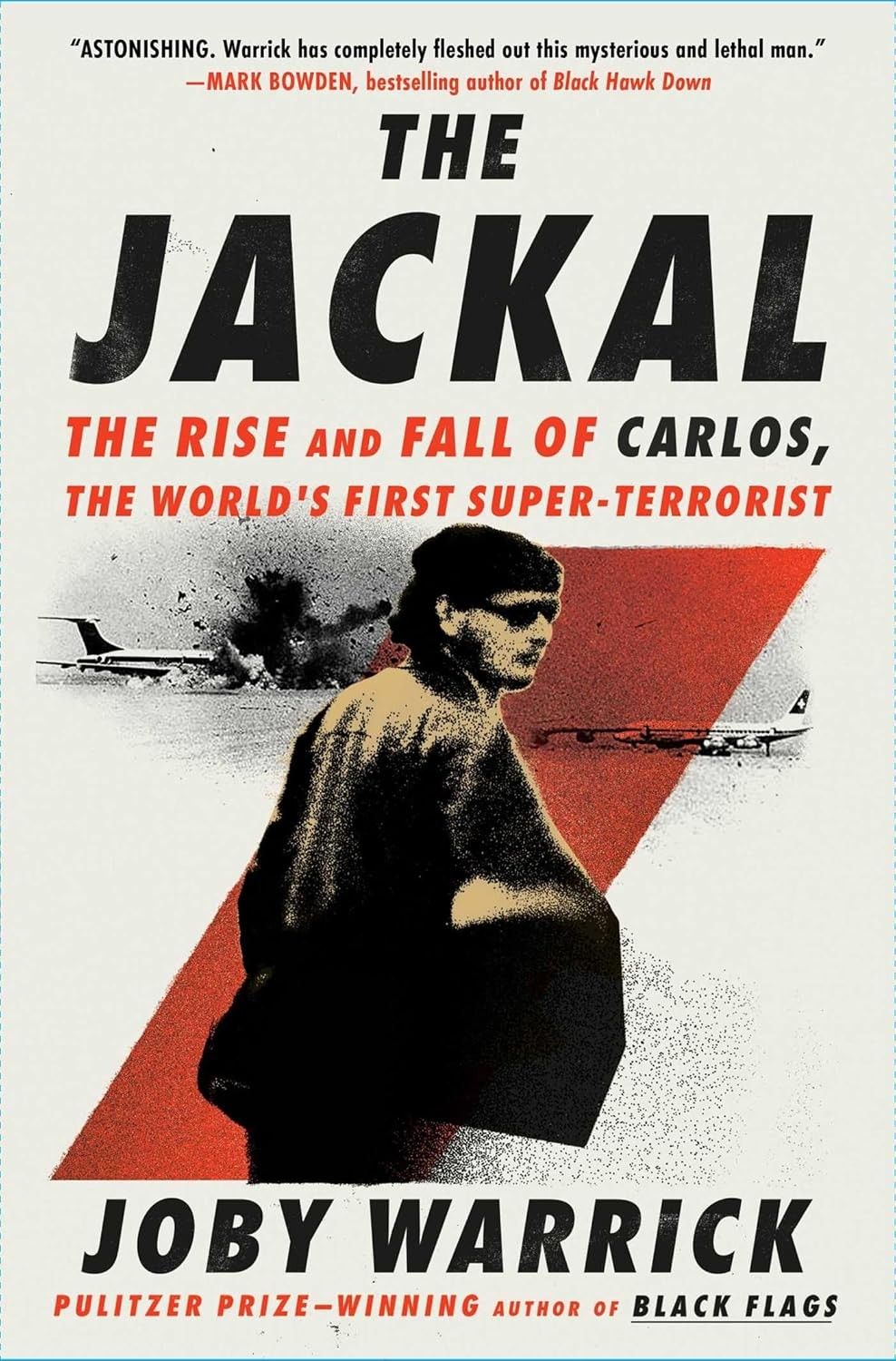

BOOK REVIEW: THE JACKAL: THE RISE AND FALL OF CARLOS, THE WORLD'S FIRST SUPER-TERRORIST
By Joby Warrick / Scribner
Reviewed by: Joe Zacks
The Reviewer — Joe Zacks is the former Deputy Assistant Director of the CIA for Counterterrorism, the Co-founder and Managing Partner of Aardwolf Global Solutions and a Cipher Brief subject matter expert.
REVIEW: As we approach the 25th anniversary of 9/11, we will see a number of books on terrorism and terrorists come to market. A case in point is Joby Warrick's, The Jackal: The Rise and Fall of Carlos, The World's First Super-Terrorist. Warrick's superb book reads like a novel and is also exceptionally well-researched and well-written, a biography of a renowned terrorist. Carlos the Jackal was largely a freelancer who benefited from the Cold War struggle between East and West and the deep pockets and ill intentions of renowned Middle Eastern strongmen of yesteryear.
As Warrick portrays him, aside from leading a playboy's lifestyle, murder and mayhem were Carlos' specialty. His narcissistic personality drove him to carefully and publicly brand his dastardly deeds as uniquely attributable to the black-beret wearing “Carlos the Jackal.” He wanted to be famous and saw terrorism as his path toward achieving this twisted goal of glory.
“Carlos” was born Ilich Ramirez Sanchez to a relatively wealthy and devoutly Marxist Venezuelan father who was so fond of Lenin that he named his sons Vladimir, Ilich, and Lenin. Carlos was a lackluster student who participated in revolutionary causes in Venezuela and attended the Patrice Lumumba People's Friendship University in the Soviet Union. He was ultimately expelled from the university and the Soviet Union for poor academics, misconduct on campus, and unsanctioned political activity. Despite his future close cooperation with and support from eastern European security services, the KGB never recruited nor showed much interest in Carlos due to his youthful bad behavior.
In 1970, not long after he left the Soviet Union, Carlos ended up in Beirut, Lebanon, in search of adventure and revolutionary causes. He volunteered to serve the Popular Front for the Liberation of Palestine (PFLP)—one of the most extremist and reactionary Palestinian groups—by boldly walking into the offices of its publication and offering his services. In short order, he closely allied himself with one of the PFLP's founders, Wadi Haddad, whom he served faithfully for six years. His relationship with Haddad taught Carlos how to meticulously plan and operationalize terrorist attacks. He carried out a series of attacks in western Europe, some more successful than others. These included complex attacks that later became a hallmark of al-Qaeda. During this period, he demonstrated his willingness to murder in cold blood. He developed a network of Arab and far left western European collaborators who would remain instrumental to his later criminal endeavors. In addition to chronicling Carlos's work with the PFLP, Warrick paints a comprehensive portrait of Haddad—to include his likely death at the hands of Mossad through poisoned toothpaste—the PFLP and the Black September battles in Jordan in 1970-71.
As Warrick explains, Carlos was formally expelled from the PFLP in 1976 after leading the infamous 1975 attack on OPEC headquarters in Vienna. While this sensational event captured world headlines for days and put Carlos publicly on the map as an international terrorist, it failed to achieve its primary objectives of murdering the Saudi and Iranian oil ministers. In fact, it is almost certain that Carlos cut a deal with Saudi Arabia to release all the hostages for a ransom that he himself pocketed and that was estimated in the tens of millions of dollars. Only Haddad's fondness for Carlos prevented him from being executed for his failures in this plot.
Unshackled from his commitments to the PFLP, Carlos became a free agent in the world of international terrorism. Often with the support of Eastern European intelligence services, he was for many years able to freely operate from bases in the region where he amassed large quantities of weapons and explosives not to mention multiple foreign—often diplomatic—passports. He contracted his services for years to eastern European governments and Libya's Muammar Gaddafi, Iraq's Saddam Hussein and the Syrian government of Hafez al-Asad. With the support of these state sponsors of terrorism and the financial largesse of these Arab leaders, Carlos operated with relative impunity for close to twenty years. It was only the collapse of the Soviet Union and the Eastern European communist regimes as well as Syria's attempt to gain favor with the West in the early 1990s that forced Carlos to flee his refuge in Syria and later Jordan to set up his last base of operations in Khartoum, Sudan, in 1993.
In concluding the book, Warrick chronicles the CIA's intense operation to locate Carlos in Khartoum. He brings to life the activities of legendary CIA operatives Cofer Black and Billy Waugh as well as the French DGSE agents who, with the support of the Sudanese government, ultimately had the legal authority to capture Carlos on August 14, 1994. This international terrorist was finally brought to justice in Paris, where he remains imprisoned for the remainder of his life.
Throughout his book, Warrick provides fascinating portraiture of a cast of international characters who rallied to support Carlos during various phases of his life. These include the Swiss financier and fanatical Nazi supporter Francois Genoud, French lawyer Jacques Vergès, and Isabelle Coutant-Peyre, the French defense lawyer whom he married while in prison.
In addition to telling an incredible tale, Warrick highlights important points related to terrorism. For example, most, if not all terrorists, are wanton murderers who often gain self-purpose through killing. Additionally, state sponsorship gives terrorists refuge and finances. As Warrick pointed out in his July 23, 2026, opinion piece in The New York Times, we are seeing these patterns with Russia and Iran today as they too are increasingly supporting and relying on a cadre of freelance terrorists. It is critical, at a minimum, to condemn publicly and sanction these state sponsors.
The Cipher Brief participates in the Amazon Affiliate program and may make a small commission from purchases made via links.
All statements of fact, opinion, or analysis expressed are those of the author and do not reflect the official positions or views of the US Government. Nothing in the contents should be construed as asserting or implying US Government authentication of information or endorsement of the author's views.