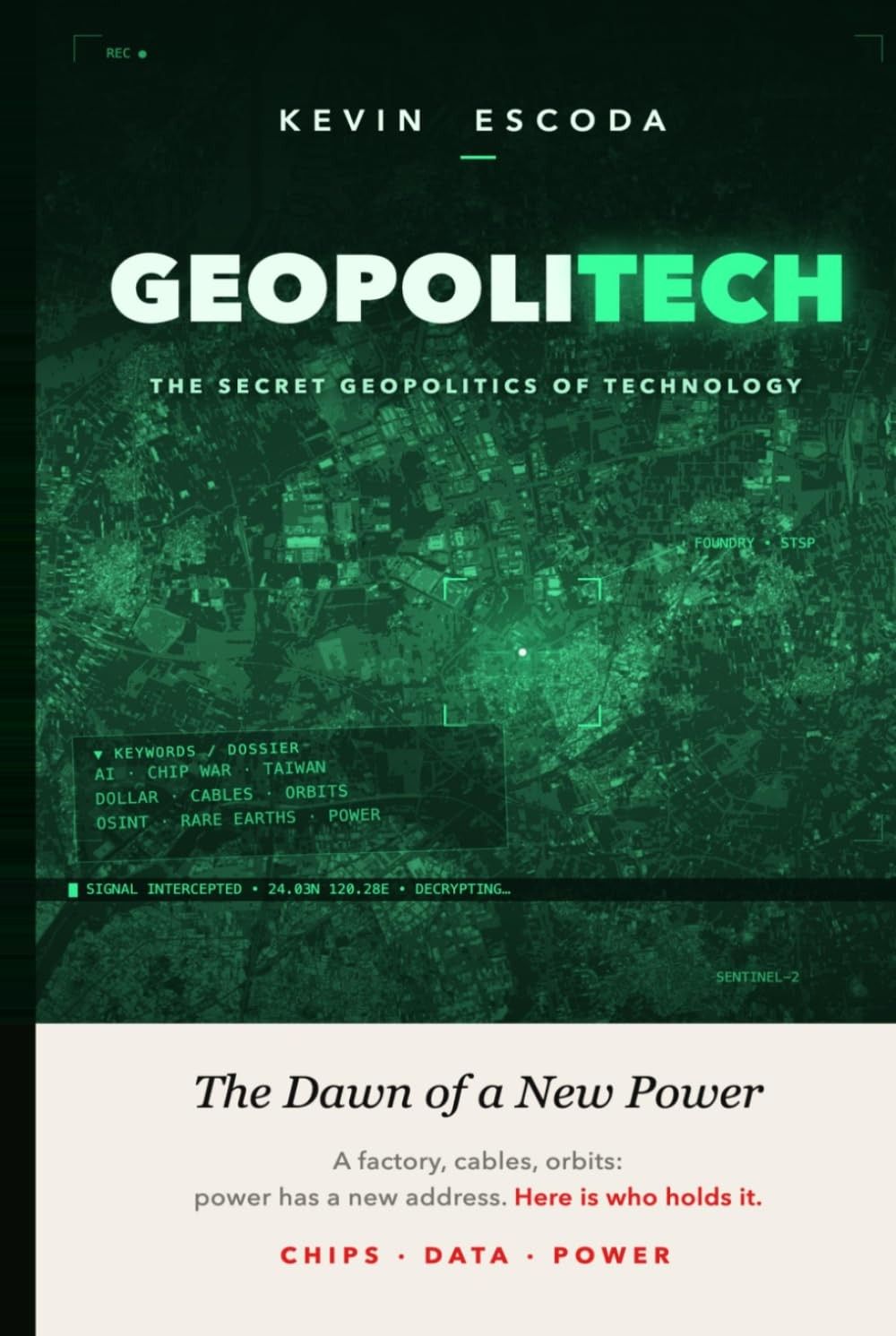

BOOK REVIEW: GEOPOLITECH - THE SECRET GEOPOLITICS OF TECHNOLOGY: THE DAWN OF A NEW POWER
By Kevin Escoda / Independently Published
Reviewed by: Jean-Thomas Nicole
The Reviewer — Jean-Thomas Nicole is a Policy Advisor with Public Safety Canada. The opinions expressed are those of the author and do not reflect the official policies or positions of Public Safety Canada or the Canadian government.
REVIEW:
Kevin Escoda's Geopolitech: The Secret Geopolitics of Technology — The Dawn of a New Power is an ambitious and accessible exploration of one of the defining realities of the twenty-first century: the fusion of technology and geopolitics. Rather than treating technology as a realm detached from geography, power, and state competition, Escoda argues that the digital age has intensified dependence on physical infrastructures, strategic bottlenecks, and invisible systems of control. The book is less a conventional geopolitical treatise than a guide for understanding how power operates beneath the surface of everyday technological life.
Kevin Escoda is a French technology consultant, AI and digital transformation specialist, and author based in Milan, Italy. His work spans fintech, blockchain, artificial intelligence, and innovation strategy, including advisory roles in the financial sector. He is the author of a trilogy exploring the intersections of technology, finance, intelligence, and geopolitics: From DeFi to Institutional DeFi, From the Machine That Calculates to the Machine That Thinks, and Geopolitech: The Secret Geopolitics of Technology.
Geopolitech's strongest and most consistent argument is that technology has not rendered geography obsolete. Instead, it has concentrated power in a series of critical nodes: semiconductor fabrication plants, rare-earth processing facilities, undersea communication cables, satellite networks, and specialized industrial technologies. Through examples such as Taiwan's semiconductor industry, ASML's near monopoly over extreme ultraviolet lithography, and China's role in resource refining, Escoda demonstrates that digital power ultimately rests on tangible infrastructure.
This argument is particularly effective because it challenges a popular misconception. The “cloud,” as Escoda repeatedly reminds readers, is not a cloud at all but a network of physical assets that can be protected, disrupted, controlled, or weaponized.
A recurring theme throughout the book is the importance of chokepoints. Escoda encourages readers to ask two deceptively simple questions:
1. Where does it run?
2. Who can close it?
These questions serve as the analytical framework for the entire volume. Whether discussing data flows, supply chains, communications networks, or financial systems, Escoda shows how influence often belongs not to the largest actor, but to whoever controls key access points. The concept is applied successfully across multiple domains and provides readers with a practical lens for analyzing global affairs (e.g., the Strait of Hormuz is closed, the Bab el-Mandeb is contested, and the Panama Canal is straining under rerouted traffic — what is happening to freedom of navigation?).
The discussion of “weaponized interdependence” is especially compelling. Drawing on contemporary scholarship, Escoda illustrates how globalization's interconnected networks can become instruments of coercion when states gain leverage over critical flows of information, resources, or technology.
Unlike many books on geopolitics that promote a single grand theory, Geopolitech focuses on method. Escoda explicitly seeks to teach readers how to observe, investigate, and think critically rather than simply accept conclusions. The book frequently introduces tools associated with open-source intelligence (OSINT), including satellite imagery analysis, metadata examination, and the verification of publicly available information.
This methodological focus is one of the book's greatest strengths. By emphasizing evidence gathering and patient observation, Escoda empowers readers to engage directly with geopolitical questions instead of relying exclusively on experts or governments. As a result, the book functions simultaneously as an introduction to geopolitical analysis and a practical guide to investigative thinking.
Another noteworthy contribution is the book's insistence that technology does not eliminate the need for human judgment. Escoda repeatedly highlights examples where human intervention prevented catastrophic outcomes or where human error introduced significant vulnerabilities. His discussion of incidents such as Stanislav Petrov's refusal to blindly trust Soviet warning systems illustrates the enduring importance of critical thinking and skepticism.
This theme gives the book a welcome human dimension. While many technology-focused works drift toward technological determinism, Escoda argues that individuals remain indispensable actors within complex systems.
The book concludes with a dossier of real-world investigations, including analyses of Chinese island-building activities, missile silo identification, and publicly available data related to the war in Ukraine. These case studies serve as practical demonstrations of the analytical methods discussed throughout the book. Rather than merely describing geopolitical developments, Escoda shows readers how those developments can be observed and understood using publicly accessible information.
This section is especially valuable because it transforms abstract concepts into concrete examples and demonstrates the growing significance of open-source intelligence in modern security analysis.
The book's greatest strengths also create some weaknesses. Its scope is exceptionally broad, spanning history, technology, intelligence, economics, cybersecurity, and international relations. As a result, certain subjects receive less depth than specialists might desire. Readers seeking detailed policy prescriptions will also find little discussion of specific reforms or governmental responses. Escoda is more interested in teaching readers how to think than in providing definitive solutions.
Additionally, the book's enthusiasm for open-source investigative methods occasionally risks overstating their democratizing potential. While Escoda acknowledges limitations and dangers, some readers may feel the work underestimates the ability of governments and corporations to manipulate information environments or restrict access to data.
Geopolitech is an intelligent, engaging, and highly relevant contribution to contemporary discussions about technology and power. Its greatest achievement is not the presentation of a novel geopolitical theory, but the development of a practical framework for understanding how modern systems function and who controls them. Escoda combines technical literacy, historical perspective, and investigative rigor in a manner that is accessible without being simplistic. Policymakers, analysts, and anyone interested in national security, technology, or international affairs will find considerable value in its insights. Ultimately, the book succeeds because it teaches readers not merely what to think about modern power, but how to see it.
The Cipher Brief participates in the Amazon Affiliate program and may make a small commission from purchases made via links.