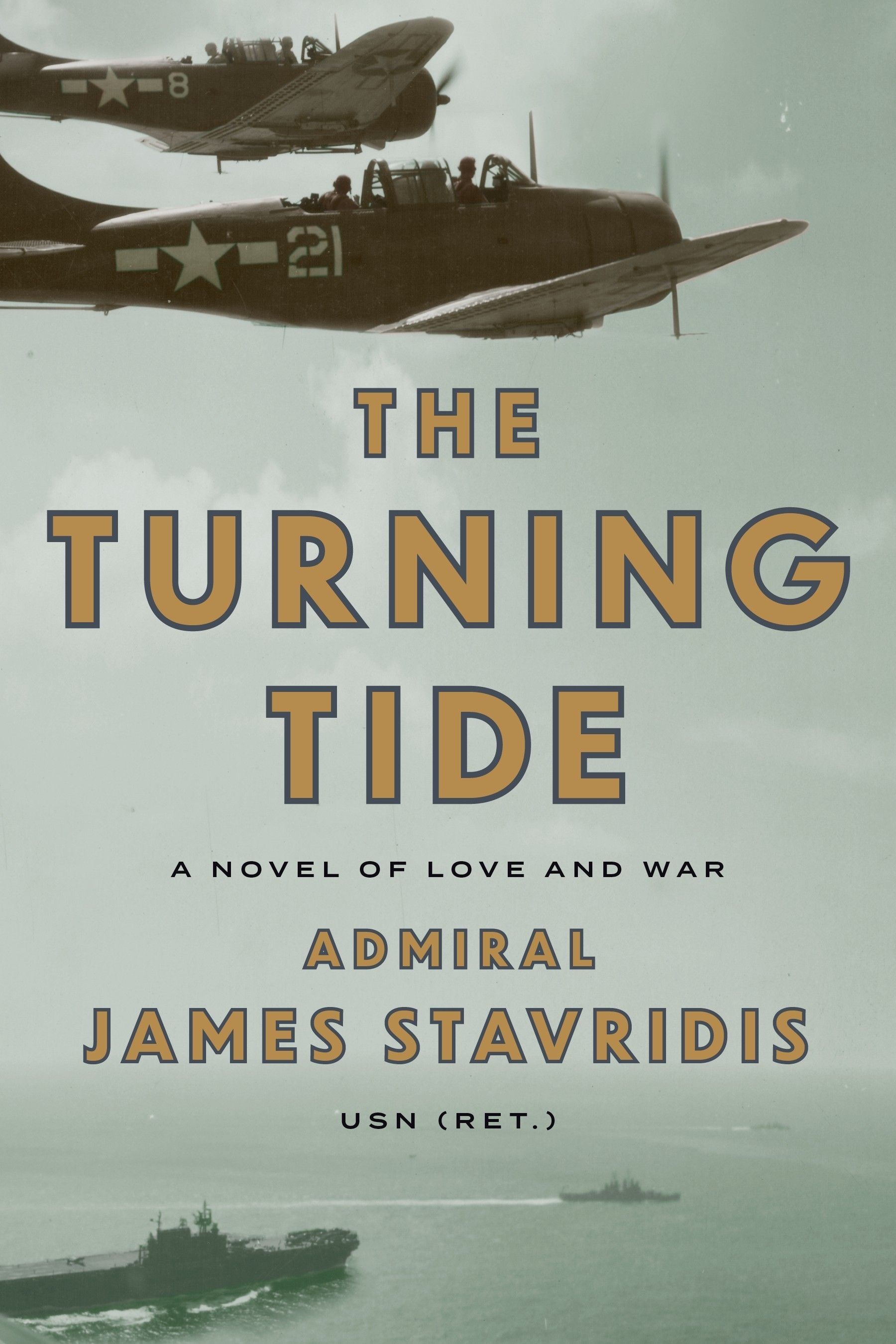

BOOK REVIEW: THE TURNING TIDE: A NOVEL OF LOVE AND WAR
By Admiral James Stavridis, USN (Ret.) / Penguin Press
Reviewed by: Nicholas Reynolds
The Reviewer — Before joining CIA, Nicholas Reynolds served as a USMC infantry officer and field historian. In retirement, he became a New York Times best-selling author. His most recent book, co-authored with Katie S. Sanders, is Ortiz’s War: The Allies’ Secret Weapon Against the Nazis in France (Harper Horizon, 2026), about a US Marine who fought the Germans behind the lines in Europe and earned two Navy Crosses.
REVIEW: World War II is the gift that keeps on giving. Just when you think there cannot be another book worth reading about the war, one more comes along. Written by a renowned officer with decades of experience, The Turning Tide is a fine novel that puts your reviewer in mind of Herman Wouk’s sagas of the war at sea in the Pacific.
The Turning Tide is the sequel to The Restless Wave, where Admiral Stavridis introduced his main character, Scott Bradley James, before sending him off to the Naval Academy in 1937, where he rooms with a midshipman named John Allen. After graduation, James joins the surface navy, while Allen becomes a Marine and then a naval aviator. Both head out to the Pacific.
The Restless Wave follows their adventures from the attack on Pearl Harbor through the battle for Guadalcanal. This book picks up there and takes James through the rest of the war, including the battles for the Marianas, Iwo Jima, and Okinawa. One focus is the sprawling Battle of Leyte Gulf. Another is “Halsey’s Typhoons.” (The pugnacious admiral steered his fleet into not one but two storms, leading to unnecessary losses.) These momentous events are compared to Dante’s circles of hell, with the Naval Academy as the first, a claim that is unlikely to figure in the Academy’s brochures.
Stavridis is, of course, too young to have experienced these battles, but he certainly knows what it is like to spend time at sea, and he has carefully studied the backdrop against which his story plays out. This historian did not catch any mistakes of fact, apart from the intentional extension of Captain Joe Rochefort’s tour at Pearl Harbor.
Real-life characters are depicted with a sure and even artful hand. The intense carrier commander Admiral Marc “Pete” Mitscher, for example, is “a wizened figure … sucking hard on a cigarette, … so thin that … he might just blow away” in a stiff breeze. He is said to live on coffee and nicotine. Counterbalancing the aviator Mitscher is his chief of staff, the famous destroyer man Arleigh Burke, a sturdy, pipe-smoking Scandinavian-American whose endless energy turns Mitscher’s intentions into plans. We are not permitted to forget the never-ending tension between aviators and SWOs (surface warfare officers), which Burke puts aside to make his relationship with Mitscher work and help win the war at sea.
Stavridis does just as well with his fictional characters, Navy and Marine, who serve under Mitscher and Burke. The dialogue flows naturally, and their personalities become ever more distinct as they deal with the challenges of a long war. They have human foibles but measure up in combat, which is described in vivid detail, especially kamikaze attacks and ship sinkings. The reader comes to care about these characters and keeps turning the pages to find out what happens next to them, to say nothing of the lovely Kai, the chief’s daughter who spent the night of December 6–7 with James and now has a toddler whose paternity is not entirely clear.
Interspersing letters from home with official messages that look like they have been pulled off a teleprinter is a technique that helps to advance the story. For this reviewer, the same is not quite as true of the poetry that these combat veterans quote at greater length than any sailor or Marine he has ever known.
Besides an extremely distinguished career in uniform at the highest levels, Admiral Stavridis has written an amazing number of books, both nonfiction and fiction. Not every writer can master both genres, but The Turning Tide leaves no doubt that this author is one of the talented few.
The Cipher Brief participates in the Amazon Affiliate program and may make a small commission from purchases made via links.