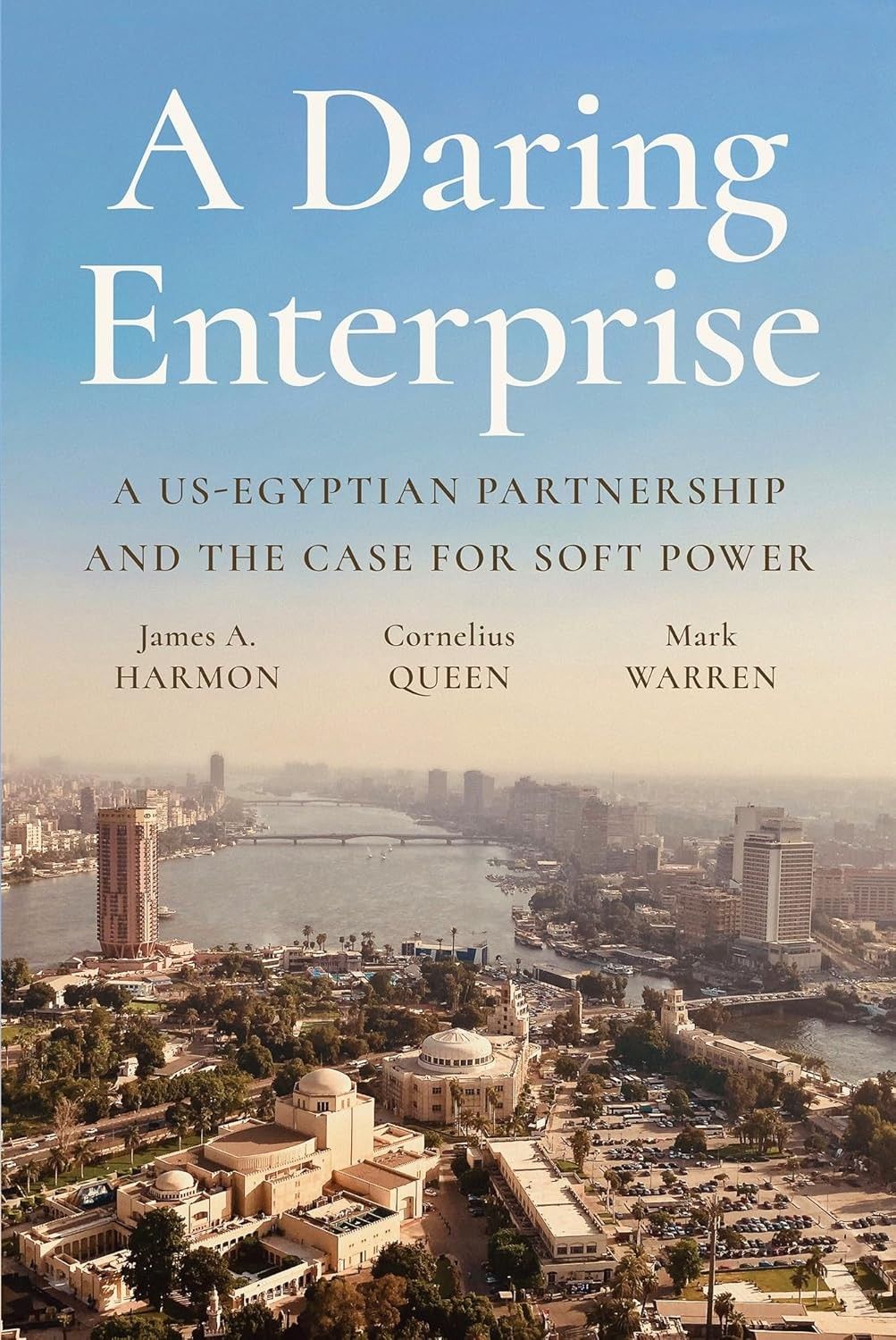


BOOK REVIEW: A Daring Enterprise: A US-Egyptian Partnership and The Case for Soft Power
By James A. Harmon, Cornelius Queen, and Mark Warren/The American University in Cairo Press
Reviewed by: James L. Bullock
The Reviewer — James L. Bullock is a retired senior Foreign Service Officer, with over forty years of U.S. Government service, as a naval officer, and as an FSO with the US Information Agency and the State Department. He spent his foreign service career mostly in Arabic-speaking countries, including Egypt, where he was Embassy Counselor for Public Affairs. After retiring from State, he returned to Egypt to work as Vice-President for Institutional Advancement at The American University in Cairo.
REVIEW — A Daring Enterprise is a plea to save one piece of an ambitious program conceived in the immediate aftermath of the Cold War to promote free markets in Eastern Europe and in the newly independent states that emerged from the collapse of the Soviet Union.
The administration of President George H.W. Bush first launched U.S.-government seeded “enterprise funds” to advance U.S. security in developing countries through targeted investments to generate economic opportunity. Unlike traditional foreign aid, these enterprise funds – with bi-partisan support in the Congress – promoted free markets and entrepreneurship through private equity investments. They also promised to generate profits and repay the U.S. Treasury.
The “Support for Eastern European Democracy” (SEED) Act set up the first two enterprise funds, for Poland and Hungary, with just $300 million. Congress soon expanded the SEED Act to additional countries in Eastern Europe and Central Asia through the Freedom Support Act (FSA).
These funds were set up to operate like venture capital firms, assuming risk and providing both equity capital and technical assistance to promising new enterprises, introducing new practices and financial products. Each fund had a presidentially appointed, pro-bono board of directors, recruited from prominent business leaders in both the U.S. and the host countries.
Funding for the new enterprise funds initially came from USAID program budgets, and this diversion provoked some initial resistance within that agency. In turn, board members, recruited from the private sector, were often wary of USAID’s bureaucracy. Relationships between USAID and the pro-bono boards, strained at first, ultimately proved to be productive.
By 2013, nine of the original ten funds had ceased making new investments and had begun exiting their investment portfolios, leaving behind “legacy foundations.” Not all the funds were completely successful, but their implementers deemed the overall program worth repeating. An increasingly risk-averse Congress, however, in the wake of the 2008 economic recession and partisan squabbling over new financial regulation, was reluctant to create new enterprise funds. Congress authorized only two new funds during the Obama administration: the Egyptian American Enterprise Fund (EAEF) and the Tunisian American Enterprise Fund (TAEF). Both were part of the U.S. response to the 2011 “Arab Spring.”
A Daring Enterprise is the story of how the Egyptian American Enterprise Fund launched, as seen through the eyes of its founding board chair, James A. Harmon, formerly chair of the U.S. Export-Import Bank during the Clinton administration. His co-authors are Cornelius Queen, EAEF’s senior vice president and former legislative aide to then-Congressman Chris Van Hollen, and Mark Warren, a Pulitzer Prize-winning author and former executive editor at Random House.
As already noted, this book is appearing now for a reason. Just a year ago the Trump administration dismantled the U.S. Agency for International Development (USAID) and cancelled almost all its worldwide programs. The offices within the downsized State Department charged with managing the remnants of the USAID portfolio are struggling. There is little apparent appetite, either in the White House or on Capitol Hill, for new international assistance programs. Supporters of the EAEF cannot take for granted its continued authorization in such an environment.
As A Daring Enterprise documents, the EAEF owes its success, and it has been a success, largely to the excellent Egyptian professionals recruited to its board, including Sherif Kamel, dean of the American University in Cairo’s business school and a former esteemed colleague of this reviewer. Equally important, however, has been the high caliber of its American board members, with ties to both the Democratic and Republican parties. Even so, Harmon has had to deal with constant challenges, both in Egypt and back in the U.S., to the EAEF’s continued existence.
Harmon and his colleagues have told EAEF’s story before. They have given countless media interviews in both the U.S. and Egypt. They have authored lengthy articles, testified before Congress, and lobbied extensively in both countries. Despite these efforts, enterprise funds in general, and the EAEF in particular, remain unknown to the great majority of Americans. Most have wildly inaccurate ideas about the extent of U.S. foreign assistance.
Even before the untimely demise of USAID, U.S. foreign aid accounted for less than one percent of the total U.S. federal budget, a small fraction of overall government spending. Nevertheless, opinion polls regularly show that the average American believes that foreign aid makes up about a quarter of the total federal budget. Even the one percent has traditionally been divided between humanitarian assistance (fighting disease and poverty) and security assistance (military support to international partners and anti-narcotics programs). Under the current administration, the amounts on the humanitarian side, which include contributions to international organizations, are declining even more.
And so, James Harmon, with Cornelius Queen, and Mark Warren, has pulled together this book. The basic arguments for the continuation of the EAEF really have not changed, but the importance of making those arguments is now greater than ever. The book contains compelling anecdotes, with more details than appear in earlier published articles. It is well-written and well-worth the time to read and ponder.
As A Daring Enterprise concludes:
The success of the EAEF should not be a footnote. It should be a blueprint. It should be a reminder to our next generation of leaders, up and down the ideological spectrum, that global engagement is not weakness, it is strength. That development finance is not charity, it is strategy. And that investing in people -- in their education, their health, their capacity to build -- is a far more powerful form of diplomacy than any show of force.
The Cipher Brief participates in the Amazon Affiliate program and may make a small commission from purchases made via links.
Sign up for our free Undercover newsletter to make sure you stay on top of all of the new releases and expert reviews.
Read more expert-driven national security insights, perspective and analysis in The Cipher Brief because National Security is Everyone’s Business