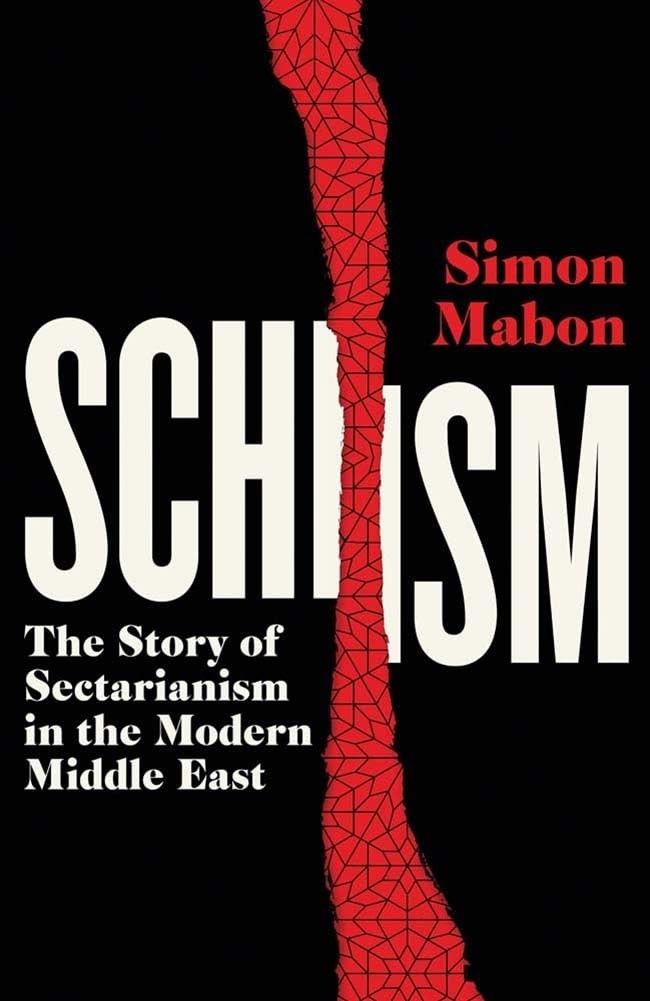

SCHISM: THE STORY OF SECTARIANISM IN THE MODERN MIDDLE EAST
by Simon Mabon / Yale University Press
Reviewed by Andy Dunn, former CIA Deputy Assistant Director
The Reviewer — Andy Dunn retired from the CIA in October 2021 after a 29-year career as an analyst and Agency leader. He last served as Deputy Assistant Director of the Near East Mission Center from 2020 to 2021 and as Chief of Analysis in the Iran Mission Center from 2018 to 2020. Iran and the violence perpetrated by its proxies and partners in the region were the major focus of these units. Previous assignments included multiple leadership positions in the Counterterrorism Mission Center and two war-zone tours. The views expressed in this review are the author’s own and do not represent those of the CIA or any other U.S. government agency.
REVIEW: SCHISM, by Professor Simon Mabon of Lancaster University in the UK, tackles the formidable task of explaining the ever-changing sectarian dynamics of the Middle East, with a particular focus on Lebanon, Saudi Arabia, Iraq, Iran, and Israel. The book argues that these political and religious authorities seek to manipulate and politicize the complex and evolving sectarian identities of their populations and the region more broadly, with mixed success. Mabon contends that these identities are more fluid than Western leaders often assume. He seems to have a particular axe to grind with President Obama’s characterization of the Middle East as a region “ravaged by historical divisions,” several times harking back to this “Orientalist” (gasp!) misapprehension by the former president.
Mabon first sets out to define sectarianism in the context of the Middle East and ultimately settles on “the process of setting apart from within for political ends” after an extended and often dense review of academic debates on the issue. If you are like me, that probably still leaves you asking, “Well, OK, but what the hell does that mean?” The answer ultimately comes down to the central point he seeks to make: much of the sectarian strife that plagues the Middle East flows from political or religious actors who seek to emphasize distinctions and boundaries between groups that belong to the same broader society or faith tradition in order to serve their own political objectives. In other words, sects become sectarian only when they are mobilized, institutionalized, and weaponized for political purposes.
Mabon spends the rest of the book applying this definition to the post-colonial history of the Middle East, with brief forays further back in time. For example, Iraq’s descent into sectarian civil war in the years after the U.S. invasion in 2003 was, in Mabon’s telling, driven by political elites in each community stoking fear among Shias and Sunnis to consolidate their own power and wealth, rather than reflecting just the reemergence of age-old animosities between the two groups. He cites the 2019 Tishreen uprising, which evolved into a widespread revolt against the sect-based post-Saddam power structure, as proof that inter-sect relations are more complex than we often assume. And that identities beyond Sunni and Shia can, in this case, motivate large swaths of Iraq’s population to political action.
He applies a similar analysis to the waves of what he judges to be elite-initiated sectarian violence in Lebanon beginning in 1975, followed by anti-sectarian popular unrest — most prominently in October 2019 — driven by many of the same grievances about corruption and economic ruin that motivated the protesters in Iraq. In both countries, though, Mabon concedes that sectarian establishments have managed to maintain their grip on privilege and power despite the unrest.
Mabon’s analysis of the zigs and zags of sectarianism in Saudi Arabia and Iran — particularly since the Iranian Revolution and the storming of the Masjid al-Haram in Mecca in 1979 — also seeks to persuade readers that sectarianism in both countries is as much a product of government manipulation and policy as of underlying animosity between sects. He traces the ebb and flow of Saudi government discrimination against the Shia community in the Kingdom’s Eastern Province to make his point. This ranges from the execution of Shia Shaykh Nimr al-Nimr on terrorism charges in January 2016 at one extreme to today’s efforts by Saudi Crown Prince Muhammad bin Salman to foster a Saudi national identity not tied to sect.
And on and on Mabon’s examples go, which brings me to the book’s shortcomings. It often feels more like an everything-but-the-kitchen-sink recitation of the region’s sectarian woes than a focused analysis. And the outlook could only emerge from academia. The last sentence of the conclusion — “How people navigate this (sectarianism), without recourse to violence, in a particularly precarious world, remains to be seen” — is not exactly an actionable insight for readers. And while Mabon mostly avoids academia’s reflexive sympathy for the Iranian regime and hostility toward Israel (his examination of growing animosity between Jewish sects in Israel is one of the book’s highlights), his epilogue denouncing Trump’s war on Iran is only tangentially connected to his primary thesis. It is little more than a temper tantrum aimed at the admittedly ill-conceived and erratically executed U.S. campaign.
Is Mabon ultimately persuasive? I suppose, but I’m not sure in a way that goes beyond the obvious. Political and sectarian leaders manipulate their followers; oftentimes, their followers follow, and sometimes they grow tired of being manipulated. That’s true in our own depressingly tribal politics and across the world. Is the book worth reading? Again, a lukewarm yes, particularly if you are unfamiliar with the region or want a refresher on its incredibly complex recent history. It helps that it is short but be prepared for a slog through often dense prose.
The Cipher Brief participates in the Amazon Affiliate program and may make a small commission from purchases made via links.
Sign up for our free Undercover newsletter to make sure you stay on top of all of the new releases and expert reviews.
Read more expert-driven national security insights, perspective and analysis in The Cipher Brief because National Security is Everyone’s Business