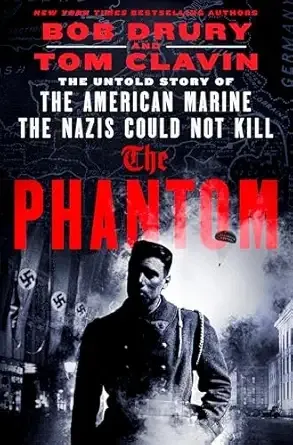

BOOK REVIEW: THE PHANTOM: THE UNTOLD STORY OF THE AMERICAN MARINE THE NAZIS COULD NOT KILL
By Bob Drury and Tom Clavin / St. Martin’s Press
Reviewed by: Robert Richer
The Reviewer — Robert Richer served as a former Associate Deputy Director for Operations at the CIA. He retired in 2005 and before his retirement he also served as Chief of the Near East and South Asia Division, responsible for Clandestine Service Operations throughout the Middle East and South Asia. Mr. Richer currently consults on Middle East and national security issues and is a senior partner with International Advisory Partners.
REVIEW:
As would be expected of veteran bestselling authors Bob Drury and Tom Clavin, their newest collaboration, The Phantom, is extremely well researched, well written and touches on the unique contribution and service of a Marine in the European theater, particularly as the roles of Marines in Europe during World War II have been less documented in such detail.
Like previous works, the authors demonstrate a unique understanding of the culture and ethos of those they write about. Be it the Rangers in The Last Hill, or the Marines in The Last Stand of Fox Company, their work captures the individual and collective measure of those they write about. As a Marine and a Clandestine Service officer, the work rings with the nuance and color of service in those unique callings.
In this newest work, the authors detail the service of a multi-lingual Marine, Pierre (Pete) Ortiz, recruited during World War II by the Office of Strategic Services (OSS), the entity which gave rise to the current Central Intelligence Agency.
The novel opens with the vignette of a mission that goes partially awry at the onset and a sensory description of death that is both haunting and vivid involving Ortiz. A scene setter for what is to come as the writers then began to build the narrative at the beginning.
As always, the writers commit much needed word space to assisting the reader in understanding the complex time, the bureaucratic infighting and distrust between foreign partners and in capturing the differences between the OSS led by Wild Bill Donovan and the British Secret Intelligence Service. The upstart Americans attempting espionage on the European continent were seen as much lesser partners with lesser capabilities. British observations that would change as the OSS and other American Clandestine operations expanded, matured and had impact.
The authors capture the spirit and mission focus of Ortiz from the onset. Accurately characterized as a “natural warfighter,” Ortiz’s journey to the French Foreign Legion, rising unusually quickly to the rank of Sergeant as a battle-tested legionnaire and his subsequent enlistment in the Marine Corps set the stage and provide the base upon which the subsequent narrative of his service in Europe, to include imprisonment as a Prisoner of War, is easily understood by the reader.
Be it writing about the German army or German SS, the politics and sometimes dysfunction of those he worked with in theater or elsewhere, the authors educate while creating a narrative which reads easily and creates interest in further exploration of the many aspects of the work.
In summary, this latest effort by two world-class authors will capture the reader from the onset to the finish with an exceptional Afterword section which brings the reader full circle about what came next for Ortiz and others after war’s end.
The Cipher Brief participates in the Amazon Affiliate program and may make a small commission from purchases made via links.
All statements of fact, opinion, or analysis expressed are those of the author and do not reflect the official positions or views of the US Government. Nothing in the contents should be construed as asserting or implying US Government authentication of information or endorsement of the author’s views.