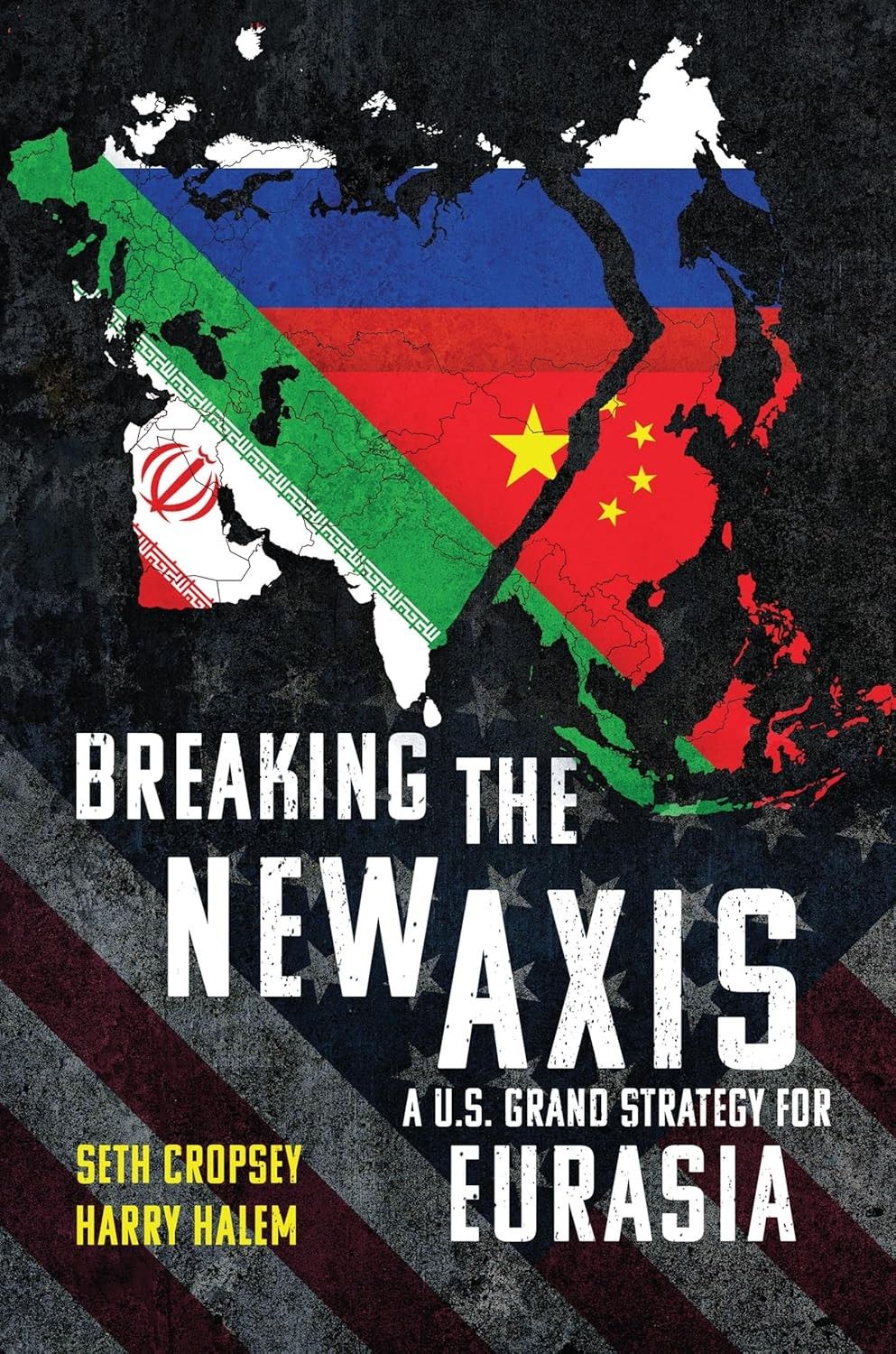


Book Review Breaking the New Axis: A Grand Strategy for Eurasia
By Seth Cropsey and Harry Halem/ Naval Institute Press
Reviewed by: Michael J. Ard
The Reviewer: Michael J. Ard is a former CIA analyst and Deputy National Intelligence Officer for the Western Hemisphere.* Ard is program director for the Master of Science in Intelligence Analysis program at Johns Hopkins University.
How can the United States manage multiple nation-state antagonists and come out on top? In this crisp and compelling analysis, authors Seth Cropsey and Harry Halem, the respective president and senior analyst at the Yorktown Institute, place the geographical focus on Eurasia. Following the influential mid-20th century geostrategist Nicholas J. Spykman, Cropsey and Halem (henceforth, C&H), assert in Breaking the New Axis that the key to shaping the global order will be control of the “rimlands” encircling and bordering on the great Eurasian landmass to prevent its domination by hostile powers. “Eurasia,” they assert, “is the lodestar of American policy.”
The U.S., therefore, must pursue a strategy of shaping events in the key Rimland “regional hinges:” Europe, the Middle East, and East Asian “First Island Chain,” which includes Taiwan. To counter this strategy, we face three “revisionist” powers, China, Iran and Russia, united in their hostility to the U.S., who seek the destruction of our international security system and the domination of Eurasia.
We can confront these threats through “strategic sequencing,” a phrase attributed to historian A. Wess Mitchell. Simply, we take them on, one at a time. But the priority must be Europe and the Middle East first. C&H disagree with the “Asia first” theorists who wish to focus on China. The authors oppose the strategy of both Washington’s foreign policy establishment (“The Blob”) and the Trump Administration and give little weight to Africa or Latin America in their analysis.
To achieve strategic sequencing, C&H urge restoring our maritime superpower status. Controlling the seas is essential for the Rimlands strategy to work. With an impressive grasp of history, the book compares this challenge to that of other great maritime empires, like Venice and Great Britain. Also, we must stabilize a strong system of alliances with rimland capitalist states, like Japan, South Korea, Australia and NATO, which “constitute the lion’s share of global military power.”
As realists, C&H coolly assess the revisionist power threat, which is manageable in part because this aggressive coalition lacks a unifying worldview. Even more crucially, they lack a NATO equivalent. We need to impose costs on these adversaries, like President Reagan in the 1980s forced upon the Soviets.
To counter Russia, C&H reason, we must buttress the Ukraine-Poland relationship and integrate Ukraine into the European security system. Likewise, Iran’s ambitions to impose its will on the Middle East must be rolled back. Our multiple attempts at realignment have eroded our credibility in the region, but we might be restoring that now. Successful offenses against Russia and Iran serve to deter China, they argue.
Which brings us to Taiwan. C&H propose Washington discard the 1972 Shanghai Communiqué, the initial basis for our longstanding “One China” policy. We cannot effectively defend Taiwan while accepting China’s narrative. Taiwan is the most relevant area of Asia, and we must prepare for a protracted conflict. This requires us to employ a multilateral coalition strategy of maritime allies, but cooperation remains uncertain. Meanwhile, we should increase our diplomatic and intelligence presence in Taiwan. Fortunately, China faces great risks in retaking Taiwan or even imposing on it a lengthy blockade.
We must gain enough leverage across Eurasia to make China’s strategic options unpalatable. But C&H provocatively assert that losing Taiwan might not be a decisive defeat for the U.S. after all. We could recover from losing Taiwan if our positions in Europe and the Middle East are secure. Although the authors are averse to accommodating China, under this scenario, détente with Beijing might make sense.
What are our challenges to achieving this Rimlands strategy? C&H argue conventional warfare is our greatest concern. Despite having a 3.5-million-person military and intelligence complex, we are undersized for conventional deterrence. Recent wars in the Middle East suggest that currently the U.S. Navy, although capable, is undersized and spread too thin. C&H urge we develop the training infrastructure for a wartime draft. Moreover, we may have trouble putting a Rimlands strategy into sustained practice. U.S. strategy has been “Balkanized” by our seven geographical Combatant Commands (CoComs), and the Office of the Secretary of Defense is overwhelmed. The U.S. system lacks “a central military mind” that can see the big picture.
Although “Breaking the New Axis” is admirably concise, more discussion would have been welcome on how our allies must contribute to this Rimland strategy and how will the present wars reprioritize our standing with some longtime allies. C&H concentrate on political and military power but neglect how we should use our vast economic and cultural power to greater advantage.
A larger question remains. Is it possible for a divided U.S. and a strained alliance system to sustain a coherent, long-term “Rimlands” strategy? Perhaps a partial answer is coming into focus. In improvisational fashion, we have been pursuing the very strategy C&H elaborate. Despite the indecisiveness of the wars, Russia is stalemated in Ukraine, and Iran has lost significant ground in the Middle East. This leaves China. Have the defeats of his allies caused President Xi Jinping to reassess his Taiwan ambitions? What lessons has he drawn: that Western military technology and prowess has gained the upper hand, or that the U.S.’s risk aversion is too great to expose its Seventh Fleet in the Taiwan Strait?
All statements of fact, opinion, or analysis expressed are those of the author and do not reflect the official positions or views of the US Government. Nothing in the contents should be construed as asserting or implying US Government authentication of information or endorsement of the author’s views.
The Cipher Brief participates in the Amazon Affiliate program and may make a small commission from purchases made via links.
Sign up for our free Undercover newsletter to make sure you stay on top of all of the new releases and expert reviews.
Read more expert-driven national security insights, perspective and analysis in The Cipher Brief because National Security is Everyone’s Business