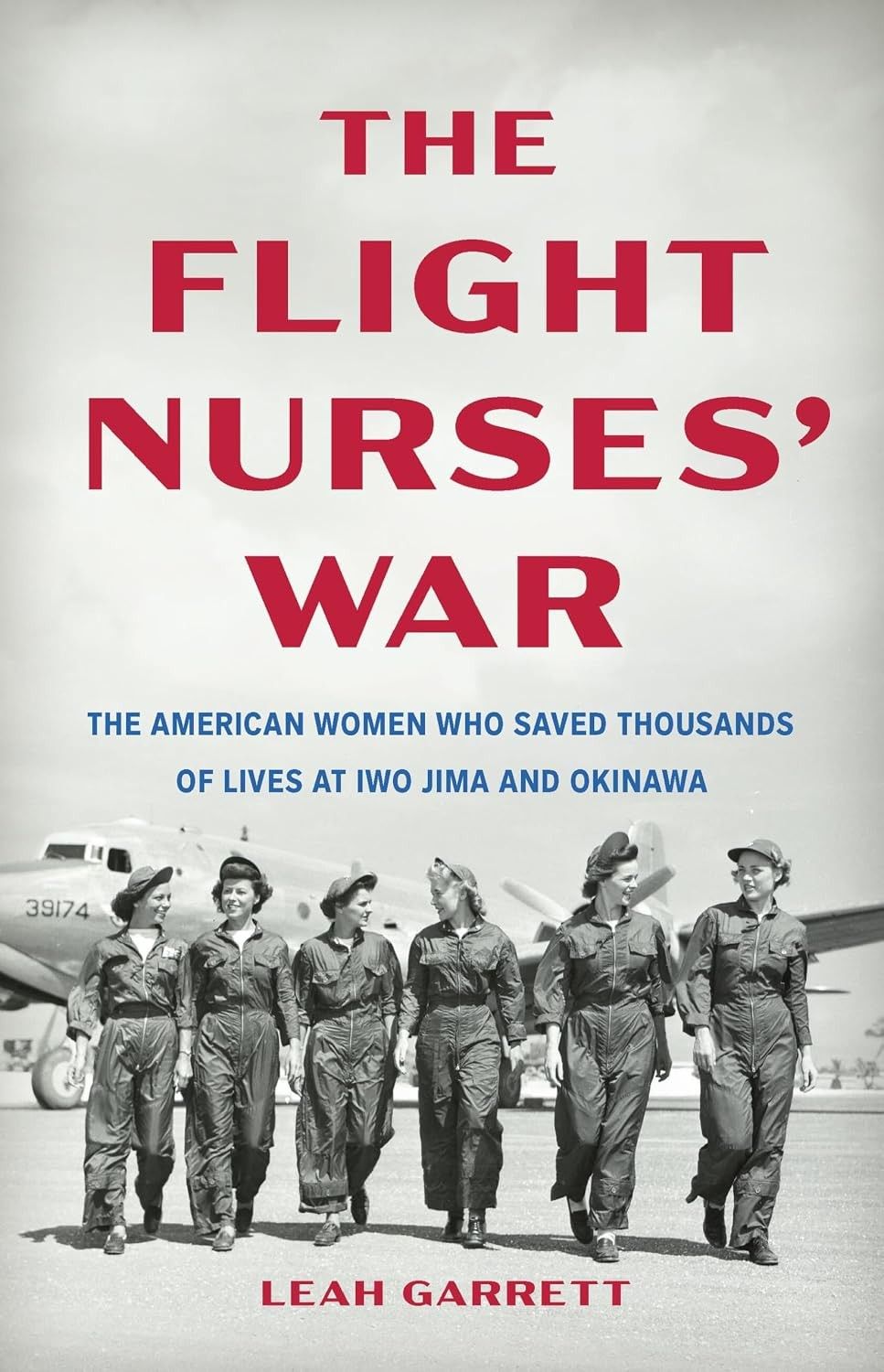

BOOK REVIEW: THE FLIGHT NURSES’ WAR: THE AMERICAN WOMEN WHO SAVED THOUSANDS OF LIVES AT IWO JIMA AND OKINAWA
By Leah Garrett / Seal Press
Reviewed by: Taylor Baldwin Kiland
The Reviewer: Taylor Baldwin Kiland is a writer and ghostwriter specializing in military non-fiction. She has written, co-authored, or edited eighteen books including three about Vietnam POWs, for example Unwavering: The Wives Who Fought to Ensure No Man is Left Behind reviewed in The Cipher Brief in 2023. She is a former naval officer, the third generation in her family to serve in the Navy.
REVIEW: As World War II stretched over increasingly vast distances and the military flew supplies and personnel closer to the front lines, commanders determined that it would be more efficient to send those empty planes back with casualties, especially when ground and sea evacuation routes were difficult and dangerous.
But evacuating patients by air called for nursing and aviation medical expertise on board. Thus, the flight nurse program was born.
Historian Leah Garrett’s book The Flight Nurses’ War focuses on the groundbreaking Navy and Army nurses first deployed as air evacuation nurses to the Pacific, specifically in the protracted battles on the islands of Iwo Jima and Okinawa. It does not tell the story of the Army nurses who were some of the first to evacuate wounded men from the front lines of combat during World War II: in the North Africa campaign and at Normandy. Before that, the military had conducted some limited flights in Alaska, Burma, New Guinea, and Guadalcanal in 1942, and had experimented with evacuating wounded by air in World War I.
Thrown into a rushed training program, the volunteers all hailed from small-town America. Few had traveled outside the United States. Motivated by patriotism and the promise of adventure, these young women were already trained nurses when they arrived for their swearing-in to the Army and Navy officer corps. There, they were put through the paces of learning combat medicine and aviation medicine: providing medical care in high-altitude environments, loading and offloading heavy litters, passing arduous swimming tests, practicing procedures to survive emergency water landings, and working independently to make lifesaving medical decisions for multiple, severely wounded patients.
They were tested for their medical skills, professionalism, and demeanor under stressful conditions, all under the public spotlight. Combat photographers followed them through their training and into combat, chronicling their experience and publicizing their role in newspapers throughout the United States. In effect, they were used as propaganda.
The images of these courageous, young, physically attractive women appearing at the bedside or litter of men who were on the brink of death became iconic and were intended to prop up national morale at a time when the high casualty rates at Iwo Jima were reaching the American public.
Garrett is emphatic that the role of the air evacuation nurses “was crucial in helping America actually win the war: they repaired broken men, kept up morale in the infernos of Okinawa and Iwo Jima, and inspired Americans on the home front to purchase war bonds to support the Pacific campaign even when things were wrapping up in Europe.” The nurses performed all these tasks, but the claim that they were critical to the American victory seems an exaggeration.
Clearly, the women’s lifesaving work was instrumental in the overwhelming success of the new air evacuation program, which radically changed the entire combat medical logistics system. More than 1 million patients were evacuated by air during the war and only 46 died in flight. But the air crews also contributed to this success, as did the doctors, corpsmen, and medics who stabilized the patients prior to the flights, as well as the medical professionals who assisted the nurses on the long, cold, unpressurized flights.
The battles of Iwo Jima and Okinawa were Allied victories, but costly ones, with more than 28,000 Allied casualties at Iwo Jima and more than 75,000 at Okinawa. Garrett makes it clear that the women were girding themselves for a grisly invasion of the mainland of Japan, where they undoubtedly would have been tasked with caring for the estimated hundreds of thousands of casualties. Quoting Navy nurse Norma Harrison: “We knew that if they invaded Japan, we would be going. I was scared, and a lot of us were scared. The fellows were scared to death. You knew it was going to be the bitter end.”
But it was the devastation wreaked by Little Boy and Fat Man at Hiroshima and Nagasaki that prevented that invasion and brought the Japanese to the surrender table.
The bravery of nurses in wartime has often been overlooked or minimized, despite their heroic efforts to care for patients while under incoming fire and enduring deplorable living and working conditions. As Garrett poignantly says, “Traditionally, a nurse embodied the idealized opposite of a soldier. She was a caretaker, he was a fighter; she was dedicated to saving lives, he sought to take them; she was gentle and beautiful, he was tough and strong. The World War II combat nurse, however, lived in both worlds, the battlefield and the hospital. As the war waged all around her, she changed dressings, administered morphine, and cleaned off the mud and blood of horrifically injured young men while whispering gently, ‘It’s going to be all right, son.’”
Nurses have suffered casualties in every war in our nation’s history, and 17 air evacuation nurses died during World War II. Garrett offers rich detail on the lives and experiences of these women who served in the vanguard of this profession, shining a spotlight on this little-known piece of history and ensuring the names Jane Kendeigh Cheverton, Norma Harrison Crotty, Jeanne Doll Dolan, Doris Gardner Howard, Mary Leahy Hudnall, Ora Mae Sorensen Hyatt, Betty Rothenberg Lynch, Kay Pribram, and Evelyn Wisner are not forgotten.
The Cipher Brief participates in the Amazon Affiliate program and may make a small commission from purchases made via links.