
Book Review
American Pogroms: Lessons on Political Violence, State Capacity, and Democratic Resilience
Steven R. Ward
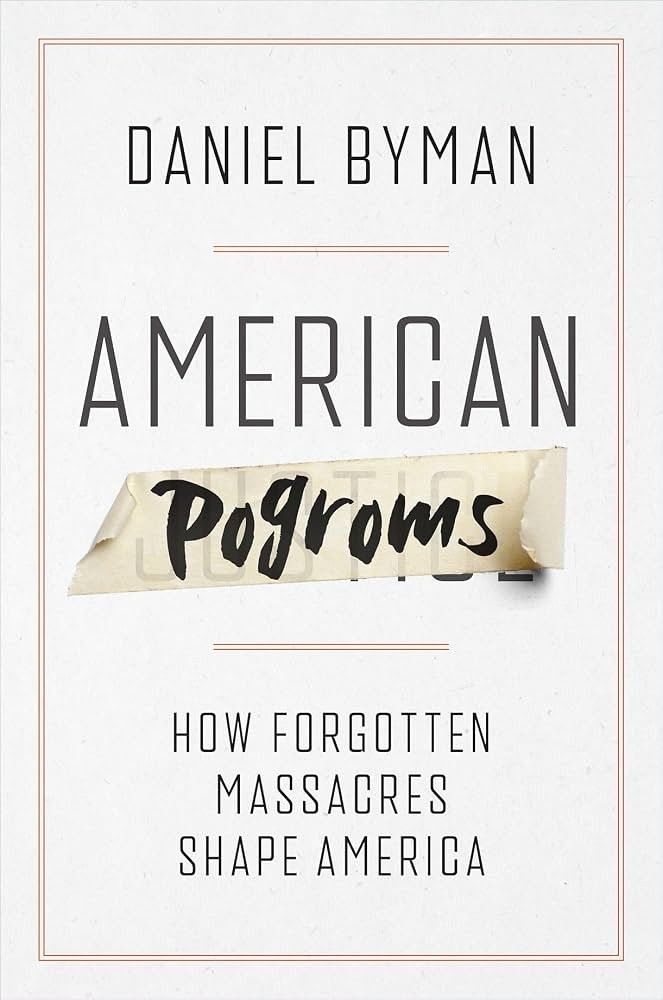
Daniel Byman. American Pogroms: How Forgotten Massacres Shape America. Oxford University Press, 2026.
National security professionals spend much of their careers studying political violence abroad. They analyze insurgencies, ethnic conflict, civil unrest, democratic backsliding, and state failure around the globe. Daniel Byman’s American Pogroms asks readers to perform the far more uncomfortable exercise of applying the same analytical frameworks to the United States. The result is a highly original and timely book.
Byman, a leading scholar of terrorism and political violence, is uniquely qualified for the task. He argues persuasively that episodes of frontier violence, religious persecution, and vigilante justice in American history are better understood through a provocative term normally associated with Tsarist Russia and anti-Jewish violence. As he presents them, these events fit the pattern of “pogroms,” organized campaigns in which elite-led members of a dominant community attack a vulnerable minority to preserve or restore an existing political and social order.
That distinction matters because it shifts attention away from spontaneous public disorder and toward the political and institutional conditions that make organized violence possible. In Byman’s account, pogroms are not irrational explosions of hatred but instruments of social control, political coercion, and democratic exclusion couched in terms of local justice and security. Across nineteenth- and early twentieth-century America, they shared common features: overwhelmingly one-sided violence, victims blamed for provoking it, perpetrators rarely punished, and general success in stalling social change.
The book ranges widely across U.S. history, beginning with anti-Mormon violence and continuing through anti-Catholic riots, anti-Chinese expulsions, anti-Mexican violence, and anti-Black massacres, including the New York Draft Riots of 1863, the overthrow of Reconstruction-era governments, and the 1921 destruction of Tulsa’s “Black Wall Street.” Byman demonstrates remarkable continuity across episodes separated by generations and directed against different oppressed communities. Still, each chapter tells a compelling story, with individual events vivid enough to stand on their own while building a cumulative case.
Byman’s real achievement lies in explaining why this violence occurred so often. The same variables recur: previously subordinate communities appear poised to gain political, economic, or social influence; political and civic leaders frame these developments as existential threats; rumors and conspiracy theories portray minorities as dangerous aggressors; appeals to protect women, religion, or traditional values supply moral cover for coercion; and local law enforcement proves unwilling, unable, or politically reluctant to intervene. Once unleashed, violence develops its own momentum while advancing the objectives of those who encouraged it.
One of Byman’s most important insights is that these pogroms always “revolved around the vital question of who should enjoy the full rights of being an American.” Violence emerged when established communities believed that expanding rights for others threatened their political dominance. Pogroms became mechanisms for determining who could safely vote, hold office, own property, participate in civic life, or even remain in a community.
The discussion of elections is especially compelling. Throughout American history, elections repeatedly served as focal points for communal violence because they made shifts in political power immediate rather than hypothetical. Immigration, emancipation, demographic change, and new voting rights threatened established coalitions, and influential elites sometimes chose intimidation and violence rather than risk losing power through democratic competition.
This observation deserves particular attention today as the United States enters another contentious election cycle. Byman does not argue that history is destined to repeat itself, nor does he indulge in alarmism. Instead, he reminds readers that democratic resilience depends less on the goodwill of political officials than on institutions capable of enforcing the rule of law regardless of circumstance.
That institutional emphasis is another critical insight. Byman argues that the United States largely escaped its history of pogroms not because prejudice disappeared but because institutions improved. Professional police forces, stronger federal authority, independent courts, investigative journalism, civil rights enforcement, and broader conceptions of citizenship raised the political and legal costs of organized violence. The history he recounts is therefore one of inadequate state-building and state capacity as much as racial and religious conflict. He also briefly discusses advances in civil rights, stronger state protection, changing attitudes, and the gradual recovery of the truth about these dark periods in American history.
The book’s final chapters ask whether current safeguards remain sufficient. Byman points to several developments over the past decade that already concern national security professionals: rising political polarization; fragmented media environments in which rumor outpaces verified information; declining trust in public institutions; greater tolerance for political intimidation; and leaders who portray opponents as existential enemies rather than democratic competitors. None guarantees renewed communal violence, but collectively these conditions resemble those that historically made it more likely.
Perhaps the book’s most sobering lesson concerns accountability. Again and again, Byman shows that American pogroms flourished not merely because prejudice existed but because influential leaders believed they would face no consequences for encouraging or tolerating violence. Political elites organized mobs, newspapers legitimized inflammatory narratives, local authorities failed to intervene, and prosecutions seldom followed. Violence became politically profitable because impunity was the norm. As Byman observes, mobs carry out attacks, but elites determine whether violence is encouraged, restrained, or ignored. This lesson is neither partisan nor ideological. Democracies endure only when political leaders accept electoral defeat, the rule of law constrains those tempted to incite violence, and citizens refuse to let fear, rumor, or grievance define who belongs.
That lesson gives American Pogroms significance well beyond historical scholarship. Domestic political violence is not merely a law enforcement problem but a test of state effectiveness. Citizens must demand that leaders at every level possess the capacity and the will to enforce the law impartially, monopolize legitimate force against mobs bent on intimidation, and protect vulnerable citizens during periods of intense political competition. Domestic security depends not only on preventing terrorism or responding to disorder after violence erupts, but also on preserving confidence in elections, maintaining politically neutral law enforcement, resisting elite incitement, and holding those who encourage violence accountable regardless of status or party. History suggests that elections become especially dangerous when influential actors regard losing office as an existential threat rather than an ordinary feature of constitutional government.
More than an excellent history, American Pogroms is a sophisticated study of political violence, democratic resilience, and the foundations of domestic order. Elegantly written, meticulously researched, and analytically rigorous, it deserves a wide readership among policymakers, law enforcement and homeland security leaders, judicial and intelligence professionals, and anyone concerned with safeguarding American democracy. By turning the study of political violence inward, Daniel Byman has produced a book that illuminates neglected chapters of America’s past while offering a timely framework for recognizing—and preventing—the conditions under which they might return.
The Cipher Brief participates in the Amazon Affiliate program and may make a small commission from purchases made via links.