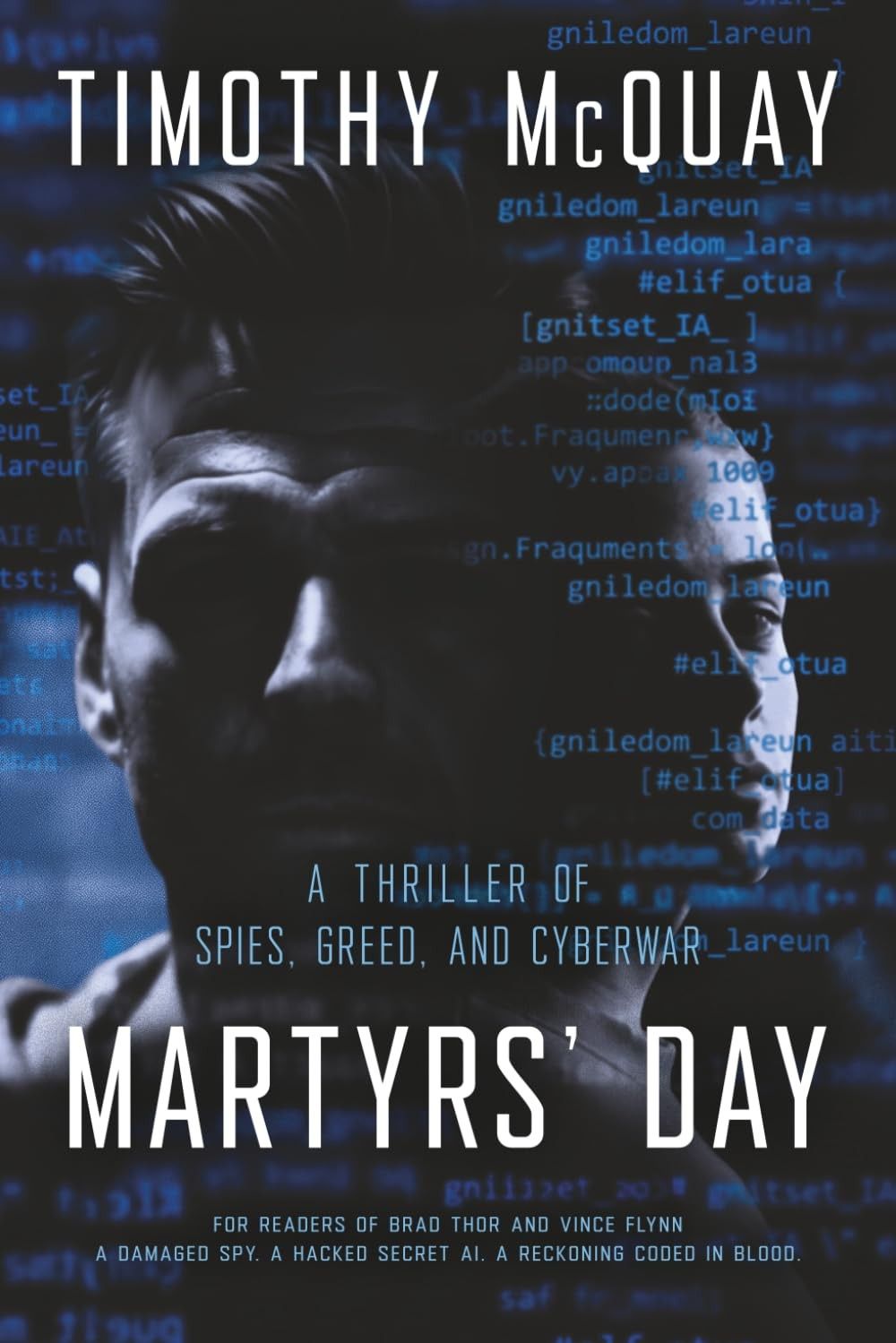

BOOK REVIEW: MARTYRS’ DAY
By Timothy McQuay / Hot Type Publishing LLC
Reviewed by: Dr. David McNamee
The Reviewer — Dr. David McNamee is a retired U.S. Air Force senior SIGINT systems officer and served as an MBA Department Chair and as Associate Dean for Strategic Security Studies. He currently serves as Professor of Leadership with University of Arkansas Grantham, International Faculty with Jesuit Worldwide Learning, and is a Senior Fellow at Co-Serve International. He is also the author of several books on servant leadership and has a debut novel, Echoes of the Gulf.
REVIEW: Martyrs’ Day is a contemporary espionage thriller and the second outing for CIA officer Tom Rivers, following McQuay’s debut, Now They Will Know I Am Here. When a freelance hacker named Bobby DelRay is hired to stress-test a newly installed, supposedly “unhackable” AI system shared by the CIA and Pentagon, she discovers something far worse than a vulnerability: someone has already broken in. Within hours, her girlfriend is murdered by mistake, and Rivers, a battle-scarred officer counting down his last days at the agency, is sent to extract DelRay before she becomes the next target. What begins as a straightforward protection detail widens fast, pulling in Rivers’ partner Raz Jackson (a former CIA officer turned Paris-based security CEO), a billionaire AI mogul with a very personal stake in the cover-up, a Russian financier laundering money for the Kremlin, and eventually a live crisis over Taiwan. The novel moves from Key West to Paris, Rome, Croatia, Dubai, and the Potomac, tracing how a single act of corporate arrogance metastasizes into an international emergency. Without giving away the ending, the book resolves its central mystery, while leaving its characters to reckon with what the mission cost them personally.
McQuay, a longtime journalist, writes with the instincts of a newsroom veteran: short paragraphs, clipped dialogue, and scenes built to end on a hook. That instinct serves the book well in its best stretches. The Key West opening, in particular, is an effective set piece, and the drag-queen-bar escape sequence is the novel’s most purely fun writing. The prose is functional. It moves, and the book rarely stalls.
The book’s main weakness is a lack of restraint. The plot adds one storyline after another: hacked AI, insider trading, Russian money laundering, a father-son betrayal, a billionaire’s blackmail scheme, and a move concerning Taiwan. Characters often arrive at the next plot point because the story needs them there, with little evidence leading them. The AI is the most obvious case in point. At different times it acts as an incomprehensible “hallucinating” system, as a plot device that conveniently holds back or reveals information at the right moment, and by the climax, it has become something resembling an independent actor with a kind of intention. The rules seem inconsistent. There is also a continuity error. The CIA paramilitary officer who is first introduced as “Jack Rojas” reappears later in the book as “Jack Rivas.” A more careful copyedit should have caught this error.
The dialogue is a mixed bag. It’s brisk and often does useful work establishing tradecraft and stakes. Supporting characters, especially the tech billionaire TLong, tend to speak in thesis statements (“There’s a new global order of the accomplished rising”), and Rivers’ internal narration sometimes blurs into the same register as everyone else’s speech. The romance between Rivers and Raz is sincere and the book’s emotional spine. Still, the prose reaches for soap-opera phrasing (“her skin felt silky”) in ways that undercut the harder-edged espionage material around it. There is a lot of violence, including an extended torture sequence involving nails driven through a character’s hand and calf. It is graphic enough to be a sticking point for some readers, even seasoned genre fans.
The tradecraft details, such as Faraday bags, protective custody logic, encrypted comms, and the mechanics of a fentanyl-gas raid, are specific enough to feel grounded, even when the plot around them strains credulity.
The cover copy pitches the book squarely at “fans of Brad Thor and Vince Flynn.” On that promise, the book largely delivers the commercial-thriller experience it’s selling: high body count, globe-trotting set pieces, a ticking-clock geopolitical crisis, and a wounded hero with a redemption arc. It’s a page-turner in the moment-to-moment sense. It’s less successful at sustaining internal logic across 84 short chapters. Readers looking for the “stayed up all night to finish it” immersion of the genre’s best practitioners will notice the seams: engineered plot mechanics, expository dialogue instead of earned discovery, and a climax whose resolution depends on the AI’s capabilities being whatever the scene requires.
This is a book for readers who want a fast, plotty, unapologetically pulpy spy thriller and have a high tolerance for on-page violence. Fans of Brad Thor, Vince Flynn, or Mark Greaney will recognize the terrain at once, including the topical hooks (AI anxiety, billionaire influence, great-power rivalry) layered onto a fairly traditional damaged-operative plot. Readers sensitive to graphic depictions of torture should be forewarned. For its intended audience, commercial thriller readers looking for momentum over polish, it’s a reasonably satisfying, if overstuffed, read.
The Cipher Brief participates in the Amazon Affiliate program and may make a small commission from purchases made via links.