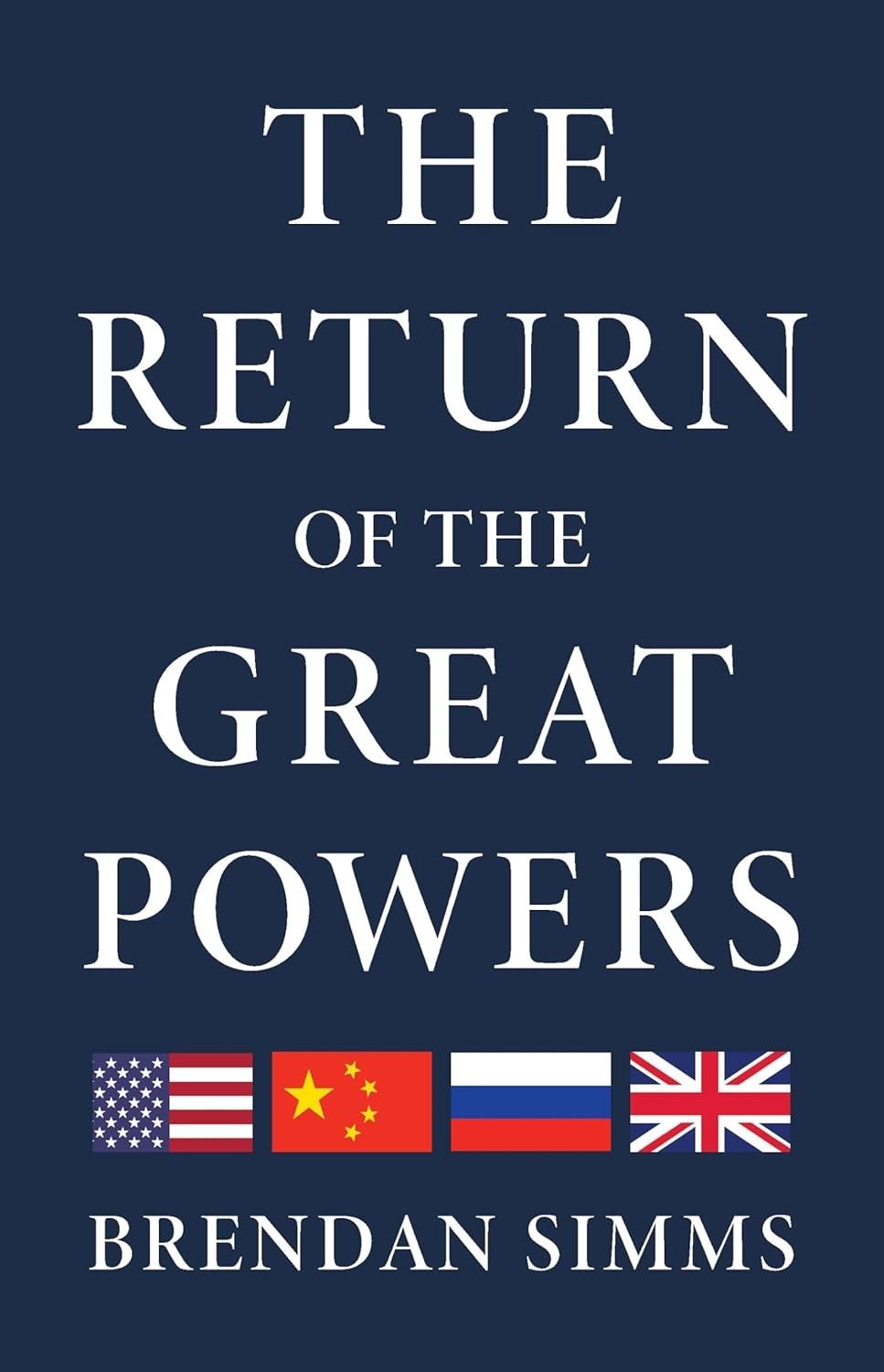


BOOK REVIEW: The Return of Great Powers
By Brendan Simms | Basic Books
REVIEWER: Jean-Thomas Nicole is a Policy Advisor with Public Safety Canada. The opinions expressed are those of the author and do not reflect the official policies or positions of Public Safety Canada or the Canadian government.
REVIEW: Providing a brief introduction to our new great-powers world in its wider historical context, Brendan Simms’s new book, ‘The Return of Great Powers,’ lands an unfashionable, necessary punch: in the real hierarchy of causes, geopolitics has muscled back to the top. The belief that trade ties, treaties, and talk could outrank raw power, he argues, lulled elites from Washington to Brussels to boardrooms into misreading the age—right up to Crimea in 2014 and the full-scale invasion of Ukraine in 2022. “Geopolitics is thus the thing that may kill us before climate change does,” he writes with a historian’s chill.
Brendan Simms is an Irish historian, prolific writer, and Cambridge academic—Professor of the History of International Relations (POLIS) and Fellow of Peterhouse—who founded and directs the university’s Centre for Geopolitics; his work centers on European geopolitics, the German Question, Britain–Europe relations, humanitarian intervention, and Hitler’s worldview.
Beyond academia, he co-founded and has served as president of the Henry Jackson Society (HJS), a UK foreign-policy and national-security think tank founded in 2005 at Cambridge and named after U.S. Senator Henry M. “Scoop” Jackson; HJS advocates a robust, values-led foreign policy to promote liberal democracy, human rights, rule of law, and the market economy, and is variously described by observers as right-wing, neoliberal, or neoconservative.
Simms’s intervention works because it is not only a lament; it is a toolkit. He evaluates states by four practical tests—Resources, Reach, Reputation, Resilience—rather than by GDP league tables or rhetorical flourish. Nuclear weapons still matter (not all nuclear states are Great Powers, but all Great Powers today are nuclear), sea-lane access still matters, and so do stamina and status: “A Great Power is as a Great Power does.”
That framework lets him make a bracing cut of the present. In Simms’s telling there are four real Great Powers now—the United States, the People’s Republic of China, Russia, and the United Kingdom—and a second tier of what he calls “almost” powers: Japan (self-restraint), France (travails), Germany (self-denial), India (stalling), and the European Union (failure to become a power state).
You do not have to agree with every placement to feel the clarity. By his own measures—nuclear deterrent, global basing and alliances, intelligence reach, maritime presence, coalition leadership—Britain still clears the bar more than continental heavyweights that lack either ambition or usable military spine.
The United States remains the yardstick power by resources and reach, even as its politics whipsaw between over- and under-reach. Simms’s account of 2025—a second Trump term that initially rattles allies with tariff shocks and a flirtation with a “great-power cartel,” before market and alliance realities force partial course-corrections—will set op-ed pages alight. You can debate the timbre of the year’s events, but his point is not speculative gossip; it is structural: when the hegemon experiments, every ally recalculates.
China, in Simms’s view, is less “rising” than resuming a status it considers natural. It leveraged globalization masterfully—WTO access, supply-chain centrality, dominance in critical-mineral processing—to build the industrial and technological sinew of power. Yet its assertiveness (from the South China Sea to coercive trade), demographic headwinds, and the West’s slow pivot from efficiency to resilience have made interdependence weaponizable both ways. The Belt and Road, rare earths, and green-tech value chains appear here not as buzzwords, but as state instruments.
Russia is rendered without illusions: smaller than it looks by GDP, tougher than it seems by PPP, energy leverage, and a nuclear arsenal; a coercive, opportunistic actor whose war on Ukraine exposed brittleness yet did not erase reach or resilience. Simms is noticeably clear: sanctions, tech choke points, and battlefield setbacks have hurt Moscow; they have not deleted its great-power status by his four-R test.
The “almost” chapters are worth the price of admission. Japan, after a decade of rearmament and alliance-building, still carries the material strength but not yet the public appetite—or the nuclear deterrent—to close the status gap: “Japan as a Great Power remains very much ‘under reconstruction.’” Germany is the world’s premier geoeconomic power that has preferred a philosophy of self-denial in security; France possesses a nuclear force and global habits but fights travails—from Africa to industrial competitiveness—when measured against systemic ambitions; India is the world’s swing state—civilizational in ambition, impressive in scale, but stalling whenever capacity, cohesion, or hedging collides with strategy. And the EU, the book’s most controversial portrait, is judged an outstanding market power that never made the leap to power state—excellent at rules, slow at force.
Two additional contributions recommend this book to policymakers and CEOs alike. First, Simms shows how history—especially remembered history—anchors choice. Putin’s lectures, Xi’s civilizational narrative, Japan’s pacifist reflex, Germany’s reticence: these are not decor; they are operating systems. Second, he draws a straight line from the “flat world” of just-in-time to today’s chokepoint world: rare earths, semiconductors, undersea cables, straits from Hormuz to Malacca. Globalization did not abolish power; it rearranged it for those who saw the levers early—and it is now being rearranged again under the stress of war, sanctions, export controls, and friend-shoring.
Readers may disagree with the British ranking or want more on non-state actors and big tech. Fair enough. But Simms’s virtue is to force the trade-offs. If you think the EU is a Great Power, do you mean Brussels can mobilize force quickly, sustain losses, and coerce adversaries—or that it regulates platforms brilliantly? If you think Japan has arrived, are you counting budgets or the bomb? If you think India’s century is here, how do you score resilience and reach next to reputation and resources? The four-R test sharpens every loose claim.
The book closes without moralizing, but with urgency. The twenty-year bet on interdependence bought prosperity—and fragility. The next decade will be about repairs: stockpiles and shipyards, alliances and deterrence, redundancy, and resolve. If you work in government, the framework is useful. If you sit on a supply-chain or risk committee, it is indispensable. And if you still hope that “the age of great powers” has passed, Simms offers a curt reminder: even if you are not interested in them, they are interested in you.
The Cipher Brief participates in the Amazon Affiliate program and may make a small commission from purchases made via links.
Sign up for our free Undercover newsletter to make sure you stay on top of all of the new releases and expert reviews.
Read more expert-driven national security insights, perspective and analysis in The Cipher Brief because National Security is Everyone’s Business