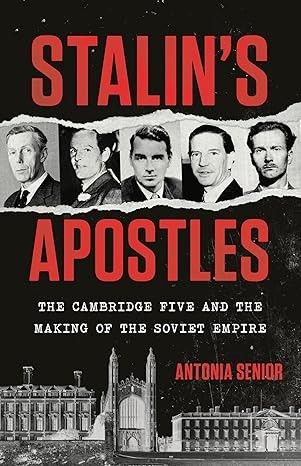


BOOK REVIEW: Stalin’s Apostles: The Cambridge Five and the Making of the Soviet Empire
By Antonia Senior/ Public Affairs
Reviewed by: Nick Fishwick
The Reviewer: Nick Fishwick CMG retired after nearly thirty years in the British Foreign Service. His postings included Lagos, Istanbul and Kabul. His responsibilities in London included director of security and, after returning from Afghanistan in 2007, he served as director for counter-terrorism. His final role was as director general for international operations.
REVIEW: Another book on the Cambridge Five? Do we need this? That was my first thought when picking up Antonia Senior’s “Stalin’s Apostles.”
American readers may welcome a reminder of who the Cambridge Five were. These were men born before the First World War who were recruited by Soviet intelligence in the 1930s. They came from close to the highest reaches of a very class-bound society. They were privately educated, if not at the very elite schools like Eton, and went to Cambridge University. Many were gay, at a time when homosexuality was illegal. Three of them were massive drinkers. They worked inside or close to the heart of the British state: for MI5, MI6, the Foreign Office, the Treasury, Bletchley Park, the BBC, the Times newspaper, even for our late Queen. They were fervent believers in Marx and Stalin. They reported whatever they could to their Soviet case officers. Each traitor was unmasked in his lifetime: three fled to and died in the Soviet Union, the other two died in England. None was prosecuted.
The story has intrigued British spy writers ever since two of the Five, Guy Burgess and Donald Maclean, escaped to Russia in 1952. A third, the former MI6 officer Kim Philby, followed in 1963, two years after MI6 officer George Blake – not one of the Five – was imprisoned for spying for the Soviet Union. In 1964 a fourth of the Five, Sir Anthony Blunt, the Queen’s Surveyor of Pictures, confessed in secret that he had worked for the Soviets. Margaret Thatcher, under pressure, outed him publicly in 1979. John Cairncross, the fifth man, also confessed in secret in 1964.
The themes for some people here are irresistible. The British establishment, convinced of its God-given mission to run and protect the British state, turned out to be full of traitors loyal to its most deadly ideological enemy, the Soviet Union. And the Five were so unusual that the average British person in the street was bound to be intrigued. They were not traitors who kept their heads down, using discreet spycraft to meet their Soviet masters without drawing attention to themselves from the British authorities. Each seems to have simply gathered up all the most sensitive papers he could find, stuffed them in his briefcase, walked out of his office and handed them to his case officer, a KGB illegal. Burgess occasionally spilled his papers onto the floor of a filthy public washroom, whatever he was doing there, en route to the meeting. He was a “character,” hiding in plain sight, known across high political society as an aggressively promiscuous homosexual (in defiance of the law), a drunk, but also a wit and a charmer. Maclean after a few drinks would treat anyone within range to anti-American and pro-Soviet tirades. Philby, when he seemed in danger of exposure in 1955, held a press conference to clear his name (“PHILBY TALKS” – shown at every cinema in Britain). Burgess and Maclean gave MI5 the slip under their noses; MI6 were interrogating Philby in Beirut when he escaped to Moscow. Blunt’s confession to MI5 did not stop him from working for the Queen. Only Cairncross, from a more humble background, kept largely out of the public eye, working as a translator and researcher.
The books about the Five have kept coming. Philby’s autobiography, My Secret War, appeared in 1968. It had a foreword by one of our greatest, if most disreputable, novelists, the former MI6 officer Graham Greene. It was criticized at the time in Britain as a work of Soviet disinformation. Well, what would you expect, the unvarnished truth? This was followed by a less indulgent work, Philby: The Spy Who Betrayed a Generation, by Bruce Page, Philip Knightley and David Leitch. The introduction came from another former MI6 officer, John le Carré. Knightley wrote another book about Philby, partly based on interviews with the traitor shortly before his death in 1988. More recently Richard Davenport-Hines wrote the well-researched and well-argued Enemies Within (2018) about the Five. And Ben Macintyre’s A Spy Among Friends focuses on the relationship between Philby, his CIA friend James Jesus Angleton, and his MI6 friend Nicholas Elliott. There are countless other books, articles, fictionalized films, plays, documentaries and, for all I know, ballets about one or all of the Cambridge Five for those who just can’t get enough.
Why did they do it? How did they get away with it? The answers are supposed to reveal deeper things about Britain, or at any rate the British establishment, and the decline of the British Empire. The unnatural trauma caused by private all-male boarding schools. The cult of “brilliance” over other qualities. The hypocrisy of a repressive ideology when the governing classes were freely breaking the laws against drug-taking and sexual experimentation. How the guardians of their country turned out to be its betrayers. The incompetence or moral corruption of those who sheltered them or failed to expose them.
Personally, I thought I had quite enough about the Cambridge Five. They tell me nothing about the country I grew up in. And the hype starts to get boring. Knightley, having a low opinion of spying as a whole, tried to deflate the importance of what the Five leaked. So what they did didn’t really matter. Davenport-Hines refuted the idea that it was an “establishment conspiracy” that kept Cairncross, Blunt and maybe Philby from prosecution. The reality was that much of the key evidence, from intercepts, could not be revealed in court, and juries were reluctant to convict – whether the accused had been to a posh school or not. So no establishment cover-up or incompetence.
So, do we need another book on the Cambridge Five?
Senior’s book is a fine piece of work. The real strength of the book, which draws on archives not visited by previous Cambridge Five writers, is to show how the betrayals affected the real world. The seedy, rather disturbing lives of these five dysfunctional men are woven into history – history that Senior shows they shaped, to an often breathtaking extent. The Five enabled Stalin to understand the positions of his western allies as they prepared a post-Nazi world in 1943–45; he knew how to exploit the differences between the British and the Americans. They gave Stalin a massive advantage in foiling western attempts to contain Soviet expansion in central and eastern Europe after 1945. They focused Stalin’s attention on the reality of what the western atom bomb could and could not do, and on the imperative need for the Soviets to develop their own. They compromised the so-called special relationship from the start: American readers may wonder whether Washington ever truly forgave London for Burgess, Maclean and Philby.
And as Senior vividly shows, countless European partisans suffered torture and death because of the Five. Encouraged by the CIA, MI6 and others to provide information about and resistance to the Soviet imperialists, some incredibly brave patriots in Poland, Albania, the Baltic states, Ukraine and elsewhere met their end. Their failure meant their countries, already ripped apart by the Nazi wars, had to endure decades more of Soviet oppression. Even now, for Putin, this is unfinished business.
So, a book that focuses not on what frightfully interesting chaps the Five were, nor on the supposed corruption of the British establishment, but on the real impact of their betrayal, is probably a book that we do, after all, need. Still, if I see another book on the Cambridge Five I will scream and run away.
The Cipher Brief participates in the Amazon Affiliate program and may make a small commission from purchases made via links.
Sign up for our free Undercover newsletter to make sure you stay on top of all of the new releases and expert reviews.
Read more expert-driven national security insights, perspective and analysis in The Cipher Brief because National Security is Everyone’s Business