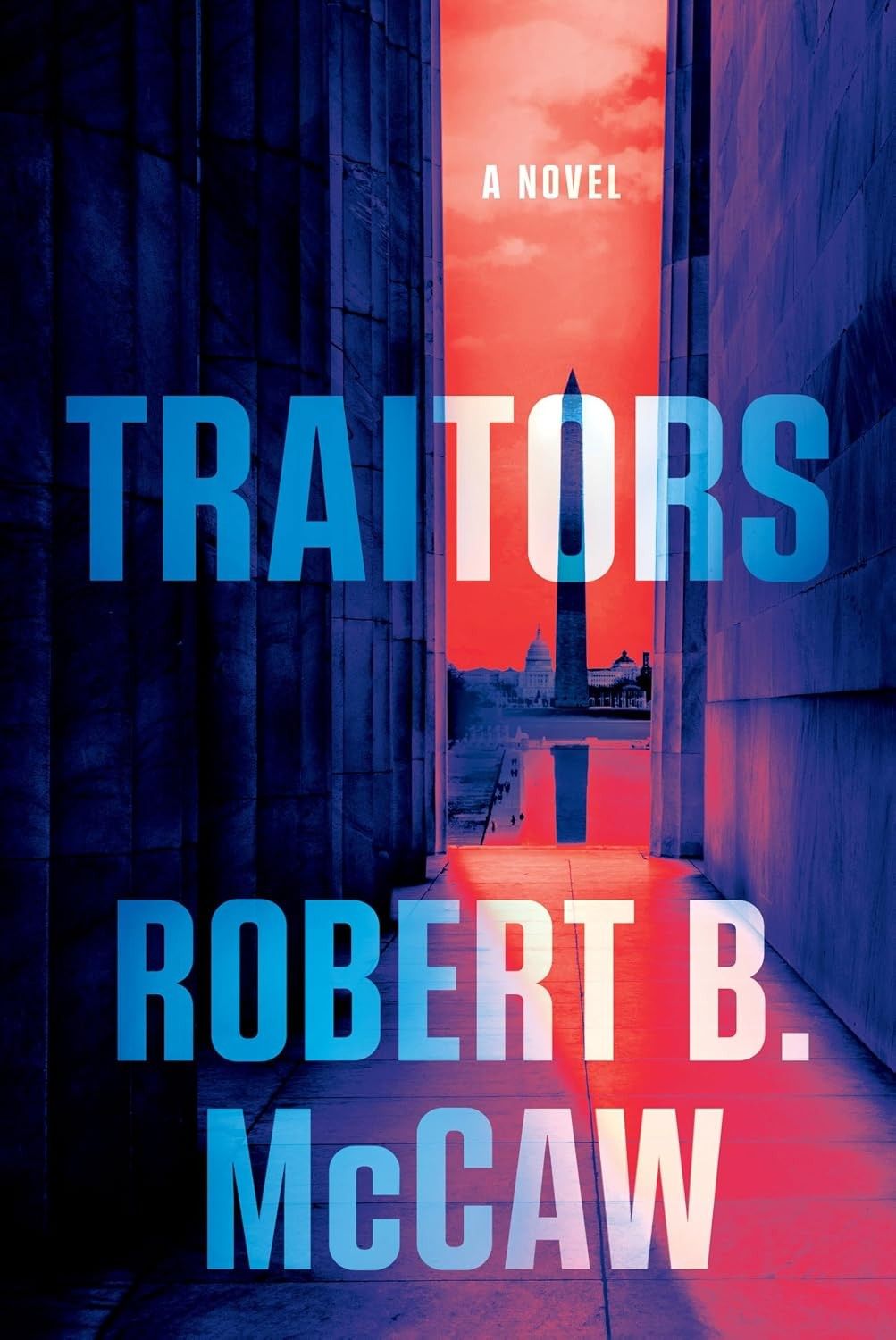

BOOK REVIEW: TRAITORS: A Novel
By Robert B. McCaw /W.W. Norton & Company
Reviewed by Joseph Augustyn
The Reviewer: Joseph Augustyn is a 28-year veteran of the CIA’s Directorate of Operations and once headed the CIA’s National Resettlement Operations Center.
Review: The idea that there is a mole in either the CIA or another agency of the U.S. government has long been a theme of countless spy novels over the years and, to many at least, the storyline has become humdrum and even tiresome. But what if there were five moles? Five Russian agents who have been embedded in the highest levels of the U.S. Government’s national security apparatus? Five moles who have been reporting to, and providing intelligence to their Russian handlers for decades? This scenario not only puts a different spin on a timeworn plot line, but also lends itself to an intriguing, engaging and thought-provoking look into a world that, while not likely, is certainly not impossible in today’s murky world of intelligence and espionage.
Robert McCaw is best known as the author of the Koa Kane Hawaiian Mystery series, a five-book crime fiction compendium featuring a police protagonist with exceptional intellectual and investigative skills working to solve cases amidst the beauty of Hawaii, featuring the state’s history, culture, landscapes and local traditions. So, with his most recent work, Traitors, McCaw has ventured into new territory, producing a credible and gripping account of what is every intelligence officer’s worst nightmare —the discovery of a mole (or in McCaw’s case: five moles) working for the enemy within the sacred halls of government.
What makes McCaw’s Traitors different from other spy novels is that the hero of the story does not work in or occupy a position in the CIA or FBI, but rather in the National Security Division (NSD) of the Department of Justice (DOJ). McCaw, himself a lawyer, focuses his story on Robert Cooper, the Deputy Assistant Attorney General for Counterintelligence in DOJ, a hardworking, dedicated, loyal and, in many ways, nondescript career bureaucrat. Heading the NSD at DOJ is Cooper’s dream job, and he has just been nominated for the position by the Attorney General. But while awaiting Senate confirmation hearings, Cooper’s life is turned upside down when he is approached on a quiet Long Island beach by a would-be Russian defector who feeds Cooper just enough counterintelligence information to rock not only his world, but threaten the security of the United States. As the onion is peeled, we learn that the defector is actually an illegal who, over the past approximate forty years, has penetrated the halls of Congress and is privy to the Russian recruitment and treachery of five senior U.S. Government officials who walk the halls of Congress and the FBI. Not able to trust anyone in the traditional intelligence community chain of command to investigate the presumed betrayals, Cooper goes it alone with the aid of a few trusted DOJ and NSA operatives.
While taking on the Herculean task of ferreting out the traitors, Cooper’s life is further complicated when he is forced to deal with a disgruntled but brilliant colleague who was passed over for the NSD’s top spot and who does her best to sabotage his nomination by besmirching his reputation with the head of the Senate Intelligence Committee. In addition, we learn early-on in the book that Russian President Vladimir Putin has been overthrown in a coup and replaced by a far right general who is poised to invade Finland and possibly use short range nuclear weapons to achieve his goal. This makes the intelligence provided by the defector even more important and puts pressure on Cooper to do everything possible to protect him and unearth the as yet unidentified American turncoats.
While the novel is entitled Traitors, the book focuses most heavily on main character Cooper, who McCaw artfully portrays as a likable, compassionate and sympathetic figure. We feel Cooper’s angst when he discovers his most trusted colleague in DOJ is trying to sabotage his nomination; we feel his sincere concern over the safety and validity of his walk-in; we understand his urgency as he attempts to help thwart the overtures of a mad Russian general intent on invading Finland; and we feel his disgust over the realization that five senior members in the United States government have betrayed their country for decades. We get a glimpse too of Cooper’s personal life, including his evolving relationship with a Georgetown University professor who was introduced to him by Cooper’s doting daughter, a PhD student who thinks her dissertation advisor just might be what her widower father needs in his life.
In part because of McCaw’s legal background, he is convincing in his portrayal of the machinations and inner workings that occur within the halls of the National Security Division of DOJ, and effective when describing the relationship that developed between Cooper and the Attorney General and, by extension, with the U.S. president that grew over time during numerous briefings about the defector and Russia’s threatening potential invasion of Finland. There are intense page-turning moments in McCaw’s book that involve shoot-outs and SWAT-team-like actions carried-out while protecting Cooper’s sleeper agent from the Russians now intent on silencing their double agent. And there are eyebrow raising occasions when we learn that members of the U.S. Congress and senior military officials have been on the Russian payroll for decades. Adding relevancy for today’s political environment, McCaw discusses too how the Russians were attempting to interfere with Congressional elections to ensure the victory of those candidates more sympathetic to their interests.
McCaw is an excellent writer and storyteller, and this reviewer hopes there are more spy thrillers to come. He gets things mostly right when it comes to issues like agent handling and interagency relationships, but I was struck by how little he mentions CIA or the role the Agency could play in providing background on his defector, counterintelligence operational guidance or even bigger picture analysis of what the Russians intentions were vis a vis Finland. McCaw’s rationale for not involving the FBI makes sense given Cooper was aware of a high-level penetration, but Cooper’s reliance almost exclusively on personnel from NSA and a handful of DOJ confidants to conduct surveillance, personal protection and the oversight of the entire counterintelligence operation did not, to this reviewer at least, hold true to reality.
In spite of this, McCaw’s Traitors is a highly entertaining novel that should appease the appetite of those looking for an engrossing and differently approached espionage thriller. Traitors is not a Jason Bourne spy adventure, but rather a thought-provoking story of betrayal that will appeal to, and may even worry, those concerned with the omnipresent specter of foreign intelligence services targeting our government officials and working within our midst to do us harm.
All statements of fact, opinion, or analysis expressed are those of the author and do not reflect the official positions or views of the US Government. Nothing in the contents should be construed as asserting or implying US Government authentication of information or endorsement of the author's views.