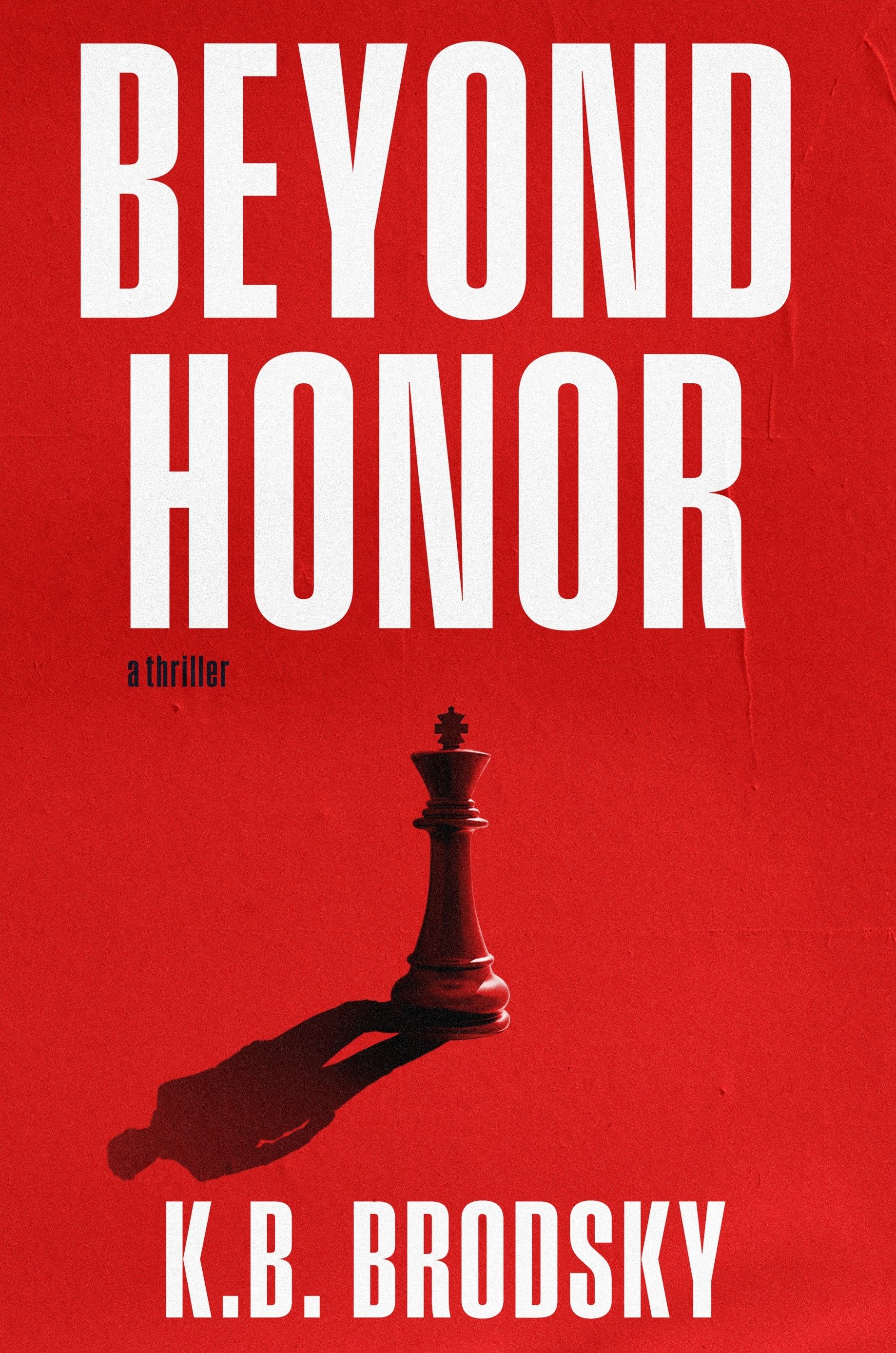

BOOK REVIEW: BEYOND HONOR
By K.B. Brodsky / Atria Emily Bestler Books
Reviewed by: Anne and Jay Gruner
The Reviewers: Anne and Jay Gruner were career CIA officers in analysis and operations, respectively. Formerly Deputy Director of WINPAC and a practicing lawyer, Anne, a Pushcart-nominee, writes poetry, short stories, and creative non-fiction which have appeared in over two dozen print and on-line publications. Jay served as Chief of Station in multiple countries, as an area division chief, and founded J.K. Gruner Associates, a business intelligence consultancy. Anne and Jay live in McLean, Virginia with their two golden retrievers.
REVIEW: "Beyond Honor," by “K.B. Brodsky,” a debut novel by husband and wife team Bill and Karen Brodsky, is an intriguing novel illustrating the lengths a modern day entrepreneur might have to go to maintain his profit. The story combines sexpionage, military special operations, and political fiction in a fast-paced novel that moves around Washington D.C., New York City, and Moscow, with excursions to Iran, Syria, East Berlin, and Siberia. Seemingly unconnected characters come together into a spider web of trouble for a newly elected American president.
The story is triggered in the first chapter when CIA loses contact with Daniel Komoroff, codenamed Python, a CIA officer under non-official cover (NOC) who has been working in Russia as an employee of a Belarus-based financial systems support firm. Komoroff's covert job has been to secretly install cyber spyware into the electronic systems of Russian banks, in particular the OFAC-sanctioned Alta Bank in Moscow, known as Putin's laundromat. The Deputy Director of Operations (DDO) orders the CIA's "operations center" to be "cleared" in order to discuss the cessation of Python's communications. CIA readers will find this venue for such a sensitive discussion implausible since the "ops center," inter alia, continuously monitors worldwide activities, and is never "cleared" and would not be used for such a sensitive discussion. It also is curious that the DDO does not know who the officer is who handles a critical "agent" like Python. The DDO refers to other CIA officers as "agents" and "technicians," which sounds a bit disparaging and might make an informed reader wonder if the DDO is a new political appointee.
Python's sudden curtailment of communications prompts the DDO to ask if Python has defected. The Deputy Director of the Russian desk assures him that is not the case because he personally recruited Komoroff straight out of Yale and had him training in a class at "The Farm" within months of his graduation. Moreover, Komoroff, who grew up speaking Russian in his family, had been posted to U.S. Embassies around the region in Uzbekistan, Kyrgyzstan, Tajikistan and "other stans" to "get his feet wet" before his assignment in Russia.
The conflation of CIA "officer" and "agent" nomenclature and missions, starting in Chapter One, is a fundamental flaw, which along with others permeate the book and form the basis of the plot. With intelligence officers conducting missions more appropriate for agents, the plot resembles that of a TV show rather than a serious espionage novel.
Along the same lines, the tradecraft and overseas activities portrayed by other officers are divorced from reality, such as during a 1986 Cold War flashback, when two female CIA officers using counterfeit West German identity papers drive an East German vehicle through the Berlin Wall checkpoints into East Berlin to meet an agent/asset in a bar. Similar criticism of tradecraft can be levied regarding SVR activities portrayed in the book, including having a high profile undercover SVR officer become the very public girlfriend of the American president's best friend. These reviewers have confidence that British intelligence, when they were asked by the CIA about this alleged British financial expert, would have "outed" the SVR official before things advanced this far. Finally, the "wet work" activity attributed to the SVR in the story is more typically carried out by the GRU and using more subtle techniques.
These are a few of the misconceptions that might bother readers with an intelligence background who are looking to read a realistic spy novel. Readers unfamiliar with operational tradecraft, intelligence nomenclature, rules, and procedures, however, may well be captivated by the unfolding action-packed plot.
Tradecraft aside, the story cleverly integrates paramilitary operations into the plot, such as that of a CIA "direct-action unit" from its Special Activities Division that conducts an Osama bin Laden-type raid 100 miles within Iranian territory to extract the brother of a valuable target who has been funding ISIS. The operation is exciting and well-written though again it is unlikely that CIA uses its own special forces officers in a Delta or Seal-like team, especially on a regular "rinse and repeat" basis to conduct routine extractions and gunfights. The detailed description of the military equipment, helpfully defined in a glossary at the end, may seem excessive to some. It is during this improbable special ops mission that the readers meet the two charismatic main protagonists of the story, Whitney Skyler, a CIA analyst, and Kevin Rhoads, a member of CIA's "Omega" strike force team.
Perhaps more realistic by today's standards, is Peter Michaels, a twice-divorced, over-leveraged real estate developer from New York City who is meeting with a Russian Alta Bank manager in the bar of the National Hotel in Moscow to discuss an $800 million loan he needs to pay off his debt in New York, which no American bank will provide. To Michaels' surprise, a beautiful woman with a British accent shows up and introduces herself as Lillian Montgomery from the UK. The SVR — the Russian civilian foreign intelligence service — has had Michaels under surveillance and arranged for him to meet one of their best "swallows," who is a highly skilled SVR "officer," Anya Pestova. Curiously, Pestova appears to be the same "Anya" mentioned in the book's prologue, whose father was Ilya Magnitsky, a tax lawyer and confidant of Alexei Navalny, both of whom were murdered by the regime. In the prologue, Anya as a teenager in 2011 was strongly anti-Putin and dedicated to opposing him at that time. The subsequent story provides no explanation how or why "Anya" transitioned from a strong-willed regime opponent to a star SVR officer accomplishing nefarious missions on Putin's behalf. Perhaps her story will surface in a sequel. The similarity of the Ilya Magnitsky in the prologue to the real life Sergei Magnitsky, a Russian tax lawyer who exposed Russian corruption and died in custody, may cause some head scratching.
We later learn that Michaels is the best friend of Phil Kemp, a former businessman and current Senator from New York who wears a red tie and blue suit and is running for President on an energy independence, border security, and deregulation platform. This will be plausible and even familiar to many readers. Michaels runs one of Kemp's PACs that provides a significant amount of money to his campaign, which sets the stage for future problems.
The story is easy to read, well written, and moves apace with characters thoughtfully developed, vibrant descriptions, and page-turning action scenes portraying kinetic extractions in Iran and Siberia, and a stake out and pursuit in Damascus. It's refreshing to see a strong role for women intelligence professionals in "Beyond Honor," including Whitney Skyler, an analyst who gets much operational action and opportunity to shine as well as by two senior CIA females, one of whom is a former operations officer and the Director of CIA.
Despite its misunderstanding of CIA functions and operational tradecraft, "Beyond Honor" is a fun read with a surprising ending, which some intelligence officers may find unlikely, if not slightly repugnant. For those who may feel this way, remember it's fiction. And given today's world, many say political fiction has a hard time competing with reality.
The Cipher Brief participates in the Amazon Affiliate program and may make a small commission from purchases made via links.
The views, opinions, and characterizations expressed in this review are those of the reviewers and do not represent the official views, opinions, or positions of the Central Intelligence Agency, any other agency of the U.S. Government, or The Cipher Brief.