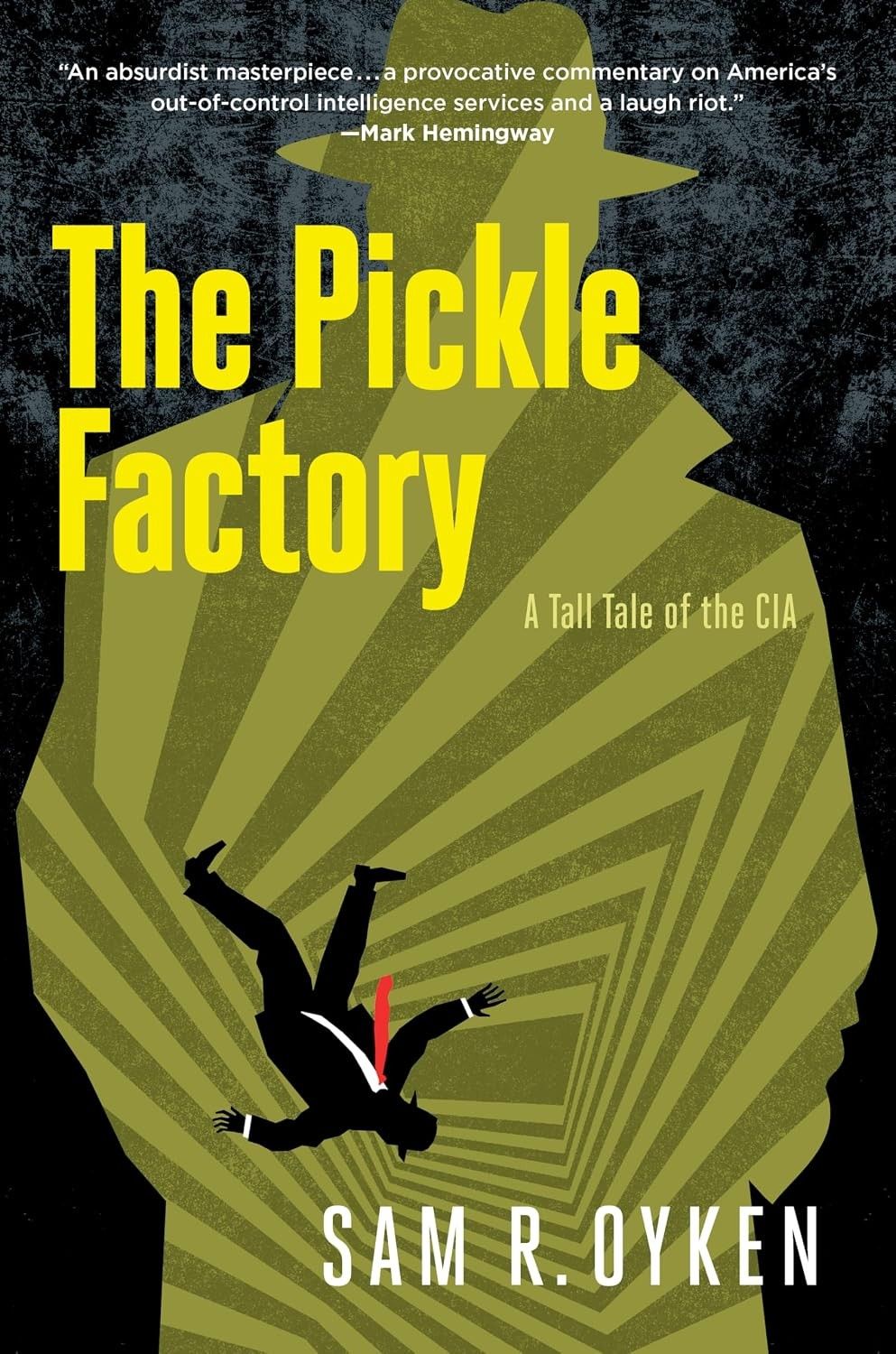

BOOK REVIEW: THE PICKLE FACTORY: A TALL TALE OF THE CIA
By Sam R. Oyken / Ark Press
Reviewed by: Robert Dannenberg
The Reviewer - Rob Dannenberg is a 24-year veteran of the CIA, where he served in several senior leadership positions, including as chief of operations for the Counterterrorism Center, chief of the Central Eurasia Division and chief of the CIA’s Information Operations Center. He is the co-author of “A Spy Walked into a Bar: A Practitioner’s Guide to Cocktail Tradecraft.”
REVIEW: The Pickel Factory is a brilliant and biting work of satire written by someone who has an insider’s eye for the decay that comes to organizations that have lost their mission focus. The novel centers on the transformation of a once-elite intelligence organization into one driven by the bureaucratic imperative to survive in the madness of the DC budget environment. The story is told from the perspective of a non-official cover officer (NOC) temporarily assigned to CIA Headquarters, where he is a bit of a stranger in a strange land.
The author takes us down a rabbit hole in the opening chapter, where he hilariously describes the way Agency pseudonyms, or “funny names,” are created. Sometimes these names really are funny, and they are often a source of amusement in conversation between Agency colleagues.
For readers not familiar with NOCs, these officers operate outside official installations and do not have the direct support structure afforded officers under official cover. To operate successfully as a NOC, one must have a very high tolerance for risk and the wits and skill to operate independently. It is a risky business.
Temporarily assigned to Langley, the novel’s protagonist, Andre B. KRAY, amusingly encounters various “mafias,” including the Marine Corps, “plus size,” “West Virginia,” “the Closet,” “Irish Catholic,” and others. These mafias seem to have the primary mission of protecting and advancing their members and holding back those who are not. Having possibly run into some of those mafias during my career, I think the author describes the phenomenon quite accurately.
More disturbingly, KRAY is exposed to how headquarters has turned into a self-licking ice cream cone where “mafias,” managers, and layer upon layer of administrative, personnel, and human resources officers focus on protecting their space in the budgetary trough, with almost no understanding of the Agency’s mission.
The author’s style reminded this reviewer a bit of Kurt Vonnegut in several of his novels, most particularly Slaughterhouse-Five, and of Joseph Heller’s Catch-22. Oyken takes the reader on an odyssey from Washington to Europe to Asia and describes a bit of operational tradecraft along the way. That adds credibility to a story that would be credible even without it.
KRAY’s headquarters assignment is to take responsibility for a program designed to deploy more operations officers to the field under non-official cover. This seems a worthy program, given the challenges presented today by the pervasive surveillance and internet scrutiny available to internal counterintelligence services focused on officially covered officers.
What our protagonist discovers during his disillusioning interim at headquarters is an organization focused on preserving its budgetary and bureaucratic place in the architecture of Washington. It is led by officers promoted for their success in that arena rather than for their success or experience in actual collection operations in the field.
KRAY reflects on these senior headquarters officers by noting that most of the good ones never come back to headquarters. They stay overseas for years and years. Then the author hits the nail on the head: “Once in a while someone who wants to improve things gives upper management a try, but eventually the bureaucracy either co-opts or crushes them. The bureaucracy is a living thing that protects itself. It’s the ace bureaucrats who rise up in that structure, not the ace collectors.”
The vehicle the author uses to allow KRAY to candidly share some of his experiences with headquarters nonsense is a series of conversations with an experienced officer assigned to headquarters near the end of his career. A chance encounter at Starbucks brings the two together and allows this experienced officer, BUTTONFLY, to shed some light for KRAY on the mysteries of headquarters.
During one Starbucks conversation, KRAY asks BUTTONFLY what can be done to fix the problem. BUTTONFLY’s answer is perfect: “Why, nothing should be done of course. Nothing? That’s right, nothing. Nothing should be done with ninety-three percent of the Agency’s workforce. They should be left in place and allowed to carry on as the big fat government jobs program they’ve become. Let them continue doing whatever it is they do all day long. Maybe eventually a few of the more ambitious ones will jump ship for TSA, and the ones who stay behind can go on rearranging the deck chairs.” The author adds to this critique by paraphrasing President Reagan: our federal bureaucracies are the nearest thing to eternal life we will ever see on this earth.
The author blends history into his narrative in an interesting and informative manner, including quotes from an OSS field manual on covert action tactics for saboteurs inside enemy institutions. These recommendations now seem to be in use against the Agency itself.
THE PICKLE FACTORY is a standalone novel, and you do not need to be a current or former member of the Intelligence Community to enjoy the read. There are certainly parts of the novel that will strike home with former Agency officers. Overall, the author’s points are cleverly presented with humor and some little-known but discoverable facts. This novel might be disillusioning for those who may continue to believe the US Intelligence Community, and the CIA in particular, has somehow resisted the inertia of Washington. But it is a fun and worthy read nonetheless.
The Cipher Brief participates in the Amazon Affiliate program and may make a small commission from purchases made via links.
All statements of fact, opinion, or analysis expressed are those of the author and do not reflect the official positions or views of the US Government. Nothing in the contents should be construed as asserting or implying US Government authentication of information or endorsement of the author’s views.