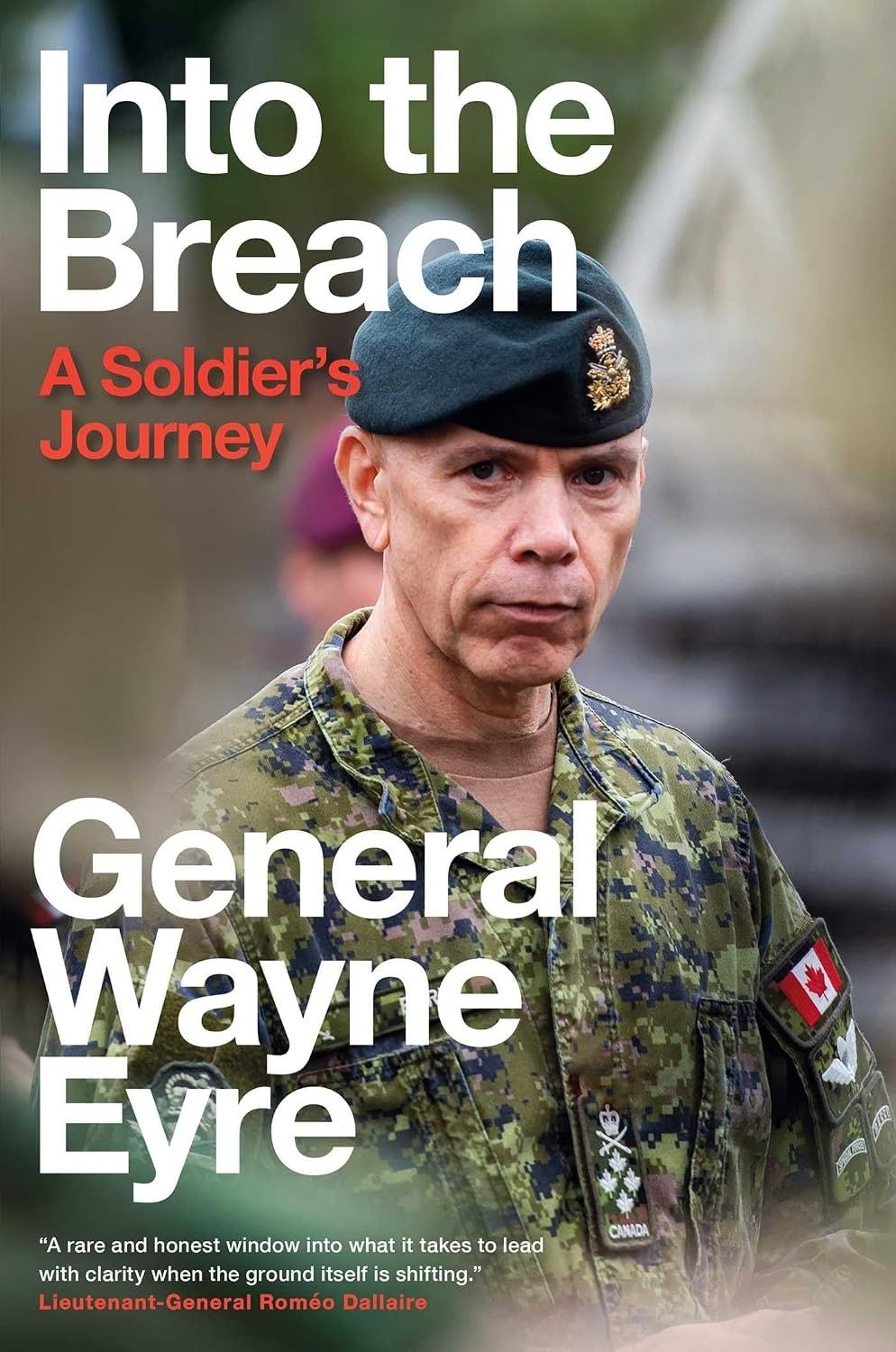

BOOK REVIEW: INTO THE BREACH: A SOLDIER’S JOURNEY
By Wayne Eyre / Simon & Schuster
Reviewed by: Jean-Thomas Nicole
The Reviewer: Jean-Thomas Nicole is a Policy Advisor with Public Safety Canada. The opinions expressed are those of the author and do not reflect the official policies or positions of Public Safety Canada or the Canadian government.
REVIEW: General Wayne Eyre served as Canada’s Chief of the Defence Staff (CDS), the senior uniformed officer of the Canadian Armed Forces, from 2021 until his retirement in 2024. Over a distinguished 40-year career, he held command at every level, from infantry platoon to the Canadian Army, and served operationally in Cyprus, Croatia (including the Battle of Medak Pocket), Bosnia, Afghanistan and South Korea. A graduate of the Royal Military College of Canada, the U.S. Army War College and the U.S. Marine Corps School of Advanced Warfighting, he is now a senior fellow at the University of Ottawa.
In Into the Breach: A Soldier’s Journey, Eyre recounts a career that began in the late Cold War and culminated during a period of overlapping institutional, domestic and international crises:
“A confluence of upheavals, spanning geopolitics, climate change, technological advancement, and societal change would stress the world, our country, and by extension, our military. History will certainly view the unique convergence of stressors in this period as a turning point—to what we do not yet know...”
Organized chronologically until his appointment as CDS, and thematically thereafter, the memoir traces his path from Saskatchewan farm boy and army cadet to Canada’s senior uniformed leader. Its central argument is that Canada has repeatedly relied on highly capable military personnel while chronically failing to give them the resources, support and strategic direction they need.
The book’s six-part structure works well. The early chapters trace the roots of Eyre’s leadership philosophy in rural self-reliance, infantry culture and operational hardship. The final two parts shift from memoir to strategic reflection on the decline of the international order, the changing character of war, Canadian sovereignty and defense procurement.
The strongest operational writing concerns the Balkans and Afghanistan. Eyre’s account of the Medak Pocket, a September 1993 confrontation in Croatia during the breakup of Yugoslavia, conveys the confusion, danger and moral shock of lightly armed peacekeepers confronting forces engaged in ethnic cleansing. It grounds his enduring contention that traditional peacekeeping, dependent on consent and impartiality, fails when belligerents respond only to credible force. The accompanying maps help clarify the tactical movement into the pocket.
His later account of Bosnia shows a different kind of military effectiveness. The removal of the Bosnian Croat 1st Guards Brigade from the town of Drvar illustrates how influence, intelligence and negotiation can translate military presence into political effect without resorting to violence.
Afghanistan is the memoir’s emotional and analytical center. Eyre describes the Operational Mentor and Liaison Team as an improvised organization that trained and advised Afghan forces while accompanying them into combat. He is candid about personnel shortages, confused coalition command arrangements, corruption and the tendency to impose Western organizational structures on Afghan institutions. His doubts about the Afghan National Army’s cohesion, recorded well before its collapse, give these chapters retrospective weight.
Three themes announced in the prologue persist throughout: the quality of Canadian military personnel, Canada’s recurring unpreparedness, and character as the essence of leadership. Eyre argues that Canadian troops succeed through initiative and adaptability. Yet their ability to “make it work” conceals institutional weakness and lets governments sustain commitments without properly resourcing them. The can-do ethos becomes the military’s greatest asset and, at the same time, a way of deferring strategic risk.
His formulation that “character leads, competence follows” is persuasive because it draws on cases ranging from junior leadership under fire to senior-level misconduct. He also acknowledges occasions when he missed signs of harassment or focused too narrowly on the mission, which adds credibility to an otherwise affirmative portrait of military service.
A further strength is the attention to political-military relations. Eyre portrays the CDS as a military adviser and institutional steward who operates under elected civilian authority. His idea of an “unequal dialogue” captures the tension: senior officers must give candid advice, but political leaders decide. His accounts of the truckers’ protest that occupied downtown Ottawa, Haiti, Ukraine and modernization of the North American Aerospace Defense Command (NORAD) show military advice competing with fiscal, diplomatic and electoral considerations.
The chapters covering Eyre’s appointment as Acting CDS are unusually revealing. He inherited a crisis of confidence after allegations against successive senior leaders, while the Canadian Armed Forces were also managing COVID-19, personnel shortages and declining readiness. His “Listen-Learn-Act” framework and the creation of the Chief Professional Conduct and Culture organization show an institution attempting reform under public pressure. His discussion of mistakes, including the controversy over a senior naval leader’s golf game, is candid, if naturally told from his own perspective.
The memoir is especially valuable on the friction between policy ambitions and limited military means. From the Afghanistan and Sudan evacuations to Arctic surveillance and domestic disasters, Eyre stresses readiness, support capabilities and the trade-offs involved in committing limited resources to competing missions. These episodes support his broader claim that a military cannot be treated as an infinitely renewable resource for every national emergency.
The final chapters present a forceful diagnosis of Canada’s security posture. Eyre argues that the international order established after World War II is eroding under pressure from authoritarian states, technological disruption and hybrid threats, and that Canada’s geographic insulation, particularly in the Arctic, can no longer be assumed. His recommended response includes stronger partnerships, continental defense, procurement reform and much larger Regular and Reserve forces.
This section is ambitious but less balanced than the operational memoir. Threats and military deficiencies receive sustained treatment, while fiscal constraints and alternative force designs get less examination. Proposals to expand Canada’s active-duty military to more than 100,000 personnel, build a reserve force of comparable size and consider national service are provocative, but their affordability and political feasibility are not developed in comparable detail.
As an autobiography, the book is necessarily selective. Eyre acknowledges that memory is fallible, that classified material is excluded, and that others may remember events differently. The narrative relies heavily on his journals and rarely places contrary institutional interpretations alongside his own. Government delay is often described convincingly, yet civilian decision-makers’ reasoning is not equally represented.
The book is also long and occasionally repetitive. Readiness shortfalls, bureaucratic friction and the value of relationships recur often, reinforcing the thesis at some cost to momentum. Readers looking primarily for autobiography may find the later turn to policy demanding, while defense-policy readers will consider it the book’s most important contribution.
INTO THE BREACH is nevertheless a significant contribution to Canadian military literature. Senior Canadian commanders have seldom written such comprehensive accounts of operational command, institutional leadership and relations with government. Its greatest value lies in showing how one senior commander understood events, made decisions under uncertainty, and connected tactical experience to national strategy.
The memoir’s most compelling warning is that exceptional personnel cannot indefinitely compensate for inadequate capacity. Even readers who disagree with his prescriptions will find a persuasive case that Canada must align commitments with resources and treat defense preparedness as a continuous national responsibility rather than an episodic reaction to crisis.
Eyre reminds readers that Canadian military history has repeatedly been shaped by inadequate preparedness. The outbreak of World War I in 1914, the start of World War II in 1939, the Korean War in 1950 and the attacks of September 11, 2001, each disrupted periods of inward-looking complacency and compelled Canada to respond to events beyond its borders. At the same time, INTO THE BREACH gives Canadians and their allies ample reason to take pride in the men and women who have served, and in their readiness to stand on guard for their country.
The Cipher Brief participates in the Amazon Affiliate program and may make a small commission from purchases made via links.