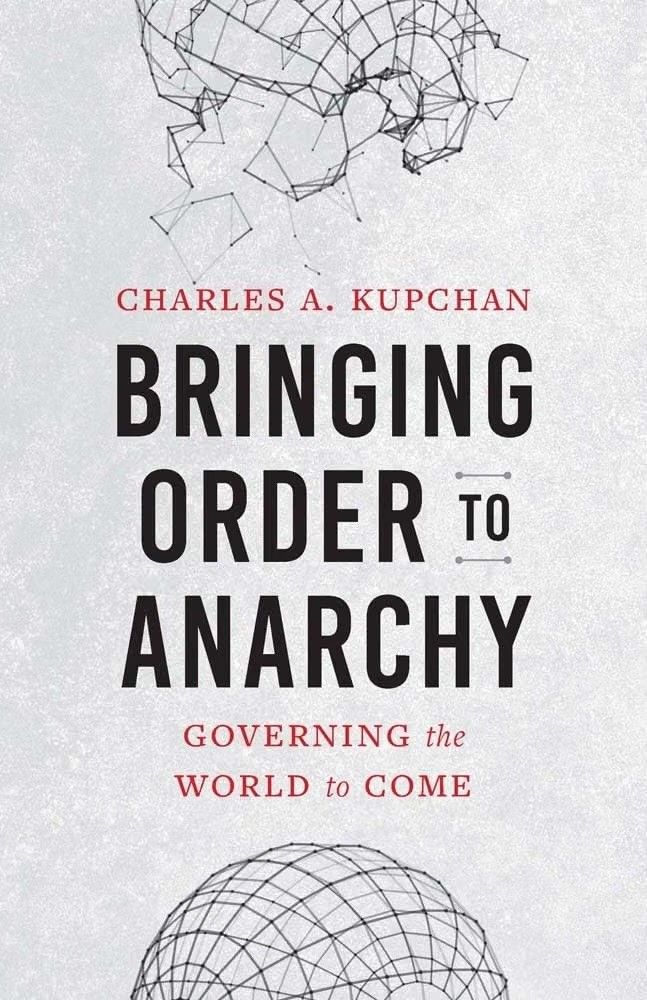

BOOK REVIEW: BRINGING ORDER TO ANARCHY
By Charles A. Kupchan / Yale University Press
Reviewed by: Jean-Thomas Nicole
The Reviewer — Jean-Thomas Nicole is a Policy Advisor with Public Safety Canada. The opinions expressed are those of the author and do not reflect the official policies or positions of Public Safety Canada or the Canadian government.
REVIEW: Charles A. Kupchan is a professor of international affairs at Georgetown University’s Walsh School of Foreign Service and Department of Government, as well as a senior fellow at the Council on Foreign Relations. He served on the U.S. National Security Council as director for European affairs during the first Clinton administration and, from 2014 to 2017, as special assistant to President Barack Obama and senior director for European affairs; he also worked on the State Department’s Policy Planning Staff and previously taught at Princeton University. Educated at Harvard University and Oxford University, Mr. Kupchan has written extensively on international order, American foreign policy, strategic rivalry, and the transition from enmity to stable peace.
Mr. Kupchan’s Bringing Order to Anarchy is an ambitious attempt to formulate a new architecture of international order for an era in which American predominance is receding, democratic governments are under strain, and geopolitical rivalry is intensifying. Kupchan’s central contention is that the post-Cold War liberal order cannot be restored because its material and domestic foundations have eroded. The emerging system will instead be one of “globalized multipolarity”: power will be distributed among several states and regions, even as economic, technological, environmental, and epidemiological interdependence continues to bind them together.
This diagnosis provides the book with considerable analytical power. Kupchan rejects two misleading analogies. The coming world will not resemble the unipolar 1990s because the United States and its allies can no longer set the rules unilaterally. Nor will it reproduce the Cold War’s orderly bipolarity. China and Russia may form the nucleus of an autocratic alignment, but India, Brazil, Indonesia, Saudi Arabia, Turkey, and other influential states will resist incorporation into fixed blocs. Their “multi-alignment” will make international politics more fluid, pluralistic, and difficult to manage. The resulting problem is stark: cooperation is becoming harder precisely when climate change, pandemics, artificial intelligence, nuclear proliferation, and financial instability require more of it.
Kupchan explains this transformation through the interaction of geopolitics and political economy. Globally, power is moving from West to East and from North to South. Domestically, the transition from the industrial to the digital age is weakening the middle classes and political coalitions that sustained postwar democratic internationalism. Automation, trade dislocation, inequality, immigration pressures, and digitally amplified polarization have fragmented democratic societies. In the United States, these structural disruptions were aggravated by what Kupchan calls liberal and strategic overreach: excessive faith in deregulated markets, insufficient protection for displaced workers, expansive democracy promotion, NATO enlargement, and costly interventions in the Middle East.
His treatment of these causes is sweeping and often persuasive, especially when connecting domestic legitimacy to foreign-policy sustainability. Kupchan correctly emphasizes that international orders are not maintained through material power alone. They depend on governments having the resources, public confidence, and political consensus needed to support external commitments. His insistence that American grand strategy cannot be steadier than American democracy is one of the book’s most valuable observations.
The institutional remedy is the book’s most original contribution. Kupchan advocates a polycentric order in which stronger regional organizations provide governance from below, while a new Global Concert provides coordination from above. Inspired by the nineteenth-century Concert of Europe, this informal steering group would initially include the United States, European Union, China, Russia, India, and Japan, alongside representatives of ASEAN, the African Union, the Arab League, and the Organization of American States. It would complement rather than replace the United Nations, using private and continuous consultation to develop consensus that existing institutions could implement. Specialized “subconcerts” would address strategic stability, trade, climate, technology, public health, and human development.
This proposal has genuine merits. Informal, small-group diplomacy can be more flexible than treaty-based institutions and more effective than occasional summits. Kupchan also recognizes that legitimacy in a multipolar system requires giving emerging states and regions a meaningful voice. His distinction between “thick” regional orders and a “thin” global order is particularly useful: states may disagree profoundly about domestic governance while still observing minimum rules of coexistence and cooperating on common threats.
Yet the proposal raises difficulties that the book does not fully resolve. The Concert of Europe rested on a limited number of states, an elite diplomatic culture, and a partial acceptance of territorial arrangements established after a decisive war. Today’s system is vastly larger, more ideologically diverse, and penetrated by public opinion, transnational commerce, nonstate actors, and instantaneous communications. Informality may facilitate negotiation, but it also reduces transparency, accountability, and enforcement. A Concert powerful enough to guide the United Nations could look to excluded states like an oligarchy of major powers; one restrained enough to remain merely consultative might produce little beyond dialogue.
A second problem concerns spheres of influence. Kupchan’s regionalism realistically acknowledges that powerful states seek deference in their neighborhoods. Nevertheless, treating such spheres as stabilizing can compromise the sovereignty of smaller countries. His arguments about NATO enlargement and Ukraine illustrate the danger. Kupchan convincingly shows that Russia perceived NATO’s expansion as threatening, but accommodating a great power’s declared security interests can allow coercion to determine the strategic choices of neighboring states. The book needs a clearer criterion for distinguishing legitimate accommodation from the normalization of aggression.
Kupchan is likewise right that democracies and autocracies must cooperate, but the proposed separation of domestic governance from international diplomacy is harder to sustain than he admits. Repression, disinformation, corruption, refugee movements, and technological surveillance frequently cross borders. A regime’s domestic conduct can directly shape its external behavior. Ideological pluralism may therefore be necessary for coexistence, but it cannot render political values geopolitically irrelevant.
The final portion turns to American renewal. Kupchan proposes rebuilding the middle class, investing in education and infrastructure, reforming immigration, restoring fiscal sustainability, strengthening civic education, encouraging national service, curbing gerrymandering, and reforming campaign finance. These recommendations reinforce his essential point that domestic renewal and international leadership are inseparable. However, the breadth of this agenda occasionally makes the book feel like several books compressed into one. The transition from international theory to detailed prescriptions on taxation, schooling, immigration enforcement, and voting procedures weakens the otherwise disciplined focus on global order.
Overall, Bringing Order to Anarchy is a bold and intellectually serious work. Its historical analogies are debatable, and its Global Concert may underestimate problems of legitimacy, enforcement, and asymmetric power. Nevertheless, Kupchan succeeds in the more fundamental task of forcing readers beyond sterile choices between restoring American hegemony and accepting unmanaged rivalry. His proposed architecture may not be the definitive answer, but it supplies a coherent foundation for the urgently needed debate over how pluralism, regional autonomy, and great-power cooperation might coexist in an interdependent multipolar world.
The Cipher Brief participates in the Amazon Affiliate program and may make a small commission from purchases made via links.