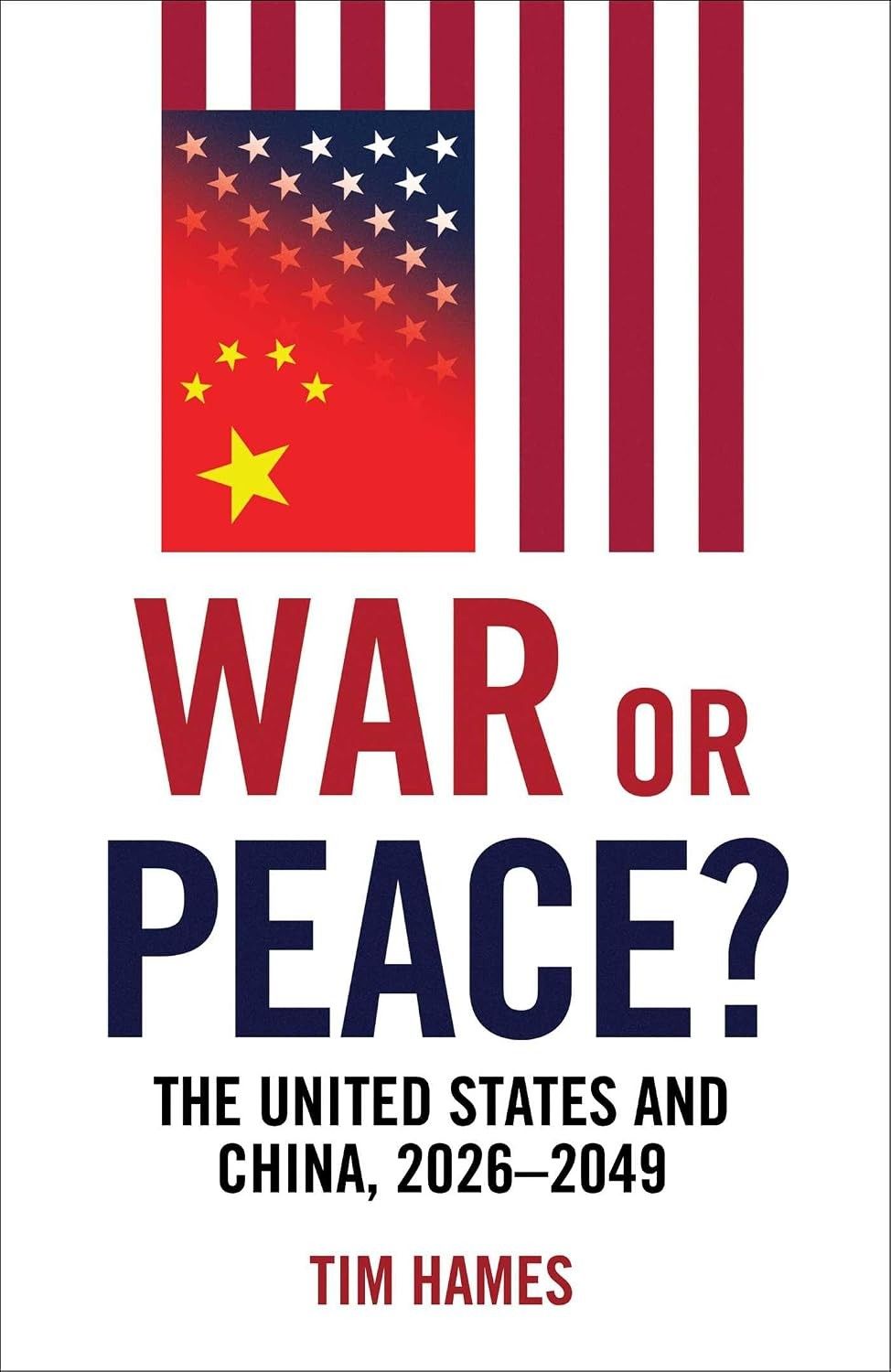

BOOK REVIEW: WAR OR PEACE? THE UNITED STATES AND CHINA, 2026–2049
By Tim Hames / Oneworld Publications
Reviewed by: Jean-Thomas Nicole
The Reviewer — Jean-Thomas Nicole is a Policy Advisor with Public Safety Canada. The opinions expressed are those of the author and do not reflect the official policies or positions of Public Safety Canada or the Canadian government.
REVIEW: In War or Peace?, Tim Hames examines what may become the defining international relationship of the next quarter-century: the rivalry between the United States and China. His central argument is clear and deliberately contrarian. Despite mounting competition and frequent predictions of conflict, Hames argues that the two powers are not “destined for war.” In his view, the much-discussed “Thucydides Trap” is a potentially dangerous intellectual framework. It could become self-fulfilling if political leaders mistake analogy for destiny.
Hames, a former Oxford politics lecturer and chief editorial writer for The Times, now works as a geopolitical adviser in London.
He begins by contrasting the historical identities of the two countries. China understands itself as the custodian of an ancient and continuous civilization. Its outlook has been shaped by foreign intervention, the “Century of Humiliation,” and the Communist Party’s claim that only it can guarantee national unity.
The United States, by contrast, sees itself as an idea as much as a country. Its identity rests on liberty and constitutional government, along with a long-running debate over whether American values should be protected at home or promoted abroad. Hames describes these competing tendencies as “monastic” and “missionary.”
This historical comparison is one of the book’s most useful features. It explains why Washington and Beijing can interpret the same action in fundamentally different ways. Washington may present its criticism as the defense of universal principles, while Beijing sees another instance of foreign interference.
The book traces the uneven history of US-China relations from early commercial contacts through the Nixon opening and decades of engagement. For much of the period following Deng Xiaoping’s reforms, American policymakers assumed that China’s integration into the global economy would gradually encourage political liberalization.
That assumption faded as Xi Jinping consolidated power, tightened Party control over the economy, and adopted a more assertive international posture. In response, bipartisan opinion in Washington shifted from engagement toward strategic competition.
Hames examines this evolution through three influential theories. Seymour Martin Lipset represents the belief that economic development encourages democracy. Paul Kennedy supplies the theory that great powers decline through overstretch. Graham Allison provides the “Thucydides Trap,” the thesis that tension between a rising and an established power frequently leads to war. Hames finds insights in all three but rejects their use as deterministic formulas.
Paired chapters examine how Xi and Donald Trump transformed their respective political systems. Xi centralized authority, revived Marxist-Leninist ideology, and abandoned Deng’s comparatively restrained foreign policy. Trump reshaped the Republican Party around “America First,” tariffs, and skepticism toward alliances.
The comparison is illuminating but imperfect. Both leaders challenged inherited orthodoxies. Xi, however, operates within a Leninist party-state, while Trump remains constrained by elections, Congress, and the courts. The parallel helps explain the two leaders’ disruptive effects without making their positions equivalent.
The demographic chapters contain some of the book’s strongest analysis. China faces population decline, extremely low fertility, and rapid aging. These trends will raise the cost of pensions and healthcare while potentially reducing the resources available for military expansion. Hames argues that China may eventually need something resembling a social-democratic welfare settlement.
The United States also faces an aging population and below-replacement fertility, but immigration gives it an adjustment mechanism unavailable to China. America’s demographic problems are therefore evolutionary rather than revolutionary.
Hames is similarly optimistic about the American economy, citing its productivity, deep capital markets, and the dollar’s reserve status. China remains an economic giant, but it must confront inefficient state-owned enterprises, a fragile property sector, and high debt.
This analysis effectively challenges assumptions of inevitable Chinese economic supremacy. It is also lopsided. American fiscal pressures and political resistance to immigration receive far less scrutiny than China’s structural weaknesses.
Hames regards a full-scale Chinese invasion of Taiwan as exceptionally difficult and strategically irrational. Mobilization would be highly visible, the Taiwan Strait is a formidable obstacle, and Taiwan’s geography favors the defender. American and possibly Japanese intervention would raise the risks further.
More plausible is what Hames calls a “tepid war”: military exercises, maritime pressure, or limited blockade measures intended to deter Taiwan from formally declaring independence. This distinction between invasion and coercion is analytically valuable.
The chapter is less convincing when it treats some forms of conflict as impossible. Maritime accidents, cyber operations, and uncontrolled escalation could produce a confrontation that neither side intended. Indeed, the book’s later emphasis on accidental conflict sits uneasily with its categorical military conclusions.
The book persuasively argues that advanced technology, more than conventional military power, is the central arena of competition. Hames explains how American export controls and the CHIPS and Science Act seek to restrict China’s access to advanced semiconductors. China’s advances in artificial intelligence, particularly DeepSeek, show that restrictions can also spur improvisation and efficiency.
One of the book’s most interesting distinctions is that the United States may seek AI “superintelligence,” while China may prioritize “super application,” meaning the rapid adoption of cheaper AI throughout its economy. If so, technological competition may not produce a single winner. Each country could lead by a different measure of success.
Hames concludes with an ambitious program for managing competition. His proposals include annual informal leadership summits, a permanent US-China Cooperation Council, expanded academic exchanges, and urgent cooperation on AI governance. He also recommends giving China greater representation in institutions such as the G7 and the IMF.
Some proposals would be difficult to implement. Expanding the G7 to include China would fundamentally change the organization’s identity, and academic exchanges would need to address research security. Still, Hames deserves credit for going beyond diagnosis. His recommendations reflect the book’s essential insight: peace will not organize itself.
War or Peace? is an ambitious, readable, and provocative synthesis. Its breadth is impressive, particularly in connecting demography and technology to international power. The book sometimes repeats its main conclusions and presents uncertain forecasts with excessive confidence. It also tends to treat American vulnerabilities as manageable while portraying Chinese weaknesses as structural. These flaws do not undermine its principal achievement.
Hames convincingly shows that rivalry does not make war inevitable. Washington and Beijing are different societies confronting different domestic pressures, and neither the Sparta-Athens analogy nor the US-Soviet Cold War fully captures their contest. Their most realistic objective is disciplined, institutionally managed competition. The book’s closing appeal to “Aristotle’s Answer” carries its central message: organizing a durable peace matters more than winning a confrontation. It is a persuasive and timely contribution to the debate over the future of US-China relations.
The Cipher Brief participates in the Amazon Affiliate program and may make a small commission from purchases made via links.