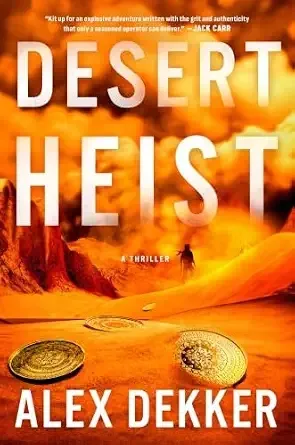

BOOK REVIEW: Desert Heist: A Thriller
By Alex Dekker/Atria/Emily Bestler Books
Reviewed by Kenneth Dekleva
The Reviewer — Dr. Kenneth Dekleva served as a Regional Medical Officer/Psychiatrist with the U.S. Dept. of State from 2002-2016 and is currently the CEO of Blackwood Advisory Solutions LLC and Professor of Psychiatry, UT Southwestern Medical Center, Dallas, TX. He is also the author of The Negotiator’s Cross, The Last Violinist, The Russian Diplomat’s Wife, and The Expediter. The views expressed are entirely his own and do not represent the views of the U.S. Government, the U.S. Dept. of State, or UT Southwestern Medical Center.
REVIEW — Alex Dekker is a novelist and former American special forces Green Beret veteran, who served extensively in the Middle East during the Global War on Terror, and whose excellent debut thriller, Desert Heist, paints a complex portrait of his protagonist Nate Wilde, a scholar-warrior, Arabist, and adventurer in the mold of his hero, the legendary T.E. Lawrence of Arabia.
In his brilliant, sensitive, Pulitzer Prize-winning biography of T.E. Lawrence, A Prince of Our Disorder: The Life of T.E. Lawrence, the late psychiatrist Dr. John Mack wrote about “Lawrence’s place among our evolving definitions of political responsibility,” and that his fate “can be seen as a contemporary version of what is likely to befall a person who takes exaggerated individual moral responsibility in a turbulent political arena.” Alex Dekker’s protagonist, Nate Wilde, would clearly resonate with such a sentiment.
This thriller begins with tragedy, in which Nate’s Green Beret team, a tightly bound group of eccentric, intelligent warriors, is ambushed by terrorists in Yemen, and suffers grievous losses, which haunt each of them years later. Fast forward a few years later, Nate finds himself a graduate student at Harvard, defending a thesis proposal in which he desires to search for, and uncover, the lost mythical city of Ubar in the Empty Quarter of the Arabian Desert. The rejection of his thesis proposal does not deter Nate, who like his hero Lawrence, had written in The Seven Pillars of Wisdom, that “the self-immolated victim took for his own the gift of sacrifice.”
In the novel’s initial chapters, Dekker’s protagonist Nate – drawing upon The Thousand and One Nights, as well as the writings of Lawrence, Harry St. John Philby, Bertram Thomas, and others (the ghost of the famed British explorer Wilfred Thesiger also comes to mind) – doggedly pursues his dream, and refuses to give up his search for the lost city of Ubar. His search takes him afar, to the halls of Cambridge and the Royal Geographical Society. And during this search, other mysteries, maps, satellite photos, tripwires, and deaths intrude. A prominent UN hydrologist goes missing, and his daughter, Egyptian-born UN geologist Ana Metry, embarks on her own journey. In this part of Dekker’s tale, the tension builds as other evil forces intrude, for Ubar is about water – the Middle East’s ‘new oil’ – as much as history. Nate’s quest draws the attention of Novikov, a former Russian Spetsnaz officer and free-lancer, who has other, darker motives.
This part of the plot reunites Nate’s team in his quixotic journey, and highlights the unique bonds of service, loyalty, and brotherhood that exist among special forces members. Like Nate, they (including a colorful British former SAS medic) are pulled along by an undertow of adventure, loyalty, and their own unresolved personal tragedies. Dekker handles this part of the story well, and it moves propulsively as Ana Metry’s path converges with the team’s own. There is a love story thrown in for good measure. Once the team lands in Yemen, and crosses into Saudi Arabia’s Empty Quarter, the novel becomes a pure, enjoyable action thriller.
The novel’s conclusion is fitting and well-earned, and best left for readers to discover for themselves. But Dekker’s fine debut thriller does one other thing. In paying homage to Lawrence, Philby, and others, he reminds us, as written about in Robert Kaplan’s The Arabists: The Romance of an American Elite, and James Stejskal’s Masters of Mayhem: Lawrence of Arabia and the British Military Mission to the Hejaz, that our fellow Brits were the first, and ultimate Arabists, a part of the ‘Great Game’ which America arrived late to. But that’s another story, which Alex Dekker and Nate Wilde would surely appreciate. Hopefully there will be more such tales of Nate’s further adventures in novels to come.
The Cipher Brief participates in the Amazon Affiliate program and may make a small commission from purchases made via links.