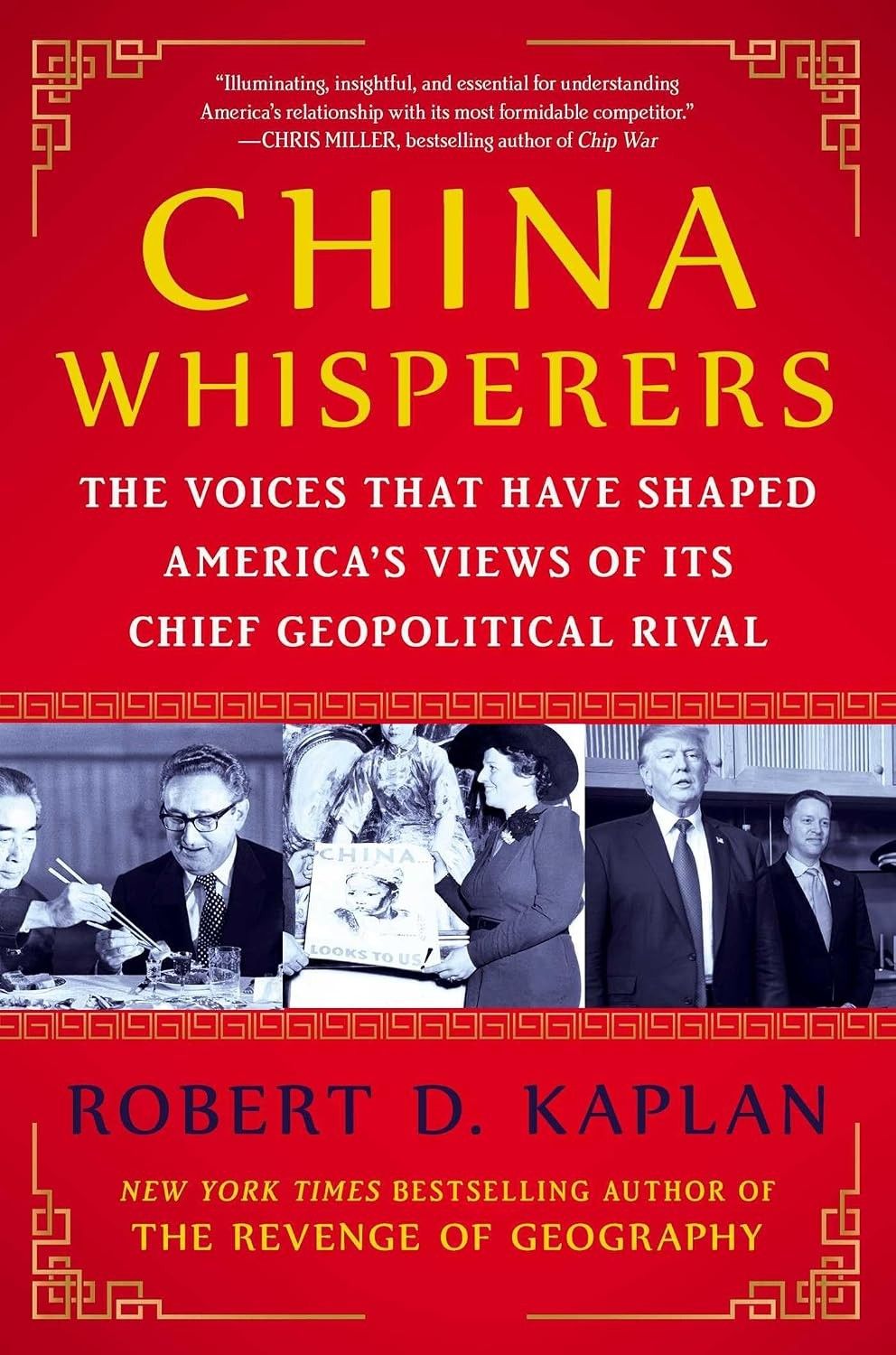

BOOK REVIEW: CHINA WHISPERERS: THE VOICES THAT HAVE SHAPED AMERICA’S VIEWS OF ITS CHIEF GEOPOLITICAL RIVAL
By Robert D. Kaplan / Scribner
Reviewed by: Jean-Thomas Nicole
The Reviewer — Jean-Thomas Nicole is a Policy Advisor with Public Safety Canada. The opinions expressed are those of the author and do not reflect the official policies or positions of Public Safety Canada or the Canadian government.
REVIEW: Robert D. Kaplan is an American author, foreign correspondent, and geopolitical analyst whose work combines history, geography, travel, and international affairs. He reported on foreign affairs for The Atlantic for three decades, served on the Pentagon’s Defense Policy Board and the U.S. Navy’s Executive Panel, and is a distinguished senior lecturer at the University of Texas at Austin. He is the author of twenty-four books, including Balkan Ghosts, The Coming Anarchy, The Revenge of Geography, Asia’s Cauldron, The Loom of Time, The Tragic Mind, and Waste Land.
In China Whisperers: The Voices That Have Shaped America’s Views of Its Chief Geopolitical Rival, Kaplan offers a sweeping intellectual history of the Americans who tried to interpret China for policymakers and the public. His subjects include missionaries, diplomats, journalists, historians, linguists, and contemporary policy specialists. His central argument is that sound China policy depends on people capable of combining linguistic and cultural immersion with strategic judgment. Yet such expertise is frequently distorted by emotional attachment, ideological fashion, bureaucratic politics, and Washington’s recurring belief that the United States can remake China.
Kaplan begins with former ambassador J. Stapleton Roy, presented as perhaps the last traditional “China hand.” Raised partly in China, fluent in Mandarin, and later exposed to Soviet communism, Roy represents Kaplan’s ideal analyst: someone with deep regional knowledge, comparative experience, emotional discipline, and a firm grasp of American domestic constraints. Roy’s central warning also provides the book’s policy framework. The United States must balance against Chinese power without becoming culturally blind, ideologically rigid, or reckless enough to stumble into war.
The book then moves through a gallery of interpreters. Owen Lattimore understood China through geography, frontier societies, and arduous travel across Inner Asia. Pearl S. Buck humanized Chinese rural life for American readers, while George Kates immersed himself in the aesthetics and social customs of old Beijing. John King Fairbank helped establish China studies as an American academic discipline, though Kaplan criticizes his overly benign interpretation of Maoism. These portraits establish the book’s recurring insight: proximity produces indispensable knowledge, but attachment to a country or privileged access to its rulers can also compromise judgment.
That tension reaches its clearest expression in Kaplan’s treatment of Edgar Snow. Snow’s access to Mao Zedong and Zhou Enlai produced pathbreaking reporting, especially in Red Star Over China. Yet the same access made him vulnerable to manipulation. Kaplan judges Snow both a great reporter and a cautionary example: he revealed Mao’s movement to the world but failed to perceive the scale of its potential for repression. His later inability to recognize the famine associated with the Great Leap Forward demonstrates the danger of becoming dependent on a regime for information and access.
Kaplan is especially sympathetic to the State Department’s wartime China specialists, including John Paton Davies Jr. and John Stewart Service. Their assessments of the Nationalist regime’s weakness and the Communists’ probable victory were frequently perceptive, but their careers were damaged during the “Who lost China?” controversy and the McCarthy era. Kaplan persuasively argues that punishing analysts for reporting unwelcome realities impoverished American expertise and contributed to later misunderstandings in Korea and Vietnam. His broader institutional lesson applies well beyond China: policy systems that reward ideological conformity eventually lose the capacity to recognize changing conditions.
Barbara Tuchman is arguably the book’s most compelling portrait. For Kaplan, Tuchman embodied historically grounded judgment: attentive to personalities, local conditions, contingency, and the limits of quantification. Her criticism of abstract strategic schemes reinforces his contention that statistics and models cannot replace cultural knowledge. He also treats Henry Kissinger as a different kind of China interpreter, one who lacked linguistic immersion but understood China’s civilizational depth and accepted that the United States could cooperate with Beijing without transforming its domestic system.
The contemporary chapters contrast the technical expertise of Evan Medeiros with the more assertive strategic vision of Matt Pottinger. Medeiros exemplifies specialization, analytical discipline, and caution. Pottinger combines Mandarin proficiency, journalism, military service, and a stronger commitment to confronting the Chinese Communist Party. Kaplan does not fully choose between their approaches. Instead, he places them within the book’s enduring dilemma: how can Washington deter Chinese aggression without transforming competition into an ideological crusade or self-fulfilling war? The final portraits of Mary Gallagher and Sulmaan Wasif Khan shift attention to China’s domestic tensions and the danger of conflict over Taiwan.
Kaplan’s method is both the book’s principal strength and its chief limitation. Biography gives intellectual history vitality. Ideas emerge from travel, language study, professional rivalry, personal temperament, and political persecution rather than appearing as bloodless theories. His prose is vivid, accessible, and frequently elegiac. He is particularly good at showing how expertise is produced through sustained exposure to foreign societies.
At times, however, the book is overly admiring of its protagonists. Kaplan occasionally treats area expertise as inherently wise, although his own evidence shows that specialists can be seduced by access, personal friendship, or professional investment. His rehabilitation of Davies, Service, and other China hands is persuasive, but his suggestion that earlier American engagement with Mao might have prevented or mitigated the Korean and Vietnam wars remains speculative. Mao’s revolutionary commitments and dependence on Soviet support significantly limited what American diplomacy could have accomplished.
The book also advances a recognizable Kaplanian realism that sometimes predetermines its judgments. Democracy promotion is repeatedly associated with naïveté, while restraint and balance-of-power diplomacy receive more sympathetic treatment. This framework clarifies the dangers of overreach, but it can understate how domestic repression, ideology, and external conduct interact. Diplomacy cannot safely wall off Chinese authoritarianism as a purely internal matter.
Despite these reservations, China Whisperers is a compelling and timely work. Experts are fallible, as Kaplan’s own subjects show. The book’s deeper lesson is that strategy without linguistic knowledge, historical memory, and cultural empathy becomes dangerously abstract. Kaplan calls for disciplined competition: strong enough to deter aggression, humble enough to recognize limits, and informed enough to avoid turning rivalry into catastrophe. That is a valuable warning as the United States and China confront each other across Taiwan, trade, technology, and the wider Indo-Pacific.
The Cipher Brief participates in the Amazon Affiliate program and may make a small commission from purchases made via links.