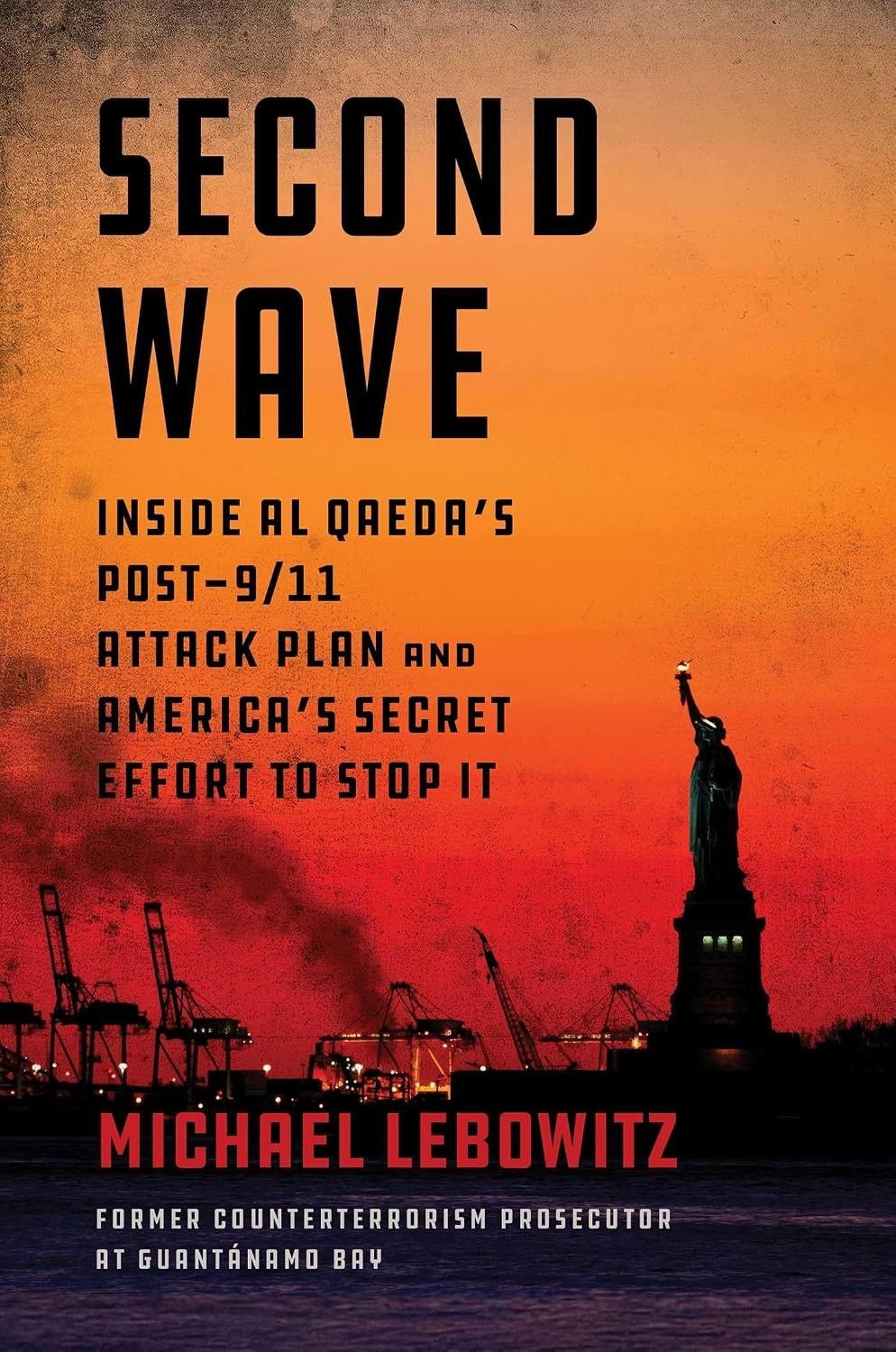

BOOK REVIEW: SECOND WAVE: INSIDE AL QAEDA’S POST-9/11 ATTACK PLAN AND AMERICA’S SECRET EFFORT TO STOP IT
By Michael Lebowitz / Diversion Books
Reviewed by: Robert J. Eatinger, Jr.
The Reviewer: Robert Eatinger is a former Senior Deputy General Counsel of the Central Intelligence Agency and a retired Captain in the U.S. Navy Judge Advocate General’s Corps with 30 years of combined active and reserve service. He is now in private law practice.
REVIEW: The horrific attacks of September 11, 2001, were not the be all and end all of al Qaeda’s plans for mass casualty attacks in the United States. It was but one attack in al Qaeda’s war on America. In Second Wave: Inside al Qaeda’s Post-9/11 Attack Plan and America’s Secret Effort to Stop It, former Department of Justice National Security Division attorney and Guantanamo Bay Military Commissions prosecutor Michael Lebowitz describes al Qaeda’s plan to smuggle explosives into the United States and trigger a second wave of attacks on U.S. soil. The scheme relied on the business operations of a Pakistani family — Saifullah Paracha and his son Uzair — who held U.S. permanent resident status. Investigators’ scrutiny of the family’s shipping company intensified once they tied Saifullah to Khalid Sheikh Mohammed, the architect of 9/11. By 2003, U.S. intelligence believed those explosives were already en route through American ports, and officials could not rule out that they included nuclear or radiological material for a so-called dirty bomb — the nightmare scenario investigators came to call the “Second Wave.”
As a military commissions prosecutor, Lebowitz had access to a staggering volume of law enforcement and intelligence information as well as to investigators, defense counsel, and even some participants. He had to sift through all these materials — as he would to present a case to a jury — to reconstruct the plot from its beginning prior to 9/11 to its disruption. Second Wave is not, however, a prosecution memo. The book is not seeking to prove the elements of a crime beyond a reasonable doubt. Far from it; the book could have just as easily been written by a defense attorney as by a prosecutor. Rather, Lebowitz has written Second Wave to engage the reader by telling the story from the different perspectives of participants and those trying to stop them or investigate them. The narrative hops back and forth in time throughout the book but not in a way that loses the reader. Instead, it makes sense and keeps one interested.
The book becomes a page turner as one progresses through it. At times, it reads less like a non-fiction and more like an intrigue novel. Lebowitz uses dramatic writing at times to whet one’s curiosity. You want to know what happens next. For example, he writes “Majid didn’t know it then, but his direct involvement with al Qaeda would eventually have real-world consequences. People were going to die.” Elsewhere, he tells us “Farhats’ persistence would later be rewarded with answers, some more harrowing that she or her family could bear.”
The main players are not two-dimensional caricatures understood only by what they did or said. Lebowitz takes time to develop their backgrounds and personalities. We get to know them, at least to the extent Lebowitz could form a view of them from the information he accessed and the interviews he conducted. Second Wave seeks to tell us who they were and how they came to be where they were and do what they did. We get a feel for which major developments were planned and which were purely circumstance but fateful. Lebowitz, however, does an excellent job of telling the story to the extent the information allows. Who among the participants was truly evil and who among them was naïve or duped? We do not even today know the answer to those questions for everyone. What is unknown, he does not attempt to resolve.
A key fact to the plot remains unknown–did the patriarch of the family know what he was doing. It does not remain unknown for lack of investigative effort. Neither does it remain unknown because the patriarch’s interrogation was poorly conducted. The patriarch’s interrogation is meticulously detailed over a number of pages. The interrogation was clearly an important event in the investigation and was superbly conducted by FBI Special Agent Janelle Miller. The fact remains unknown despite the masterful interrogation because of a demand for a potty break that was not made by the subject of the interrogation. We are left to wonder whether the interrogation was crippled because someone who was not doing the interrogating had a weak bladder or because that someone’s ego was bruised by not doing the interrogating.
US counterterrorism operations after 9/11 were and remain highly controversial and Second Wave does not avoid the controversy. Lebowitz has a definite view, and he expresses it throughout the book. He does not, however, interrupt telling the story of the second wave plotting to expound on his position; he waits until the story concludes.
Unlike an intrigue novel, Second Wave does not have an exciting, everything is wrapped up ending. It could not and remain true to the facts. The book had to end as it does to give it a purpose beyond just telling the story. There is meaning to how Second Wave ends. It is a warning appropriate to the current times and unlike so many other things today, the warning is bipartisan.
The Cipher Brief participates in the Amazon Affiliate program and may make a small commission from purchases made via links.
All statements of fact, opinion, or analysis expressed are those of the author and do not reflect the official positions or views of the US Government. Nothing in the contents should be construed as asserting or implying US Government authentication of information or endorsement of the author’s views.