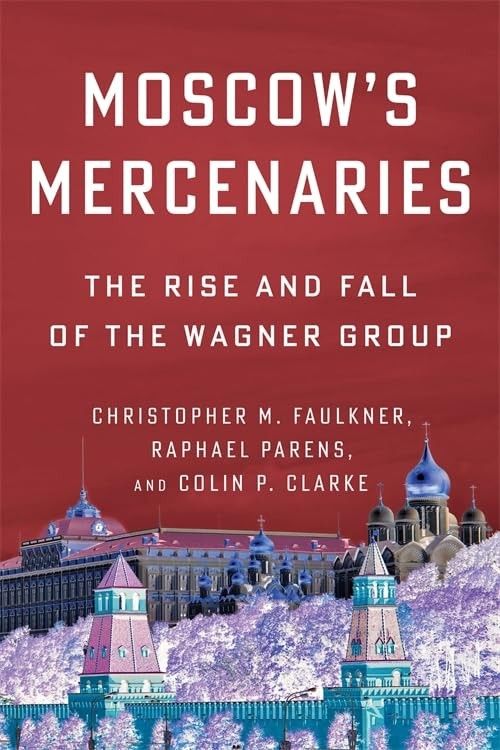

BOOK REVIEW: MOSCOW’S MERCENARIES: THE RISE AND FALL OF THE WAGNER GROUP
By Christopher M. Faulkner, Raphael Parens, and Colin P. Clarke / Columbia University Press
Reviewed by: Jean-Thomas Nicole
The Reviewer — Jean-Thomas Nicole is a Policy Advisor with Public Safety Canada. The opinions expressed are those of the author and do not reflect the official policies or positions of Public Safety Canada or the Canadian government.
REVIEW: In an era increasingly defined by deniable warfare, proxy forces, and the blurring of state and non-state violence, Moscow’s Mercenaries: The Rise and Fall of the Wagner Group offers a compelling and authoritative examination of one of the most consequential security phenomena of the early twenty-first century.
Combining rigorous scholarship with contemporary geopolitical relevance, Christopher Faulkner, Raphael Parens, and Colin P. Clarke have indeed produced what is arguably the most comprehensive study of the Wagner Group and its role in advancing Russian influence across multiple theaters of conflict.
The authors bring a rare combination of expertise in irregular warfare, terrorism, and Russian influence operations. Christopher M. Faulkner is an Assistant Professor of National Security Affairs at the U.S. Naval War College and a senior fellow at the Foreign Policy Research Institute (FPRI), focusing on private military companies and civil-military relations. Raphael Parens, a fellow at FPRI and senior fellow at Delphi Global, is one of the leading analysts of Wagner’s African footprint. Colin P. Clarke, Executive Director of The Soufan Center is a decade-long veteran of RAND, and a prominent terrorism scholar and author of After the Caliphate: The Islamic State and the Future Terrorist Diaspora and Terrorism, Inc.
Together, their backgrounds combine theoretical expertise on private military actors, deep field knowledge of Wagner’s operations in Africa, and extensive research on terrorism and transnational security, giving Moscow’s Mercenaries both scholarly credibility and significant policy relevance.
At its heart, the book is not merely a history of a mercenary organization. It is an exploration of how authoritarian states exploit private violence to pursue strategic objectives while seeking to avoid the political and diplomatic costs associated with conventional military intervention. Wagner emerges as both a symptom and an instrument of Russia’s evolving approach to power projection: a force simultaneously military, political, economic, and criminal in character. The authors persuasively demonstrate that Wagner functioned less as a traditional private military company than as an adaptable foreign policy tool, capable of advancing Kremlin interests from Syria and Libya to the Central African Republic and Mali.
One of the book’s principal strengths lies in its analytical framework. Rather than simply cataloging Wagner’s operations, the authors situate the organization within broader debates surrounding private military companies, proxy warfare, and principal-agent theory. This theoretical grounding elevates the work above descriptive narrative and allows readers to understand the structural tensions inherent in outsourcing violence. Wagner’s relationship with the Russian state was always characterized by ambiguity: sufficiently autonomous to provide plausible deniability, yet sufficiently dependent to serve Moscow’s interests. The book argues convincingly that this arrangement produced both strategic advantages and serious risks, ultimately culminating in the organization’s dramatic rupture with the Kremlin in 2023.
The figure of Yevgeny Prigozhin occupies a central place in the narrative. The authors portray his transformation from politically connected businessman to international warlord with remarkable clarity. His rise mirrored Wagner’s own ascent, while his growing public profile and willingness to challenge Russia’s military leadership foreshadowed the organization’s downfall. The account of the June 2023 mutiny is particularly compelling, illustrating how a force originally designed to strengthen state power evolved into a direct challenge to it. Prigozhin’s trajectory serves as a cautionary tale about the hazards of empowering quasi-independent actors whose ambitions eventually exceed their intended mandates.
The regional chapters are among the strongest in the volume. Through detailed case studies, the authors reveal the remarkable adaptability of the Wagner model. In Syria, Wagner operated as an expeditionary combat force supporting Russian strategic objectives. In Libya, it blended military support with political influence. In the Central African Republic, it became deeply embedded within state institutions and resource extraction networks. In Mali, it capitalized on political instability and anti-Western sentiment to expand Russian influence. These examples demonstrate that Wagner’s success depended less on military prowess alone than on its ability to integrate security assistance, economic exploitation, information operations, and political patronage into a coherent package.
Equally important is the book’s unflinching examination of Wagner’s darker legacy. The authors document allegations of human rights abuses, political manipulation, disinformation campaigns, and predatory economic practices across multiple theaters. Wagner is presented not as a stabilizing force but as an actor that often deepened institutional weakness and entrenched authoritarian governance. The result is a nuanced assessment that avoids both sensationalism and apologetics. Wagner’s operational effectiveness is acknowledged, but so too are the profound societal costs associated with its activities.
The chapters devoted to Ukraine provide the book’s dramatic culmination. Wagner’s prominent role in battles such as Bakhmut, its recruitment of prison inmates, and Prigozhin’s increasingly public disputes with Russia’s military leadership expose the contradictions at the heart of the organization. What had once been a useful instrument of state policy became an increasingly autonomous center of power. The authors argue that the mutiny was not an aberration but the logical consequence of long-standing structural tensions between the Kremlin and its most powerful proxy force. This interpretation represents one of the book’s most persuasive contributions.
The most valuable aspect of Moscow’s Mercenaries is its treatment of Wagner’s legacy. The book moves beyond the organization’s apparent demise to consider what came next: the consolidation of many Wagner functions into Russia’s state-controlled Africa Corps and the broader diffusion of the Wagner model. The authors caution that while Wagner as an organization may have declined, the underlying logic that produced it remains intact. Governments facing resource constraints, political sensitivities, or strategic competition may continue to rely on proxy forces and private military actors. In this respect, Wagner’s story is not an endpoint but a warning about future forms of conflict.
If the book has a limitation, it is its predominant focus on strategic and organizational dynamics at the expense of local perspectives in some theaters of operation. While the consequences of Wagner’s activities are examined, readers seeking a deeper exploration of how affected communities experienced their presence may desire additional treatment. Nevertheless, this is a minor shortcoming in an otherwise comprehensive study.
Moscow’s Mercenaries is more than a biography of a mercenary organization. It is a sophisticated examination of modern power, statecraft, and the privatization of violence. Scholarly yet accessible, it provides invaluable insights into how contemporary authoritarian regimes project influence beyond their borders and the risks they incur in doing so. Its central conclusion is both persuasive and unsettling: Wagner’s greatest significance lies not in what it was, but in what it may inspire others to become.
The Cipher Brief participates in the Amazon Affiliate program and may make a small commission from purchases made via links.