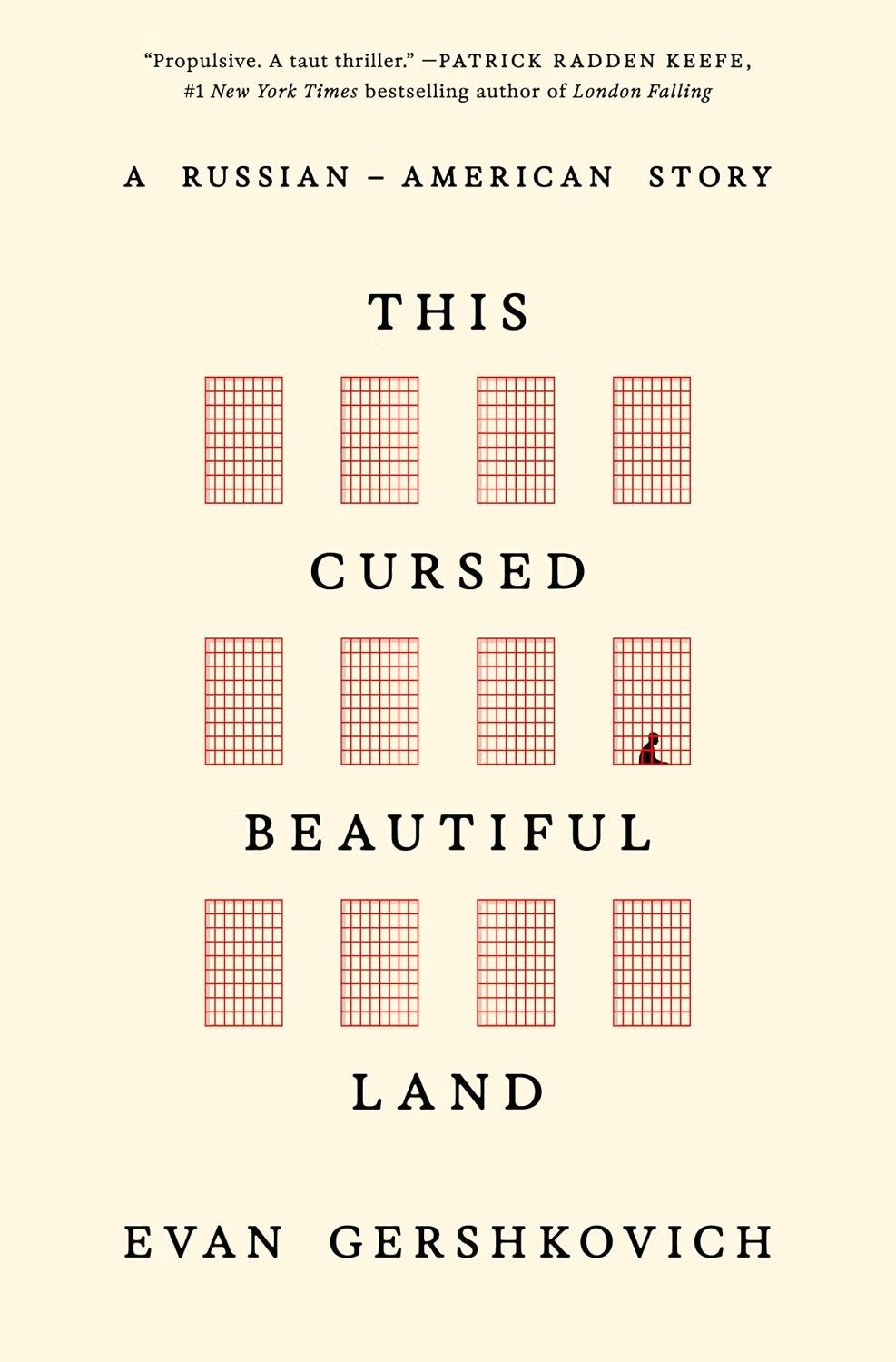

BOOK REVIEW: THIS CURSED BEAUTIFUL LAND: A RUSSIAN-AMERICAN STORY
By Evan Gershkovich / Crown
Reviewed by: Heidi Vierow
The Reviewer: Heidi Vierow, PhD, is a retired CIA Clandestine Service officer and former assistant professor at the United States Military Academy at West Point.
REVIEW: Journalists and spies both pursue secrets, relay their findings via stories, and uncover truths for their audiences, be they the reading public or the intelligence and diplomatic establishments. In some ways their methods are similar: identify sources of information, establish a level of mutual trust, sift through their findings to establish the facts, and relay those findings as objectively as possible. In other ways they diverge: reporters are supposed to be clear about their journalistic intentions and not pay their sources, while spies, at least initially, often operate under cover and frequently compensate their assets. For both journalists and spies, reliable, trustworthy sources are the lifeblood of their craft.
To ensure the objectivity of the press, 50 U.S. Code §3324 prohibits U.S. intelligence agencies from using journalists as agents or assets. This is a strict line that members of the U.S. Intelligence Community are taught from the beginning of their careers. Consequently, when Russia’s Federal Security Service (FSB), the successor to the KGB, arrested Evan Gershkovich, a Wall Street Journal reporter based in Moscow, on espionage charges on March 29, 2023, the news stunned members of the American and international press corps and the Intelligence Community. Russia imprisoned Gershkovich until August 1, 2024, when it released him as one of 26 people freed in the largest prisoner swap since the Cold War. In This Cursed Beautiful Land: A Russian-American Story, Gershkovich relates the circumstances leading up to his arrest, his detention, the international efforts involved in the negotiations, and his life in the year after regaining his freedom.
As a child of Soviet Jews who emigrated to the U.S. before his birth, Gershkovich straddles two cultures. Born in Princeton, NJ, he grew up in a Russian-speaking household and loved the food of his parents’ homeland. Gradually he let his Russian-language skills lapse, went to college, and struck out in the world for a career. He landed on journalism and eventually settled in Moscow, where he worked for several news outlets before being hired by the Journal. By the time of his arrest, his Russian skills had greatly improved, and he had developed a deep appreciation for the people and culture.
He viewed the government there with skepticism. He had seen friends and colleagues leave in haste for countries where they could continue their careers with less fear of persecution. Many warned him of his increasingly precarious position in Russia, and his Journal colleagues discussed with him the dangers of continuing to work in country. In his book, he analyzes how he weighed those warnings in making his decisions. The adrenaline of journalism drives him: to get the story and share his insights with his global readership. He was pursuing several key stories at the time of his arrest. He examines journalists’ courage and quest for truth. Gershkovich, who had months in prison to review his decisions, provides a thoughtful self-assessment of why journalists, and he in particular, make their choices.
Gershkovich survived his imprisonment by creating structure and goals. He set out to improve his Russian reading and speaking skills and to learn about the penal system so that he could report on it. He understood that his insider’s view was a narrow one, because his value as a likely pawn in a prisoner swap set him apart from ordinary inmates. The prospect of a swap gave him optimism, which was hard to maintain as months passed in tiny cells. He and his cellmate, a composite character of several prisoners, developed schedules and practices for cleaning, eating, exercising, reading, and working. Gershkovich was permitted limited contact with the outside world through food parcels, mail, and visits with his lawyers, and he resolved to stop smoking, start meditating, and resume exercising. To his surprise and some disappointment, he found psychological safety in these rituals and discovered that in prison he became the best version of himself, more patient and more focused. His sense of irony and humor also allowed him to develop some limited relationships with guards and other prisoners. While he was treated far better than most prisoners because of his utility to Putin, he showed remarkable resilience under sustained pressure and restrictions. For such a highly social person, the limited human contact must have been one of his hardest challenges.
There are many excellent parts of this book. Gershkovich writes beautifully. He is steeped in Russian history and politics and explains them clearly. He seems to be a nice person with a good sense of humor. Nonetheless, the work is a puzzling read. Hindsight is 20/20, but I was surprised at times by his guilelessness. He even characterizes himself as naive at one point. He seems innocent of the fact that the FSB controlled his prison experience. For example, he created a composite character of his cellmates to protect their identities and wonders whether they were chosen for him to report on him. He perceives the guards as friendly toward him and wonders whether they liked him and whether they might connect in the future. At the same time, he is fully aware that he was kept away from the most dangerous prisoners and given exceptional privileges that other inmates did not have. In addition, he could not believe that he was detained after being granted a visa extension, which he took as a sign of FSB approval. Moreover, he discovered that the Russians had laid two traps for him, one in which he was captured and in the other one the person sent in his place was killed. It is unclear whether this reflects optimism, naiveté, a coping mechanism for his disappointment in a country that he loves, or some combination of these factors.
Read Gershkovich’s book for his political insights and the historical context that he provides. Learn from his ability to write eloquently and with relatively little bitterness about his time as a pawn in a geopolitical contest. His dedication to the craft of journalism suggests that his is a voice we will hear again, either in the press or other fora.
The Cipher Brief participates in the Amazon Affiliate program and may make a small commission from purchases made via links.
All statements of fact, opinion, or analysis expressed are those of the author and do not reflect the official positions or views of the US Government. Nothing in the contents should be construed as asserting or implying US Government authentication of information or endorsement of the author’s views.