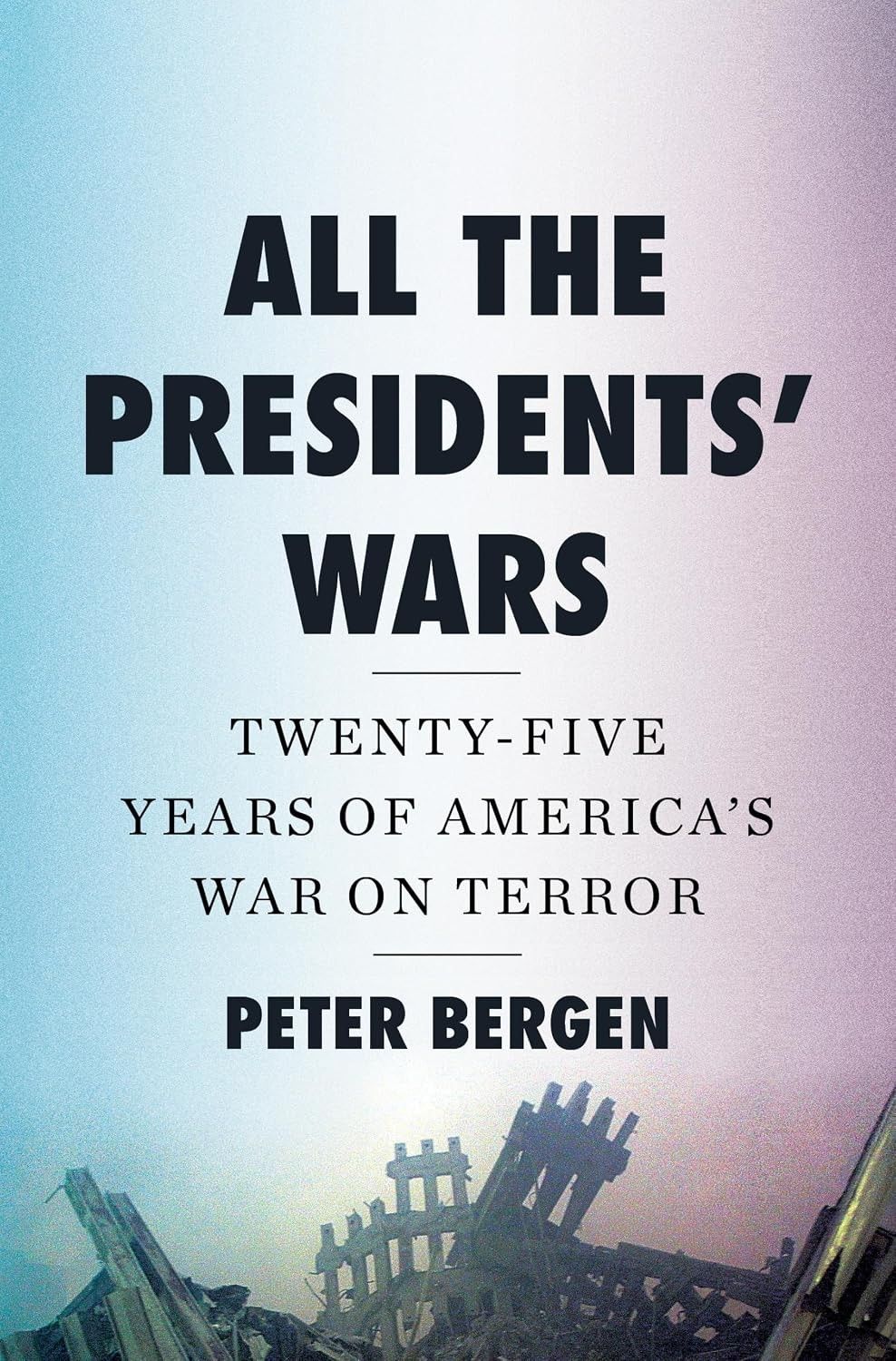

BOOK REVIEW: ALL THE PRESIDENTS' WARS
By Peter Bergen / W. W. Norton & Company
Reviewed by: Joe Zacks
The Reviewer — Joe Zacks is the former Deputy Assistant Director of the CIA for Counterterrorism, the Co-founder and Managing Partner of Aardwolf Global Solutions and a Cipher Brief Subject Matter Expert.
REVIEW: Peter Bergen's All the Presidents' Wars is an excellent compendium of America's post-9/11 war on terror and the policy achievements and failures that mark this 25-year period.
Most of the accounts that Bergen includes—such as the history of 9/11, the escape of Osama Bin Laden from Tora Bora, the long war in Afghanistan and the subsequent U.S. retrograde, the rush to war in Iraq, and the rise of Al-Qaeda in Iraq (AQI) and ISIS—are well known. There are many books that delve into each of these events individually, and this is a fine collective accounting and analysis of separate yet intertwined phases in the U.S.'s war on terror. Bergen focuses heavily on the style and policy consequences of presidential decision-making. He unmasks and discredits the cloaking of policy shortcomings as intelligence failures.
Bergen illustrates the dangers of Presidents' acting on their intuition. He portrays how President George W. Bush's instinct (ultimately wrong) that Iraq supported Bin Laden and had some culpability for 9/11 distracted his administration at pivotal moments during the early stages of the war in Afghanistan. According to Bergen, this in large part led to the missed opportunity to eliminate Bin Laden at Tora Bora. He also highlights the lack of a deliberative process among Bush's cabinet members in the decisions leading to the U.S. invasion of Iraq. Compounding these initial mistakes was the de-Baathification policy after the ouster of Saddam Hussein that in many ways led to civil war in Iraq and the rise of both AQI and the Shia militias.
The author is highly critical of President Biden's decision-making that led to the catastrophic retrograde from Afghanistan. He notes that President Biden was largely driven by his longstanding antipathy toward America's involvement in Afghanistan and his gut feelings about the path toward winding down its involvement with the country. Building on the groundwork laid by the first Trump administration in its Doha agreement with the Taliban, Biden firmly insisted, against the arguably better judgment of his military leaders, on a complete withdrawal from Afghanistan in accordance with a very ambitious and publicly disseminated timeline. This ill-designed withdrawal ultimately led to the rapid collapse of the U.S.-backed government in Afghanistan and the Taliban's return to power. Bergen points out that the ramifications of the U.S. withdrawal from Afghanistan extends well beyond the counterterrorism fight to depriving the U.S. of critically strategic basing rights in central Asia. Having control of the Bagram airfield was an important bulwark against China, Russia, and Iran. It is no wonder that President Trump has repeatedly insisted on a U.S. return to Bagram in exchange for normalized relations with the Taliban regime.
Bergen paints President Obama as likely the most deliberative, methodical, and process-driven post-9/11 President, although he demonstrates how his policies were also not without mistakes. President Obama comes across as disciplined, analytical, reasonable and able to course correct when the prospect of policy failure looms. This was clearest in his Iraq policies and recommitting U.S. troops to fight ISIS in 2014. While the U.S. withdrawal from Iraq in 2011 may be viewed superficially as an Obama policy failure, the truth is more complicated. The withdrawal of troops was a Bush-era commitment that Obama was unable to forestall because of an inability to successfully renegotiate the Status of Forces (SOFA) agreement with the Iraqi government.
It should come as no surprise that Bergen characterizes President Trump's decision-making style as largely driven by instinct. He captures Trump's stylistic differences in policy formulation between his first and second administrations. In his first administration, Trump is characterized as being constrained by his advisors in acting on his impulses, but he is much less so in his second administration. Bergen delves into the lead-up to the current conflict with Iran, but he is careful not to draw too many conclusions about this as yet unresolved dispute.
While Bergen devotes many pages to detailed accounts of well-reported stories (quite a few of which are his own) such as the Abbottabad raid on Bin Laden or the operation against ISIS leader Abu Bakr al-Baghdadi, he falls short in providing details about other highly consequential events. He devotes less than half-a-page to the Biden-era killing of al-Qaeda leader Ayman al-Zawahiri. My guess is that, despite Bergen's prowess as an investigative journalist, he knows next to nothing about the details of this extremely important and complicated operation.
Of comfort in Bergen's tale is that America is better poised today to counter terrorist threats than it ever was pre-9/11. Our counterterrorism institutions are well developed and able to take on emerging challenges in the counterterrorism landscape such as artificial intelligence, drones, and online radicalization. This though will not shield the United States from poor presidential-led decision-making, inadequate policies, and ill-conceived and executed strategies. Policymakers will be well-served in digesting Bergen's survey of policy missteps and working toward measures to preclude such mishaps in the future.
The Cipher Brief participates in the Amazon Affiliate program and may make a small commission from purchases made via links.
All statements of fact, opinion, or analysis expressed are those of the author and do not reflect the official positions or views of the US Government. Nothing in the contents should be construed as asserting or implying US Government authentication of information or endorsement of the author's views.