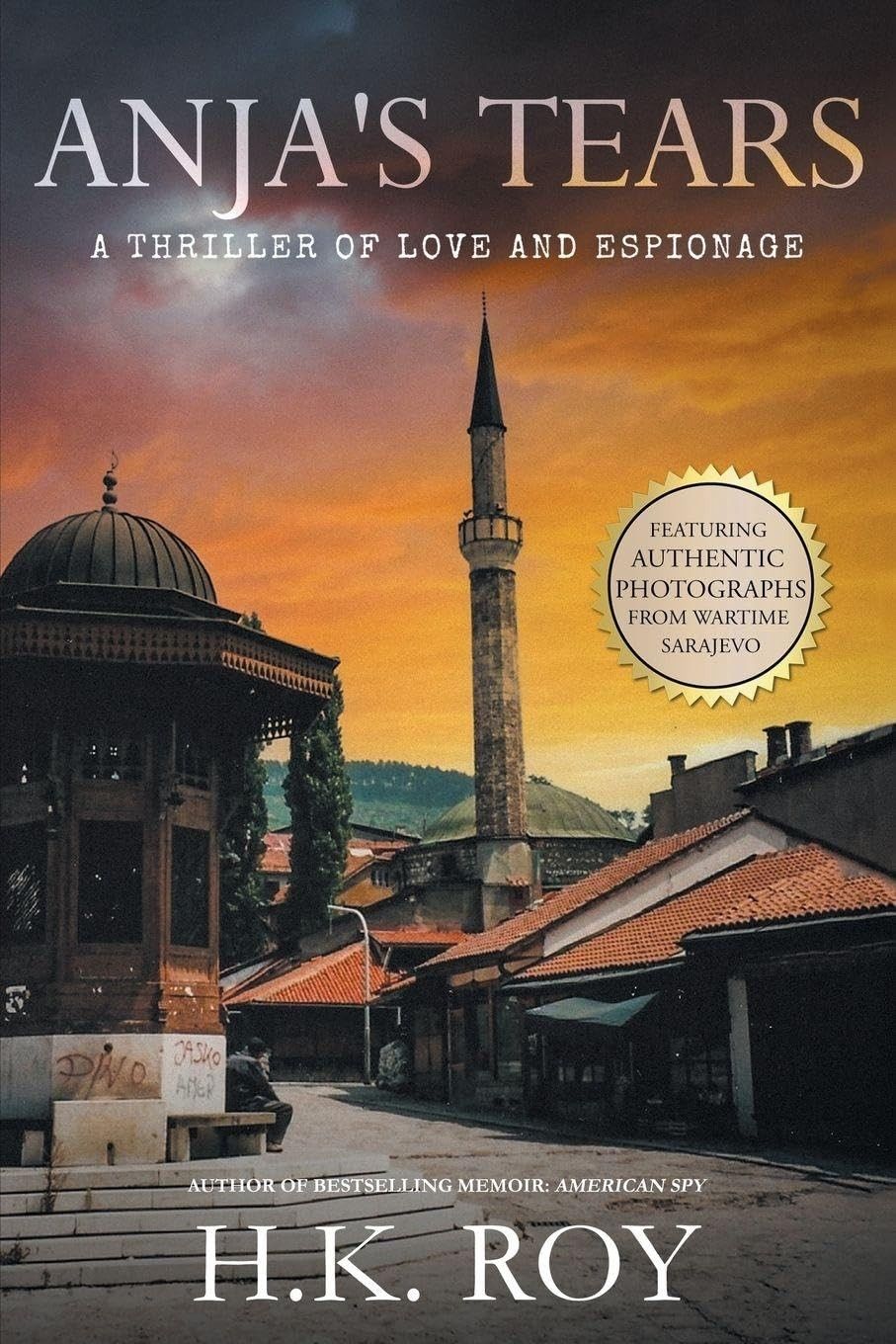

BOOK REVIEW: Anja’s Tears: A Thriller of Love and Espionage
By H.K. Roy / Manhattan Book Group
Reviewed by: Kenneth Dekleva
The Reviewer — Dr. Kenneth Dekleva served as a Regional Medical Officer/Psychiatrist with the U.S. Department of State from 2002 to 2016 and is currently the CEO of Blackwood Advisory Solutions LLC and Professor of Psychiatry, UT Southwestern Medical Center, Dallas, TX. He is also the author of The Negotiator’s Cross, The Last Violinist, The Russian Diplomat’s Wife, and The Expediter. The views expressed are entirely his own and do not represent the views of the U.S. Government, the U.S. Department of State, or UT Southwestern Medical Center.
REVIEW: H.K. Roy is a novelist and former CIA case officer who served extensively in the Balkans. His excellent debut thriller, Anja’s Tears: A Thriller of Love and Espionage, paints a complex portrait of espionage, love, tragedy, and loss in wartime Sarajevo.
In his lovely 1999 photo-essay, Forgotten Sarajevo, Miroslav Prstojević writes of an earlier time in Sarajevo, “where people lived their lives in the narrow openings of Sarajevo’s open-fronted shops. There they traded, talked, sipped their coffee and loved.” H.K. Roy’s protagonist, Mick Caruso, would resonate with such a statement, as he describes walking along Sarajevo’s streets with his beloved agent, Maja Marković, holding hands and falling in love amid the tragedies of war. But Mick Caruso would also understand another, darker Sarajevo, that of the convicted war criminal, psychiatrist, poet, and Bosnian Serb politician Radovan Karadžić, who in his 1983 poem “A Morning Hand Grenade” imagined a narrator, “bereft / Of all benefactors,” who hurls “a morning hand-grenade. / Armed with the laughter / Of a lonely man / With a dark character.”
H.K. Roy’s fine spy thriller is a tale of both Sarajevos, where Mick Caruso is assigned as the sole CIA officer, operating in a war zone using denied-area (“Moscow Rules”) tradecraft, where constant, dangerous threats abound. There are Serb paramilitaries, Iranian intelligence officers, the duplicitous Bosnian intelligence agency (with which he is supposed to establish a liaison relationship), and other adversaries, each with its own ruthless, devious agenda.
Mick Caruso’s romance with Maja Marković, a secretary in Bosnia’s intelligence agency, quickly turns to tragedy. She is kidnapped, gang-raped by Serb paramilitaries (including the late Bosnian Serb General Ratko Mladić), and killed because of information she had passed on to Mick and the CIA.
At this point, fiction and reality blend together, as Mick informs his masters of his relationship with Maja, and her rape and murder, and seeks his own revenge. Mixed in is another tale of his exfiltration (based upon a real story, which H.K. Roy has written about in his memoir American Spy: Wry Reflections on My Life in the CIA) from Sarajevo after a death threat from Iran’s intelligence chief there. That threat is lethally neutralized. The novel also weaves in the assassination, unsolved to this day, of Bosnia’s deputy intelligence chief, Nedžad Ugljen. This part of the novel moves quickly, with a stirring and propulsive plot, highlighting precise tradecraft, high risk, and eventually, redemption. It is also a tale of love, family, loyalty, and lastly, of healing, as the next generation, Sarajevo’s children of war, moves forward.
Part of the novel’s tone is nostalgic, even elegiac. Today’s Sarajevo is quiet. Its streets are once again full, its kafanas (taverns) a lodestone for those seeking solace, companionship, laughter, and romance, its character once again evident in its cacophony of sounds. Like Mick Caruso, one can walk along side streets near Sarajevo’s main pedestrian street of Ferhadija in the wee hours of the morning, when the shops are still shuttered, and only the cries of the muezzin are alive. Or one can close one’s eyes, let the imagination wander, and open them slowly to a faded, dust-speckled postcard of the Latin Bridge, near where Gavrilo Princip fired his shots in 1914. Those were, in Radovan Karadžić’s words, “wonderful, majestic bullets.”
In today’s world of great-power competition, with wars in Iran and Ukraine, as well as in other conflict zones, H.K. Roy reminds us, in this superb novel, that certain things in the world of espionage remain the same. In today’s conflicts, there are always CIA officers, like Roy’s protagonist Mick Caruso, doing, in the words of former CIA Director Bill Burns, “hard things in hard places.” Their world of service, patriotism, dedication to mission, and sacrifice has never changed. And as Roy shows us in his novel, spying is a very human business.
The Cipher Brief participates in the Amazon Affiliate program and may make a small commission from purchases made via links.