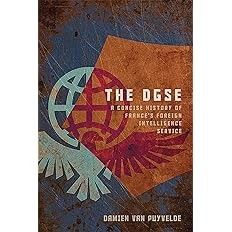

BOOK REVIEW: The DGSE: A Concise History of France’s Foreign Intelligence Service
By Damien Van Puyvelde / Georgetown University Press
Reviewed by: William D. Murray
The Reviewer William D “Bill” Murray retired in 2005 after serving more than 37 years at the CIA including 15 years as a member of the Senior Intelligence Service. He worked as a case officer and Chief of Stations in Africa, the Middle East, South Asia, the Balkans and Western Europe and was the Agency’s senior officer in Paris on 9/11. He is co-founder and Vice President of the Council on Intelligence Issues.
REVIEW: Despite its short length, less than 200 pages, The DGSE: A Concise History of France’s Foreign Intelligence Service is an excellent overview of the France’s external intelligence service and manages to cover its subject admirably. The book is part of a series of equally concise histories of intelligence services. This history could easily serve as a textbook, a reference work, or a book of general interest for someone interested in the French system.
There is a brief summary of the DGSE’s predecessor, the SDECE, founded by Charles de Gaulle’s government at the end of World War II, the true beginning of France’s modern intelligence system. That system is significantly different from both the UK and US structures that evolved during the same time period. The author does not try to evaluate or rate one system versus another but presents the French system as it is and explains why certain choices were made. For example, there is no career-long separation of analysts from those who recruit and handle human sources. The analyst function in the DGSE is a normal part of one’s early career, but that career will not usually be spent in analysis. The young officer is expected to move into a collection role and can possibly return to an analytical one at various times in the course of a career.
The book covers the history of the service, each of its directors, its relations with other services, its relations with the French state and its position within the broader structure of other French services such as military intelligence and the internal services and the various reforms undertaken in the past 10 years. It is clearly the pre-eminent French service and has complete control over certain areas such as signals intelligence. The rivalry and traditionally bad relations with the internal services is noted but not discussed in detail.
One element the author deals with at some length is the historical tradition of distance between the French intelligence services in general and French political leadership. In fact, the war on terrorism after the al-Qaida terror attacks on the US in 2001, brought the DGSE closer to the senior French leaders than was the case in any previous period. Intelligence in France was traditionally regarded as collection for its own sake, almost apart from French national interest. The struggle against terror brought the political and intelligence roles closer as the national leaders took a more direct interest in requirements levied on the service. Even former President Jacques Chirac who presided during and after 9-11, was quoted by one of his own advisers as preferring a state of tension and competition among the intelligence services rather than cooperation. Serious efforts to reform this system are recent, occurring mainly after 2007.
The book discusses each of the directors and their backgrounds. Most of the early directors had a military or business background. The service, like the SDECE which preceded it, included a large number of military personnel, a fact which only began to change after the election of President Mitterrand in 1981. The heavy military presence resulted in a hierarchical system of management and operational focus which has changed only gradually. The DGSE was, and to a large extent remains, a service oriented toward what in the United States would be considered covert action, rather than intelligence collection and analysis. The action-oriented case officer (OT or officier traitant) is the model.
The service is also the main signals intelligence service of France. There is no separate service such as the GCHQ in the UK or the NSA in the United States. The counter-terrorist effort led to an increase in the reliance on signals and other forms of technical intelligence. The only source of satellite data relies on the French SPOT satellite system which does not have the resolution of more advanced systems, so satellite derived intelligence is not a major source of intelligence.
Oversight of intelligence services is minimal in the French system. There have been major scandals involving intelligence operations, the most well known of which was the sinking of the Greenpeace vessel Rainbow Warrior in New Zealand. There have been remarkably few such incidents, however, and truly little exposure of French covert operations. The public has shown scant interest in this issue and there has never been a real impetus to disclose more information.
This book is not an exciting expose of French operations but rather a carefully researched and written academic description of the service as it evolved. It is not a large service, nor does it try to cover the world. It covers what France regards as important to its interests. For example, the former French colonies in Africa remained important culturally, economically, and politically to France even after the birth of the new countries, and the DGSE developed deep expertise on Africa. They had far less interest in Asia or South America.
It has only been in the last few years that the DGSE decided to increase public contact and understanding. The first public affairs chief was appointed a few years ago and the last couple of Directors General were the first to give occasional speeches or interviews. Recently the DGSE even took the radical step of cooperating in the production of a streaming television series known in English as The Bureau. The series does not pretend to be based on fact but does try to present dramatized but realistic scenarios based on current geopolitical realities.
If someone is looking for a good description of French foreign intelligence this book will fill the need. It is more complete and up to date than any other book on this service.
Note: All statements of fact, opinion, or analysis expressed are those of the author of this review and do not reflect the official positions or views of the US Government. Nothing in the contents should be construed as asserting or implying US Government authentication of information or endorsement of the author’s views
The Cipher Brief participates in the Amazon Affiliate program and may make a small commission from purchases made via links.
Sign up for our free Undercover newsletter to make sure you stay on top of all of the new releases and expert reviews.
Read more expert-driven national security insights, perspective and analysis in The Cipher Brief because National Security is Everyone’s Business