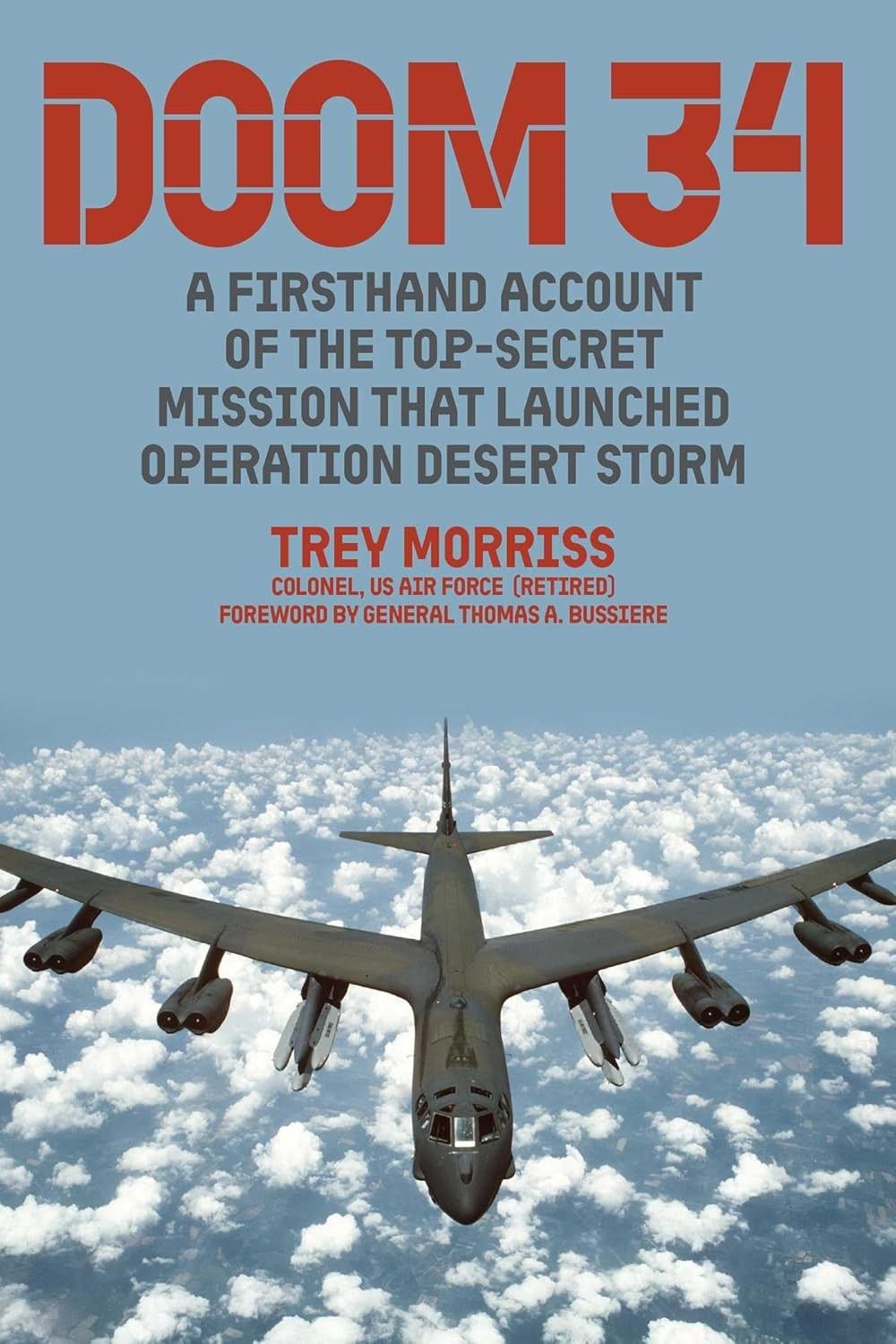


BOOK REVIEW: DOOM 34: A Firsthand Account of the Top-Secret Mission that Launched Operation Desert Storm
By Colonel Trey Morriss, U.S. Air Force (Ret) / Lyons Press
Reviewed by: Lieutenant General John Campbell, USAF (Ret)
The Reviewer — General Campbell served for 32 years in assignments around the world, including command of F-15 and F-16 wings. He retired in 2003 after a three-year assignment as the Associate Director of Central Intelligence, Central Intelligence Agency
Most observers of modern military operations have grown accustomed to reports of U.S. Air Force bombers flying nearly 40-hour round trip missions from their home bases in the United States to strike targets halfway around the world—so much so that such feats no longer seem extraordinary. During the 37-hour Midnight Hammer raid in the June Twelve-Day War, seven B-2s launched from Whiteman Air Force Base in Missouri to attack Iranian nuclear facilities with 30,000-pound “bunker-buster” munitions, in what the Chairman of the Joint Chiefs of Staff described as the second-longest B-2 mission ever flown. More recently, B-1, B-2, and B-52 bombers—some operating directly from bases in the United States—struck targets in Iran as part of Operation Epic Fury.
These long-range, long-endurance missions have become a standard tool in the combatant commander’s arsenal, and the forthcoming B-21—purpose-built for precisely this role—will add another capability to the kit. Yet there is a risk that observers may draw the wrong conclusions. As then–Air Force Chief of Staff General David Allvin said of Midnight Hammer, “the Air Force makes the ridiculously complex look routine.” With competition for resources likely to persist, some airpower advocates worry that the American public and Congress may conclude this mission area is already well covered—and choose to invest scarce defense dollars elsewhere.
For anyone who assumes such missions are as easy as they appear, DOOM 34: A Firsthand Account of the Top-Secret Mission that Launched Operation Desert Storm should be required reading. The author, Col. (Ret.) Trey Morriss, was the Electronic Warfare Officer (EWO) aboard B-52G Miami Clipper II with the call sign DOOM 34, one of seven planes that flew a 35-hour, 14,000-mile mission on June 6, 1991, the opening day of Operation Desert Storm.
The mission was planned and executed under the code name Senior Surprise—a designation so sensitive that even the code name itself was classified. The crews humorously referred to the training missions on their flight schedules as “Operation Secret Squirrel,” a nickname that persists to this day. The operation was remarkable not only for its duration—then the longest combat mission ever flown—but also for introducing the AGM-86C Conventional Air-Launched Cruise Missile (CALCM). The weapon emerged from a rapid conversion program that modified 30 nuclear-capable Air-Launched Cruise Missiles (ALCMs) into non-nuclear, GPS-guided, long-range precision strike weapons that had been briefly tested but never used in combat. In 1991 the Global Positioning System (GPS) was still a relatively new capability, lacking the coverage and reliability of today’s constellation, so the mission had to be carefully planned to exploit periods of optimal satellite geometry.
DOOM 34 weaves together several interrelated themes. The central narrative highlights the complexity—and danger—of flying a 40-hour mission in aging aircraft never designed for such endurance. The crews had to execute multiple precisely choreographed aerial refuelings, penetrate defended airspace, release their weapons at an exact time and launch point, and then recover from halfway around the globe as aircraft systems dropped offline and engines failed, with unreleased ordnance limiting landing options. All of this unfolded while fatigued crews coped with deteriorating weather and unforecast winds during the return leg.
A second major theme is that Senior Surprise served as a proof of concept for a long-standing vision within airpower theory: that long-range heavy bombers could safely and independently strike an adversary’s centers of gravity. For decades that vision had been constrained by two limitations—bombers with sufficient range and weapons capable of striking targets with precision. The B-52 and the Air Force’s global network of aerial tankers largely solved the first problem, while the emerging Global Positioning System addressed the second, enabling the accurate employment of long-range stand-off weapons.
Another theme is the teamwork, resilience, and ingenuity of the crews aboard the seven aircraft. Morriss’s narrative, pieced together from his own recollections and contributions from other DOOM 34 crewmembers, offers an in-depth look at the complexity of operating a massive aircraft older than most of those flying it. In 1991, and largely still today, the B-52 was an analog aircraft, lacking fly-by-wire controls, glass cockpits, and many of the navigation and communication aids we now take for granted. It demanded the full attention, cooperation, discipline, and skill of its six-man crew.
The seven crews were hand-picked from the 596th Bomb Squadron of the Mighty Eighth Air Force, but only one man had previous combat experience, and only one had ever launched an Air-Launched Cruise Missile before. They were, however, among the best in the heavy bomber business: products of the Cold War Strategic Air Command, where unfailing discipline, rigorous procedural knowledge, and meticulous attention to detail were standard operating procedure.
A final theme in the story is the planning and execution of the complex logistical effort required to make the mission possible, particularly the management of the tanker airbridge that supported multiple aerial refuelings along the route. Ensuring the right number of tankers were in precisely the right place at the right time to support four separate refuelings was an extraordinary feat. Yet it is the sort of complex orchestration the U.S. Air Force has made look routine, built on decades of operational experience.
Morriss’s description of the first refueling is nerve-racking: a nighttime rendezvous over the Atlantic between the seven heavy bombers of DOOM flight and fourteen KC-135 tankers, followed by careful choreography as each bomber cycled through two tankers to take on fuel. It is difficult to imagine many other air forces possessing the resources, planning capacity, and operational expertise to execute such a mission, and our adversaries must look on with envy and concern. For the U.S. Air Force, however, it was simply part of the job.
Morriss also reflects on what the tanker crews—particularly the enlisted boom operators who guide the refueling boom into the bomber’s receptacle while looking directly down onto the aircraft’s nose—might have thought as they watched the B-52s slide into contact position. From their vantage point, the missiles mounted under the bombers’ wings would have looked very much like the nuclear cruise missiles they once were—now headed toward a war zone.
While the refuelings helped break the monotony, most of the flight was uncomfortable, cold, and noisy, with the crew improvising sleeping arrangements as best they could. The B-52 is far from ergonomically friendly. Morriss describes the cramped crew compartment as “an MRI machine outfitted for war.” Only the pilots in the cockpit have windows; the rest of the crew worked in dim, enclosed compartments below.
Even with the normal six-man crew, space on a B-52 is tight, but the Senior Surprise missions required two additional crewmembers, making conditions even more crowded—and prompting what must have been an interesting conversation when the use of the aircraft’s six ejection seats was briefed. As for the aircraft’s sanitary facilities, Morriss cheerfully breaches the “too much information” rule.
Yet despite the discomfort, Morriss’s affection for the aircraft comes through clearly. As he writes, “The B-52 wasn’t designed to coddle. It was unapologetically utilitarian—a war machine stripped of comfort, bristling with power, and built solely for one purpose: delivering destruction.”
After the transit of the eastern Med, which included an intercept by a Libyan MiG-23 and challenges from Egyptian Air Traffic Control, the descent over the Red Sea into Saudi airspace and the subsequent CALCM launches are almost anticlimactic. Of the 39 CALCMS, 35 were launched and four malfunctioned and had to be retained. Post-strike analysis concluded that 28 missiles successfully guided to their targets, key Iraqi electrical grid and communication nodes, with 6 targets completely destroyed.
Next came the far more harrowing return flight, as weather, adverse winds, and a series of aircraft malfunctions created new challenges for the crews. In addition to the four retained missiles, two aircraft had failed and seized engines. These mechanical issues increased drag and fuel consumption, while higher-than-forecast winds reduced ground speed, making fuel a constant concern.
Diverting to an alternate airfield—normally a prudent option in cases of low fuel—was effectively off the table because the unfired CALCMs risked exposing the highly classified capability. With the bombers running low on fuel, additional KC-135 tankers were launched from alert to provide just enough fuel for the aircraft to make it back to Barksdale.
As each bomber touched down, its crew briefly held the record for the longest B-52 flight—until the next aircraft landed. The final jet to arrive, DOOM 33, completed the mission in 35 hours and 23 minutes, marking the longest combat flight in aviation history.
All of us should resist the temptation—especially from the comfort of our zero-airspeed, one-G chairs—to second-guess decisions made in the heat of a demanding combat mission. Still, Morriss’s account raises a few questions worth considering.
Early in the mission, the crew of Miami Clipper had to shut down the number five engine after losing oil pressure. That situation immediately presented two decisions: whether to continue the mission on the remaining seven engines, and whether to inform the mission commander of the problem. The answer to the second question is situational, and the course of action chosen probably reflected the crew’s determination to remain part of the historic mission. The first question, however, seems more foreseeable. With seven eight-engine aircraft flying a mission of this length, the probability of at least one engine failure was quite high. One might assume that pre-mission contingency planning would have anticipated this possibility and established a clear policy on whether an aircraft should continue or abort under such circumstances, saving the DOOM34 crew an excruciating decision under pressure.
Later, on the return leg, the unfired CALCMs—two in the case of DOOM 34—exacerbated the fuel situation described earlier. Diverting to an alternate field was effectively ruled out, yet Morriss’s account contains no discussion of jettisoning the missiles over the ocean as a way to reduce drag and conserve fuel—an option that, at least to an outside reader, seems worth considering.
The book’s prologue opens with the DOOM flight roll call at the twenty-fifth anniversary reunion of the mission, reminiscent of the Doolittle Raider reunions. Morriss then flashes back to the pre-launch briefing, where Eighth Air Force Commander Lt. Gen. Buck Schuler compared the Senior Surprise mission to the Doolittle Raid on Japan. There were similarities, but while the Doolittle Raid became a rallying cry for Americans eager to strike back against Japan, the Senior Surprise mission remained shrouded in secrecy until January 1992—and even then, was little known outside a small circle.
Nevertheless, it is an important part of Air Force history. DOOM34 not only preserves the story of a remarkable mission but also reminds readers that the global strike capabilities we now take for granted were built on the discipline, ingenuity, and endurance of Cold War airmen. For anyone seeking to understand the origins of modern long-range precision strike, Morriss’s account is essential reading.
Sign up for our free Undercover newsletter to make sure you stay on top of all of the new releases and expert reviews.
Read more expert-driven national security insights, perspective and analysis in The Cipher Brief because National Security is Everyone’s Business