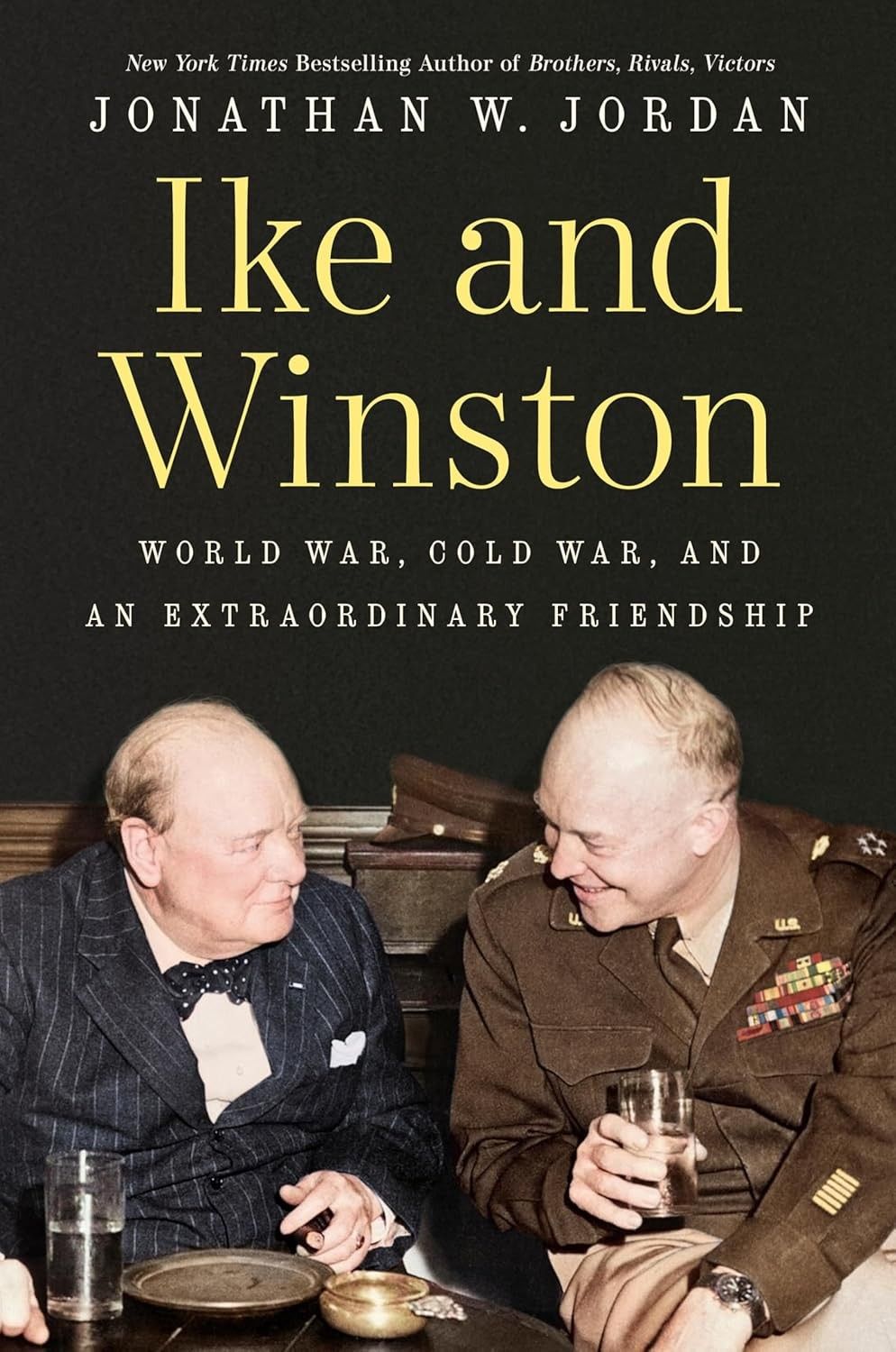

BOOK REVIEW: Ike and Winston: World War, Cold War, and an Extraordinary Friendship
By: Jonathan W. Jordan/ Dutton (publishing May 12, 2026)
Reviewed by: Admiral James Stavridis, USN (Ret.)
The Reviewer — Admiral Stavridis is Partner and Vice Chair of Carlyle, an international investment firm, and Chair of the Board of Trustees of The Rockefeller Foundation. A retired four-star naval officer, he was Supreme Allied Commander of NATO and commander of the U.S. Southern Command. His 16th book: “2084: A Novel of Future War” will be published in May, and his 17th, “The Turning Tide” about World War II will be published in November.
REVIEW: Two of the most consequential leaders of the 20th century were Sir Winston Churchill and President Dwight David Eisenhower. While they could not have been more different in age, background and appearance, they shared many qualities of personality and philosophy that served as the basis for a deep, abiding, and meaningful friendship. Each was an iconic national figure, and while they obviously represented very different nations, ultimately their bond helped cement the continuing deep and profound relationship of the United States and the United Kingdom.
In Ike and Winston, a superb single volume by New York Times best-selling author Jonathan W. Jordan, the reader gets the best of two worlds: accurate and meaningful biography of these two seminal men, full of rich period detail; and detailed historical, geopolitical and cultural analysis of their times. Taken together, this is an epic tale of two towering figures whose lives did much to shape the modern world. Ike and Winston, as they referred to each other, were indeed the twin towers of leadership in the Second World War in Europe, and their work together continued deep into the Cold War.
Under their dual-key guidance, for example, the largest amphibious assault in history, the momentous D-Day invasion, was a singular success. Their partnership also helped them manage the diverse and difficult crew of peers who were part of winning the war. Who else could have created consensus among such characters as Charles de Gaulle, Joseph Stalin, and of course Franklin Delano Roosevelt? The author shows how they again and again teamed up to find a path to solving the biggest problems by a combination of guile, charm, and partnership.
Much of the World War II material is well known, but Jordan mines and curates it well. In particular, the seemingly endless series of witty quotes from Winston (the world’s most quotable man) are nicely contrasted to the stolid, sincere statements of Ike. Even as the war comes to a close and each of them follows a new destiny (Ike to become President of Columbia University and Winston to enter a political wilderness as his ungrateful nation rejects him as a post-war leader), we see their bond continue. When they reunite for several years in the Cold War, this time with Ike the “senior partner” as US President and Winston reelected to a second term as PM, they pick up the thread of cooperation without missing a beat.
Indeed, the best and most original part of the book follows them from the war’s end through the early days of the Cold War. Facing an emerging cast of Soviet characters – including most notably Nikita Khrushchev following the death of Stalin – they end up reuniting in leadership when Churchill returns to the premiership in 1951 and Ike becomes President of the United States in early 1953. Despite the Cold War tensions that occasionally emerge – including the Suez Crisis of 1956/ 57 – each of these men continue to advise and reinforce each other in their new roles. And all of this plays out in the backdrop of the new realities of nuclear weapons.
A particular and fascinating moment occurred in 1951, when they disagreed about the approach to Iran. Churchill, always seized with the “great game” in Central Asia dating back to his days in Afghanistan as a junior officer, was anxious to intervene. Ike, always more prudent, urged negotiations. In the background, both nations were maneuvering independently. The echoes of today are striking, albeit with the national roles reversed.
Especially enjoyable are the contrasting personal gifts of the two leaders. Ike is framed as the consummate “calm strategist,” fitting an officer who spent his long, formative Army career on the staff of more senior leaders like General Douglas MacArthur. Ike never saw combat himself (something he bitterly regretted) but had an eye for putting together diverse coalitions and above all managing the complex logistics that actually win wars. Churchill, an impulsive man of action who had seen plenty of “active service” in his youth, thrived on sudden waves of energy that occasionally crested over subordinates and peers alike. Even their style as oil painters reflected their differing approaches, with Churchill flamboyant and exuberant in his use of color, Ike more controlled and subdued. Neither was especially talented in the genre, but both found deep release in the hobby.
The book is at once scholarly and gossipy, providing a bouncy, anecdote-filled style of prose that propels the reader briskly along the momentous events of the war and resultant Cold War. From the moment the book opens in 1942 with Ike’s arrival in England, we see the ability of Churchill to persuade both Ike (his local tactical partner) and FDR (his strategic backer in Washington). By 1944, with the leadership role afforded the US by simple virtue of its overwhelming war machine, utterly surpassing the UK, it is Ike who gradually becomes the more dominant actor in the duo.
Churchill, as usual, emerges as the more charming, occasionally intoxicated, and mercurial figure, while Ike is accurately portrayed as a calculating figure of steely mien effectively cloaked in a deceiving blanket of midwestern charm. Despite his famous grin, Ike had the greater temper of the two, and a will to dominate. As Jordan says of Ike, “When [he] stepped on a friend, he wouldn’t lift his boot until he got what he wanted.”
As a former Supreme Allied Commander of NATO (I was 16th in the line stretching forward from Ike’s time as the inaugural SACEUR) and a long-time Churchill aficionado, I thought I had more than covered the detailed terrain of their lives in my reading and study. And there are other wonderful individual books about (and by) both of them. For example, Churchill’s brilliant early biography, “My Early Years: A Roving Commission” and Ike’s beautifully written “Crusade in Europe” are mandatory reads – I’m lucky to have signed first editions of both. But in producing a joint biography that frames these two unique and striking individuals, Jonathan Jordan has written a masterpiece.
As today’s disagreements between the US and UK are exacerbated in the turbulent age of Trump – to include President Trump’s petulant threats to withdraw from NATO in anger over Europe’s decision to decline participating in strikes in Iran or later, to not rush in with minesweeping assistance – it is somehow comforting to think back to this golden age of Anglo-American cooperation. Somewhere in the great foreign policy lounge in the sky, I can easily picture Ike and Winston having a whiskey together and bemoaning the divisions of the moment. Cheers, gentlemen – we miss you both.
The Cipher Brief participates in the Amazon Affiliate program and may make a small commission from purchases made via links.
Sign up for our free Undercover newsletter to make sure you stay on top of all of the new releases and expert reviews.
Read more expert-driven national security insights, perspective and analysis in The Cipher Brief because National Security is Everyone’s Business