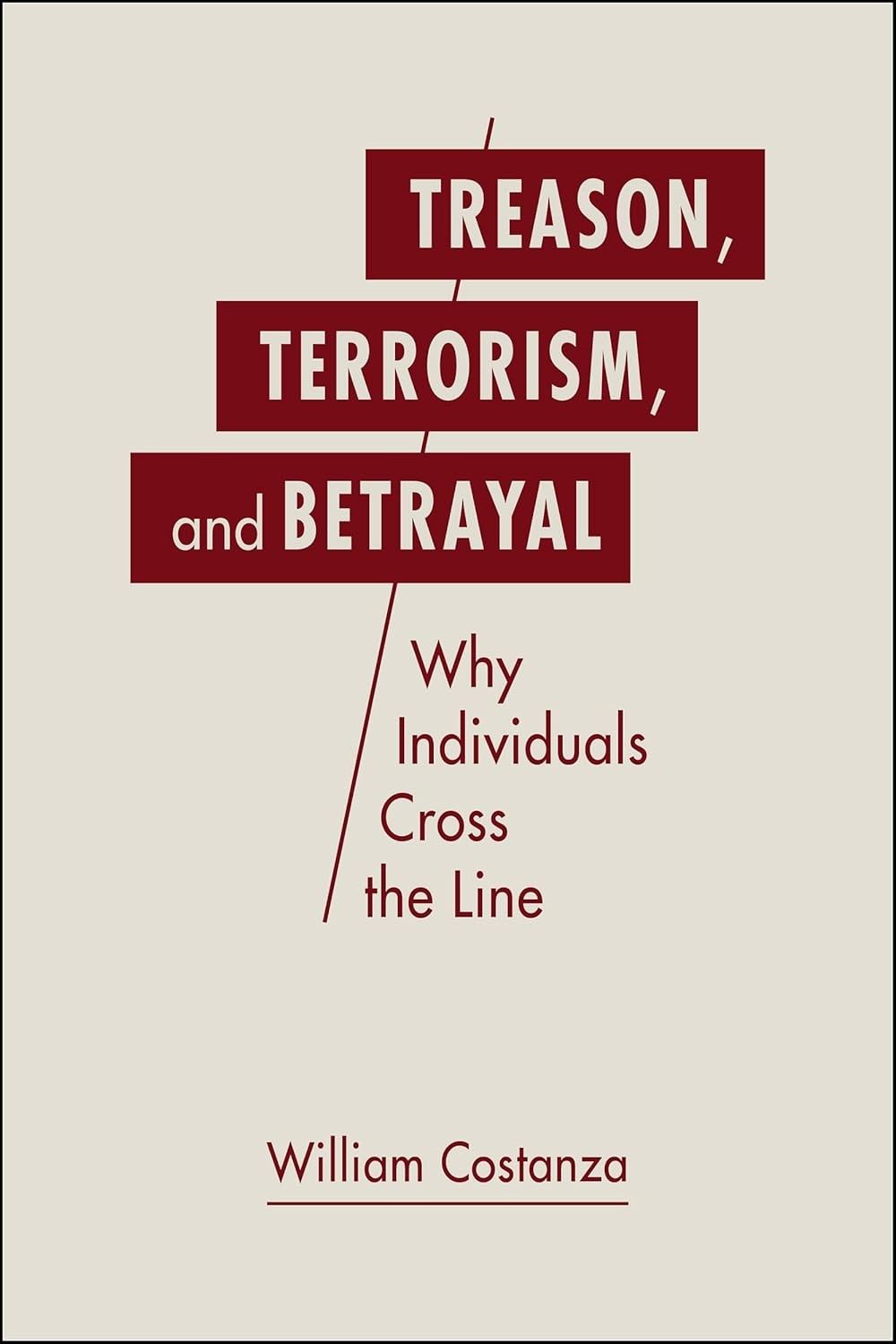


BOOK REVIEW: Treason, Terrorism, and Betrayal
By William Costanza / Lynne Rienner Publishers
Reviewed by: Sean Wiswesser
The Reviewer — Sean Wiswesser is a former senior operations officer with the CIA. He spent nearly three decades in the intelligence community, including multiple overseas tours and senior leadership roles such as Chief of Station. Sean is the author of the upcoming book Tradecraft, Tactics, and Dirty Tricks: Russian Intelligence and Putin’s Secret War (due out in April 2026), which explores the evolution of Russia's intelligence agencies, their conflict with the West, and their role in modern hybrid warfare.”
REVIEW: Betrayals by spies are hard for us in the intelligence community to bear. When we learn of a foreign penetration of our ranks, we feel the betrayal at a personal level, particularly those who may have known the spy personally and had no hint of their duplicity. For those of us who spent careers working the Russian target, these stories resonate through the decades, including moles like James Nicholson, Aldrich Ames and Robert Hanssen. It is no different for Chinese penetrations and other nations’ spies— the betrayals run deep, and the cases are even more damaging to the country than to any of us at the individual or agency level.
What leads them to betray? In his book, Treason, Terrorism, and Betrayal, William Costanza sets out to explain one of the most fascinating yet troubling phenomena: why spies choose their path. Costanza is an intelligence professional and researcher specializing in national security, espionage, and insider threat behavior. He was a former senior operations officer with the CIA, where he served for over twenty years. In the book he adopts a multi-disciplinary approach, combining historical case studies, psychological insight, and aspects of national security analysis to explore motivations ranging from ideology to personal crises in the lives of the spy cases he includes in the book.
Whereas many spy memoirs or histories focus narrowly on single episodes or dramatic Cold War intrigue, Costanza’s work is designed as a broad study, aiming to bridge gaps between individual psychology, sociopolitical context, and institutional intelligence tradecraft. To do this, he draws on a wide selection of historical examples — from Cold War spies to contemporary whistleblowers. His examination includes figures like the aforementioned Ames and Hanssen cases, but also Israeli spy Jonathan Pollard and with references to other cold war spies. From more modern times he includes the Edward Snowden case and studies of some terrorists and insider threat cases.
Costanza illustrates how no single motivation explains betrayal; instead his theory is that a variety of factors lead to treason, including: personal history, ideology, ego, and structural weaknesses interplaying at a complex psychological level.
The author’s case-by-case richness helps readers appreciate betrayal not as a monolithic act of evil, but as intertwined human decisions shaped by context and personal frailties. This does not excuse the act of betrayal, particularly when the motivations often times are so base, like Rick Ames need for money in order to pacify his second wife Rosario’s lavish lifestyle. For that barter he gave up the lives of a dozen Soviet hero-spies, including Adolf Tolkachev, the “billion-dollar spy.” Ames was not alone, however; sadly Tolkachev was also betrayed by another CIA traitor Ed Lee Howard who defected to the USSR that same year, 1985– later to be known as the “year of the spy.”
At times that distinction is perhaps not as starkly made in the book, but Costanza is not aiming to make moralistic judgements. Costanza’s willingness to draw from psychology, sociology, and counterintelligence doctrine is a strength of the book. It enables the book to move beyond pure storytelling into analysis of patterns that recur across different eras and environments — a feature that many academic readers may find valuable. For students of intelligence history, this makes the book feel less like a sequence of spy tales and more like a framework for understanding betrayal — something few works to do as comprehensively.
Although written fairly academically at times, Costanza also shares his stories in a way that doesn’t demand specialist intelligence knowledge. Readers without a background in espionage can follow the historical narratives and see clear links to modern national security and “insider” threat dilemmas. In this way, the book opens complex and historical espionage and tradecraft ideas to a broader, modern audience.
One small critique, which may disappoint readers familiar with many of these stories from intelligence history, is that the book may not delve enough into technical and espionage tradecraft given some of its assertions. While it discusses motivations, strategy, and consequences (as well as the recruitment “cycle”), readers looking for detailed operational insights on some of the cases, and how those decisions, for instance, by the foreign services that ran the spy cases may have affected the case, might be disappointed.
Costanza’s book is more conceptual than tactical, focusing more on “why” than “how.” Also, some may argue that Costanza’s interpretations risk oversimplifying motivations by grouping diverse betrayals under broad categories. For instance, ideological betrayal (such as turning against one’s government for a higher ideal) is treated in a similar analytical frame to betrayals motivated by greed or ego.
Without some of those details, and noting the nuances of the services involved more fully, there is a risk of conflating and confusing at times what psychologist call “hero-spies” against common criminals. On the one hand there are those like Oleg Penkovsky, who helped keep the U.S. informed during the Cuban Missile Crisis about Soviet capabilities (and some call “the spy who saved the world”), and on the other deviants like Robert Hanssen whose ego drove him to spy for diamonds in order to spend on pornography and prostitutes. They are very different human beings, and intelligence cases.
But that debate mirrors debates in espionage literature more broadly: when analyzing cases of espionage, particularly those of our adversaries and those of our own who betrayed us, there is a risk. Costanza’s book sometimes blurs the line between espionage and whistleblowing. While betrayal in the intelligence sense involves leaking secrets to adversaries, whistleblowers like Snowden are seen by many as acting from a different ethical category. Some may argue that grouping them under the same analytical lens can be misleading or morally ambiguous. Others, particularly many in the IC, feel that a spy who betrays their oath, whatever the cause, is a traitor
Overall, this book is a great contribution to these debates and the literature on espionage betrayal. It challenges readers to think beyond stereotypes of traitors as simple villains and instead consider the complex interplay of personal motive, institutional pressure, and geopolitical context. For those interested in intelligence history, psychological motivations, or political loyalty, Costanza’s work offers a unique perspective that complements more narrative-driven espionage books. It is a worthy contribution for every intelligence professional’s bookshelf.
Sign up for our free Undercover newsletter to make sure you stay on top of all of the new releases and expert reviews.
Read more expert-driven national security insights, perspective and analysis in The Cipher Brief because National Security is Everyone’s Business
All statements of fact, opinion, or analysis expressed in this review are those of the author and do not reflect the official positions or views of the US Government. Nothing in the contents should be construed as asserting or implying US Government authentication of information or endorsement of the author’s views.
The Cipher Brief is committed to publishing a range of perspectives on national security issues submitted by deeply experienced national security professionals. Opinions expressed are those of the author and do not represent the views or opinions of The Cipher Brief.
Have a perspective to share based on your experience in the national security field? Send it to Editor@thecipherbrief.com for publication consideration.
Read more expert-driven national security insights, perspective and analysis in The Cipher Brief